Development#
Each configuration goes through an approximate 2-year development cycle, where it is tested for key systematic errors. The science configuration has individual component testing and package testing, with continuous evaluation and verification. This is done by the Momentum Partnership.
The evaluation teams (regional known as RMED and global, GMED) have strong links throughout the Momentum Partnership to ensure that the science configurations are developed and evaluated in a collaborative manner, utilising the expertise of scientists from different centres and regions. This pooling of knowledge and resource helps to ensure that the configurations are robust, reliable, and suitable for a wide range of applications while also accelerating the development process.
Interested in getting involved in evaluation of science configurations?
One way to get involved is by joining a PEG (Priority Evaluation Group) or a CoG (Collaboration Group).
PEGs focus on a few key systemic biases, making them a great way to become involved.
CoGs are larger groups that focus on a wider range of issues, allowing for more comprehensive evaluation and development of the configurations.
If interested, find the PEG or CoG lead on the GMED or RMED Met Office Science Repository Service (MOSRS) pages and contact them, or you can contact Momentum_Partnership@metoffice.gov.uk.
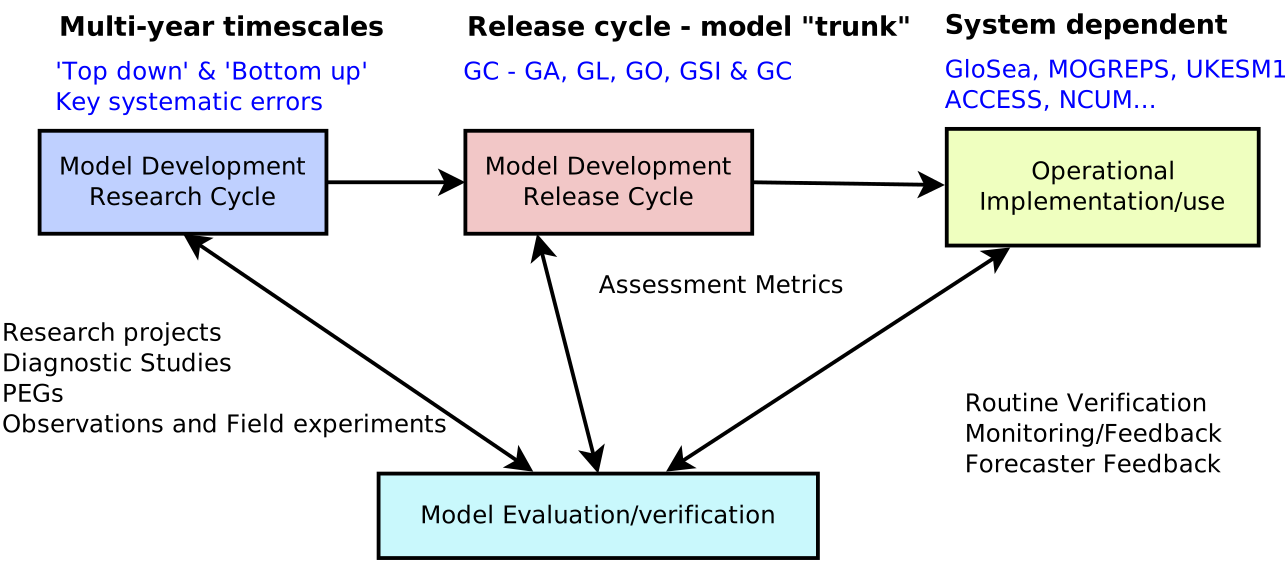
Fig. 27 The seamless development cycle for Global Coupled configurations.#
Individual component testing |
Package testing |
Final production/parallel suites |
|---|---|---|
NWP case studies |
Full hybrid-VAR DA Trials |
|
AMIP |
AMIP +4K |
MOGREPS |
Short coupled climate runs |
GloSea Hindcast ensemble |
|
Seasonal testbed |
CMIP6/UKCP1 |
|
Forced Ocean |
Coupled instant 4xCO₂ |
Parallel suites |
Coupled NWP case studies |
Coupled NWP |
|
Low Res DA runs |
DA/model Trials |
|
AMIP +4k (future climate) |
LAM testing (LBC) |
|
In July 2022, the final UM-based GC configuration was released, ‘GC5’, before the implementation of the LFRic atmospheric model into GC configurations. LFRic atmosphere is the next-generation atmospheric model being developed by the Momentum framework, which is designed to be more modular and flexible than its predecessor.
Following GC5-UM, there was a project associated with the Next Generation Modelling System (NGMS) programme to develop a GC5-LFRic science configuration. This was a like-for-like LFRic version of GC5, for purely research and validation purposes. The GC5-LFRic configuration will not be released as a science configuration, but it has been used to validate the LFRic model in a coupled configuration and will be the basis for the next science configuration, GC6.
GC6 will be the first operational use of LFRic in a science configuration at the Met Office and across the Momentum Partnership. GC6 will be implemented in PS49 and in UKESM3 for CMIP8. The development of GC6 is ongoing, with the first release expected in early 2026.
The final UM-based regional configuration, RAL3, was released in July 2022.
Date |
Milestone |
|---|---|
July 2022 |
Final UM-based regional configuration, RAL3, released. |
September 2022 |
Next Generation Modelling Systems (NGMS) programme began development of an LFRic regional configuration. |
Autumn 2025 |
Project met its Acceptance Criteria and was completed. |
Autumn 2025 |
Development of the next operational regional configuration, RAL4, began. |
January 2026 |
Met Office implemented RAL3 science operationally; other Momentum Partners also implemented this configuration. |
The NGMS programme designed this regional configuration for research and validation, as with GC5-LFRic. It provides a well-tested and understood baseline for future developments.
RAL4 represents the first regional science configuration to more fully exploit the LFRic modelling framework. Its development focuses on maintaining consistency with the established RAL3 science baseline. It does, however, introduce essential changes required to meet defined Acceptance Criteria. RAL4 is being designed to support both atmosphere/land-only and fully coupled regional environmental prediction applications.