Science Configurations#
A science configuration specifies a set of scientific and numerical settings for a single component model or a combination of component models. These settings include, for example, physical parameterization, numerical schemes and model coupling choices.
Science configurations are tested and evaluated across a set of spatial resolutions and temporal scales - e.g. Numerical Weather Prediction (NWP) to climate - to ensure they meet the required standards for accuracy and reliability. Once the evaluation is complete, the configuration is:
Frozen, so that the scientific settings are fixed
Versioned and numbered, enabling clear identification and traceability
Released as a standard package for use in modelling systems for research and operational purposes.
Released science configurations form the scientific foundation of prediction and projection systems. Dedicated workflows are constructed around these configurations using the Momentum technical infrastructure. These workflows support activities such as:
Software compilation and execution
Data assimilation for forecast systems
Post-processing and analysis of model output
By using the same science configuration within different workflows, the Momentum framework enables seamless modelling across a variety of prediction and projection systems.
Once a science configuration is defined, it can be used for different systems across the Momentum Partnership. For example:
For CMIP6, GC3.1 was used in UKESM1.1 and GAL7.1 was used in KACE
The GC4 science configuration is used for several operational NWP systems across the Momentum Partnership e.g. MOGREPS, ACCESS-S1, and NCUM.
Regional (Limited Area) Science Configurations#
In addition to global configurations, the Momentum framework also defines science configurations for regional (limited area) models, focusing on the atmosphere and land components. These are known as Regional Atmosphere and Land (RAL) configurations.
A RAL configuration is a set of science configurations for the atmosphere and land components that is designed for use in regional models. These configurations support both:
Numerical Weather Prediction (NWP)
Regional climate simulations
Regional coupled simulations
RAL configurations ensure that regional models across the Momentum Partnership share a consistent scientific basis, in the same way that global configurations (e.g. GC and GAL) do.
RAL Development and Lifecycle#
RAL configurations follow the same principles as other science configurations:
They are developed, tested, and evaluated across multiple systems and regions
Evidence is gathered to assess performance across a range of applications and scales
Once validated, they are frozen, versioned, and released for operational and research use
Within the Momentum Partnership, this process is coordinated by the RMED (Regional Model Evaluation and Development) activity, which:
Coordinates package testing across partners
Builds the scientific evidence base through evaluation
Delivers new RAL configurations for use across the partnership
At any given time:
One RAL version is operationally in use
The next RAL version is under development and evaluation
The diagram below illustrates the development process for regional modelling systems within the Momentum framework.
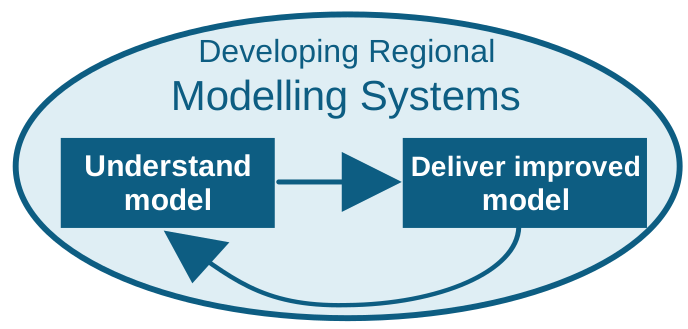
Fig. 22 RMED coordinates the RAL process by working with many other groups from across the office and Momentum partnership to identify the improvement needs, evaluate new science configurations and deliver the new RAL#
Versioning and Operational Use#
RAL configurations are versioned in a similar way to global configurations. RALn denotes the current released version. For example:
RAL3 is the current operational configuration (as of January 2026)
It is used in operational forecasting systems such as the UKV
It unified previously separate tropical and mid-latitude configurations into a single framework
It has also been operationalised by partners including National Centre for Medium Range Weather Forecasting (NCMRWF) and Centre for Climate Research Singapore (CCRS)
Future development will lead to the next release (e.g. RAL4), continuing the cycle of evaluation, improvement, and operational deployment.