LFRic Atmosphere features and history#
LFRic Atmosphere is a new atmospheric model that has been developed by the Met Office and partners as the successor to the Unified Model. While LFRic Atmosphere inherited its physics parameterisations from the Unified Model, it also introduces major advances in grid structure, numerical methods, and software design.
LFRic Atmosphere incorporates several established science schemes and component models, including:
JULES - the land surface model,
SOCRATES repository - the radiative transfer scheme,
CASIM - the cloud and aerosol microphysics scheme,
UKCA - the atmospheric chemistry and aerosol model.
Like the Unified Model, LFRic Atmosphere uses terrain-following vertical coordinates, so model levels (two-dimensional horizontal slices of the atmosphere) follow the shape of the lower boundary near the surface. Unlike the Unified Model, LFRic employs:
A cubed-sphere mesh, a grid structure designed to avoid the pole singularity in traditional latitude-longitude grids,
The GungHo mixed finite-element dynamical core,
A modern software infrastructure designed for future high-performance computing architectures.
The new software infrastructure separates the scientific description of the atmosphere from the technical details of parallel computing and hardware optimisation. This makes the model easier to maintain, improves portability across different computing platforms, and supports efficient scaling to future exascale supercomputers.
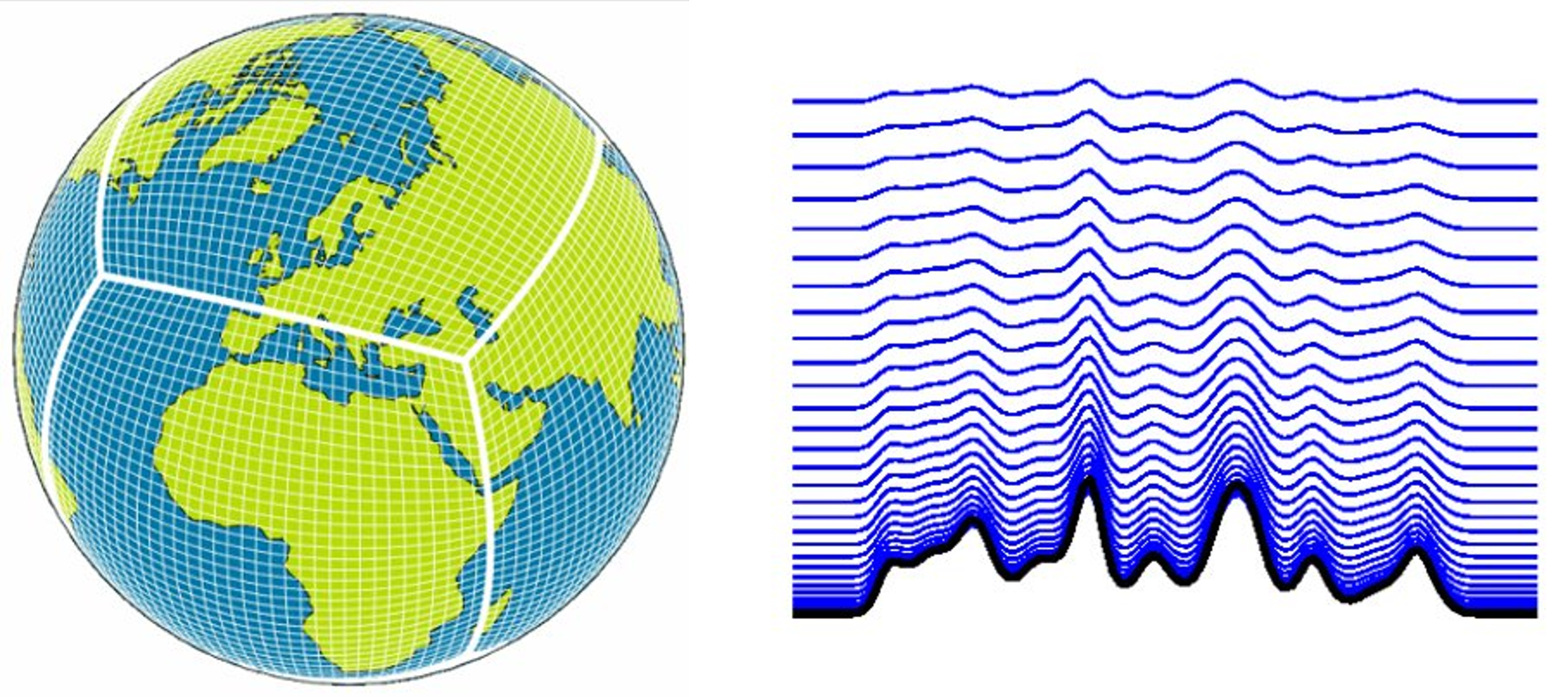
Fig. 6 Cubed sphere mesh and terrain-following vertical coordinates used by LFRic Atmosphere.#