Rivers#
In coupled models, rivers are an important component of the water cycle and are important to provide freshwater input into the oceans at the river mouths and also to maintain water conservation.
The Momentum framework is unable to compile the river component within the atmosphere and land executable (due to the LFRic cube-sphere grid being incompatible with the rivers latitude-longitude grid). Instead the river component is compiled into a separate executable and passes information from/to the atmosphere and to the ocean via the OASIS3-MCT coupler.
The river model used in Momentum is the Total Runoff Integrating Pathways (TRIP) model developed at the NASA/Goddard Space Flight Center [Oki_and_Sud_1998].
In the Momentum framework JULES (embedded within LFRic) handles the soil moisture calculations and determines the amount of surface runoff and sub-surface runoff. These two 2D fields are passed to the OASIS3-MCT coupler which regrids these fields to the TRIP grid and passes them to the TRIP river model. The TRIP river model then passes this water through the pre-determined route of the rivers through the TRIP grid until the water arrives at the river mouth. Then this 2D field of river outflows is converted to a 1D array where each river is an index in that array, roughly in order of climatological outflow (so the Amazon is river number one). This 1D array is passed through OASIS3-MCT to NEMO without any regridding. NEMO uses a river number ancillary file to determine which grid boxes recieve the river outflow for each river and uses this to convert the 1D river outflow to a 2D river outflow field. This fresh water then gets put into the ocean, raising local sea surface heights and reducing salinity.
However not all rivers end up at the ocean. Some rivers arrive into lakes with no outflow point; or dry basins and simply evaporate away. These points are classed as inland basin flow points. In Momentum we transfer river water arriving into an inland basin flow point through the OASIS3-MCT coupler back to JULES (embedded within LFRic). JULES then adds this water back into soil moisture.
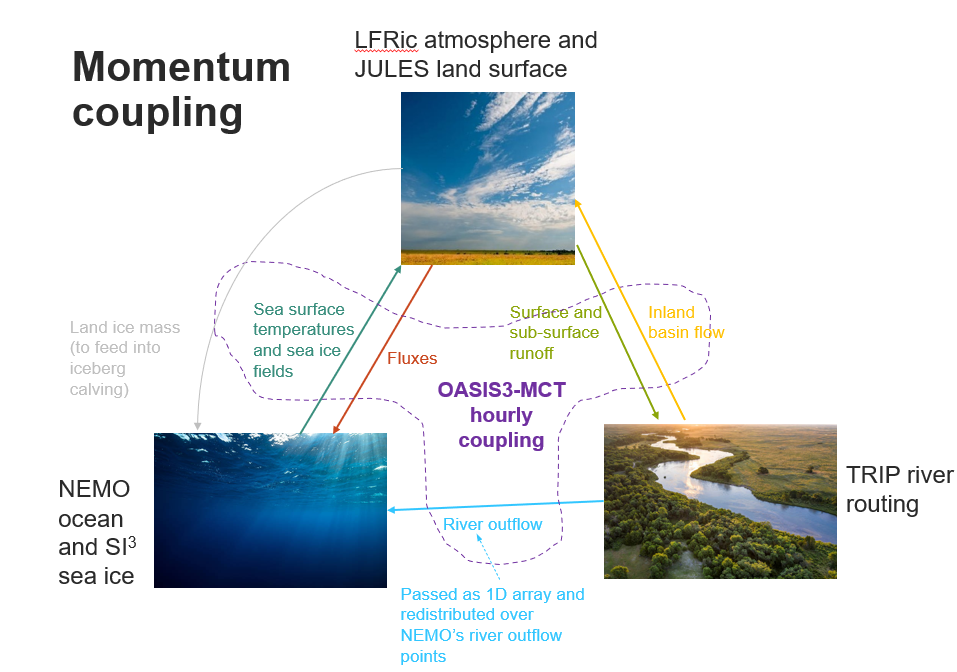
Fig. 5 Schematic showing the three submodels that are run as separate executables (Atmosphere, Ocean and Rivers) and what they pass through the OASIS3-MCT coupler.#