Aerosols
This recipe is available via AutoAssess.
Overview
The ‘aerosols’ component assesses the following parameters/ processess:
Sulphur-cycle simulation: SO2 and SO4 concentrations against EMEP measurements
Aerosol microphysical processes : Aerosol Optical Depth (AOD) values against AERONET measurements
Dust assessment: Emissions, Loadings, Deposition, AOD against U. Miami and AERONET measurements
The scripts can handle the older “CLASSIC” as well as recent “GLOMAP” aerosol schemes without any modification.
Available recipes and diagnostics
The assessment code is available from the AutoAssess repository.
Performance metrics:
S-cycle: Root Mean Square Error (RMSE) of SO2 and SO4 surface concentrations against EMEP and IMPROVE stations for all seasons
AOD : RMSE of Optical Depth at 440 nanometer against AERONET station measurements for all seasons.
Dust: Combined assessment of dust surface concentrations against U. Miami and AOD against AERONET at Global (all seasons) as well as Regional (annual) level.
Diagnostics:
Seasonal mean SO2 and SO4 surface concentrations
Seasonal mean Aerosol Optical Depth at 440 nm
Seasonal mean Dust emission, concentration and AOD values
User settings in recipe
There are no user settings for this recipe
Variables
Variable/Field name |
realm |
frequency |
Comment |
|---|---|---|---|
Sulphur Dioxide Mass mixing ratio |
Atmosphere |
seasonal mean |
STASH item: s00i101 (CLASSIC), s34i072 (GLOMAP) |
Sulphate Aitken mode mass mix. rat. |
Atmosphere |
seasonal mean |
CLASSIC aerosol scheme only |
Sulphate Accum. mode mass mix. rat. |
Atmosphere |
seasonal mean |
CLASSIC only |
Sulphate Dissolved mode mmr |
Atmosphere |
seasonal mean |
CLASSIC only |
Nucleation mode (soluble) H2SO4 MMR |
Atmosphere |
seasonal mean |
GLOMAP aerosol scheme only |
Aitken mode (soluble) H2SO4 MMR |
Atmosphere |
seasonal mean |
GLOMAP only |
Accum. mode (soluble) H2SO4 MMR |
Atmosphere |
seasonal mean |
GLOMAP only |
Coarse mode (soluble) H2SO4 MMR |
Atmosphere |
seasonal mean |
GLOMAP only |
Sulphate Optical Depth in Radiation |
Atmosphere |
seasonal mean |
CLASSIC only |
Mineral Dust Optical Depth in Radn. |
Atmosphere |
seasonal mean |
CLASSIC or GLOMAP+CLASSIC-dust |
Sea salt Optical Depth in Radn. |
Atmosphere |
seasonal mean |
CLASSIC only |
Soot Optical Depth in Radn. |
Atmosphere |
seasonal mean |
CLASSIC only |
Biomass Optical Depth in Radn. |
Atmosphere |
seasonal mean |
CLASSIC only |
Biogenic Optical Depth in Radn. |
Atmosphere |
seasonal mean |
CLASSIC only |
Foss Fuel Org. Carb OD in Radn. |
Atmosphere |
seasonal mean |
CLASSIC only |
Aitken mode (soluble) Optical Depth |
Atmosphere |
seasonal mean |
GLOMAP only |
Accum. mode (soluble) Optical Depth |
Atmosphere |
seasonal mean |
GLOMAP only |
Coarse mode (soluble) Optical Depth |
Atmosphere |
seasonal mean |
GLOMAP only |
Aitken mode (insoluble) Opt. Depth |
Atmosphere |
seasonal mean |
GLOMAP only |
Dust mass mixing ratio (6 divisions) |
Atmosphere |
seasonal mean |
CLASSIC or GLOMAP+CLASSIC-dust STASH codes: s00-i431 to i436 |
Dust emission flux (6 divisions) |
Atmosphere |
seasonal mean |
STASH: s03-i401 to i406 |
Dust dry deposition flux (6 div) |
Atmosphere |
seasonal mean |
STASH: s03-i441 to i446, i451 to i456 |
Dust wet dep flux ls precip (6 div) |
Atmosphere |
seasonal mean |
STASH: s04-i431 to i436 |
Dust wet dep flux conv prec (6 div) |
Atmosphere |
seasonal mean |
STASH: s05-i281 to i286 |
Potential temperature |
Atmosphere |
seasonal mean |
|
Specific Humidity |
Atmosphere |
seasonal mean |
|
Pressure on Theta levels |
Atmosphere |
seasonal mean |
|
Orography |
Atmos/Land |
seasonal mean |
Observations and reformat scripts
How to obtain and process the data
EMEP SO2 and Sulphate data (currently Year 2000)
IMPROVE Sulphate data (currently Year 2000)
AERONET measurements
References
Sulphur cycle: EMEP:(European Monitoring and Evaluation Programme) K. Tørseth, W. Aas, K. Breivik, A. M. Fjæraa, M. Fiebig, A. G. Hjellbrekke, C. Lund Myhre, S. Solberg, and K. E. Yttri; Introduction to the European Monitoring and Evaluation Programme (EMEP) and observed atmospheric composition change during 1972–2009; Atmos. Chem. Phys., 12, 5447–5481, 2012. http://www.atmos-chem-phys.net/12/5447/2012/, doi:10.5194/acp-12-5447-2012
IMPROVE:(Interagency Monitoring of PROtected Visual Environments) Malm, W. C., J. F. Sisler, D. Huffman, R. A. Eldred, and T. A. Cahill; Spatial and seasonal trends in particle concentration and optical extinction in the United States, J. Geophys. Res., 99, 1347-1370,(1994)
(Suggested Acknowledgement: IMPROVE is a collaborative association of state, tribal, and federal agencies, and international partners. US Environmental Protection Agency is the primary funding source, with contracting and research support from the National Park Service. The Air Quality Group at the University of California, Davis is the central analytical laboratory, with ion analysis provided by Research Triangle Institute, and carbon analysis provided by Desert Research Institute.)
AERONET: (AErosol RObotic NETwork) Holben B.N., T.F.Eck, I.Slutsker, D.Tanre, J.P.Buis, A.Setzer, E.Vermote, J.A.Reagan, Y.Kaufman, T.Nakajima, F.Lavenu, I.Jankowiak, and A.Smirnov, 1998: AERONET - A federated instrument network and data archive for aerosol characterization, Rem. Sens. Environ., 66, 1-16.
Example plots
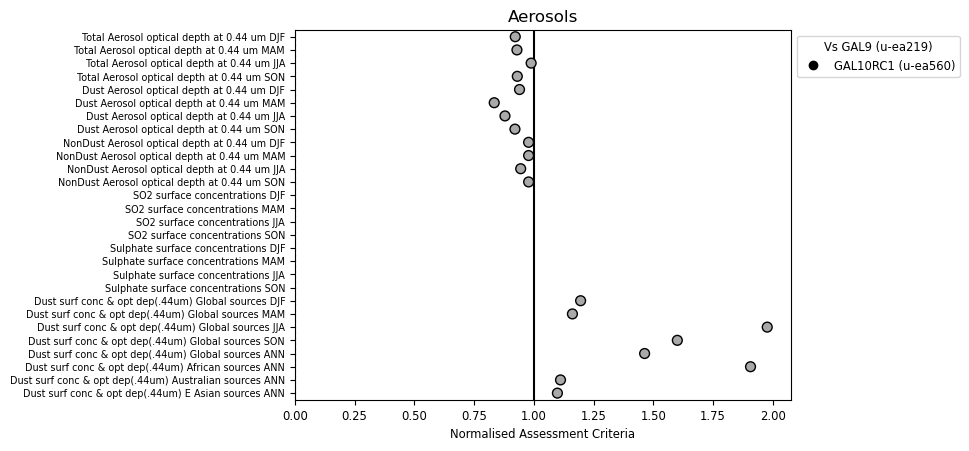
Summary overview of metrics from the Aerosols assessment
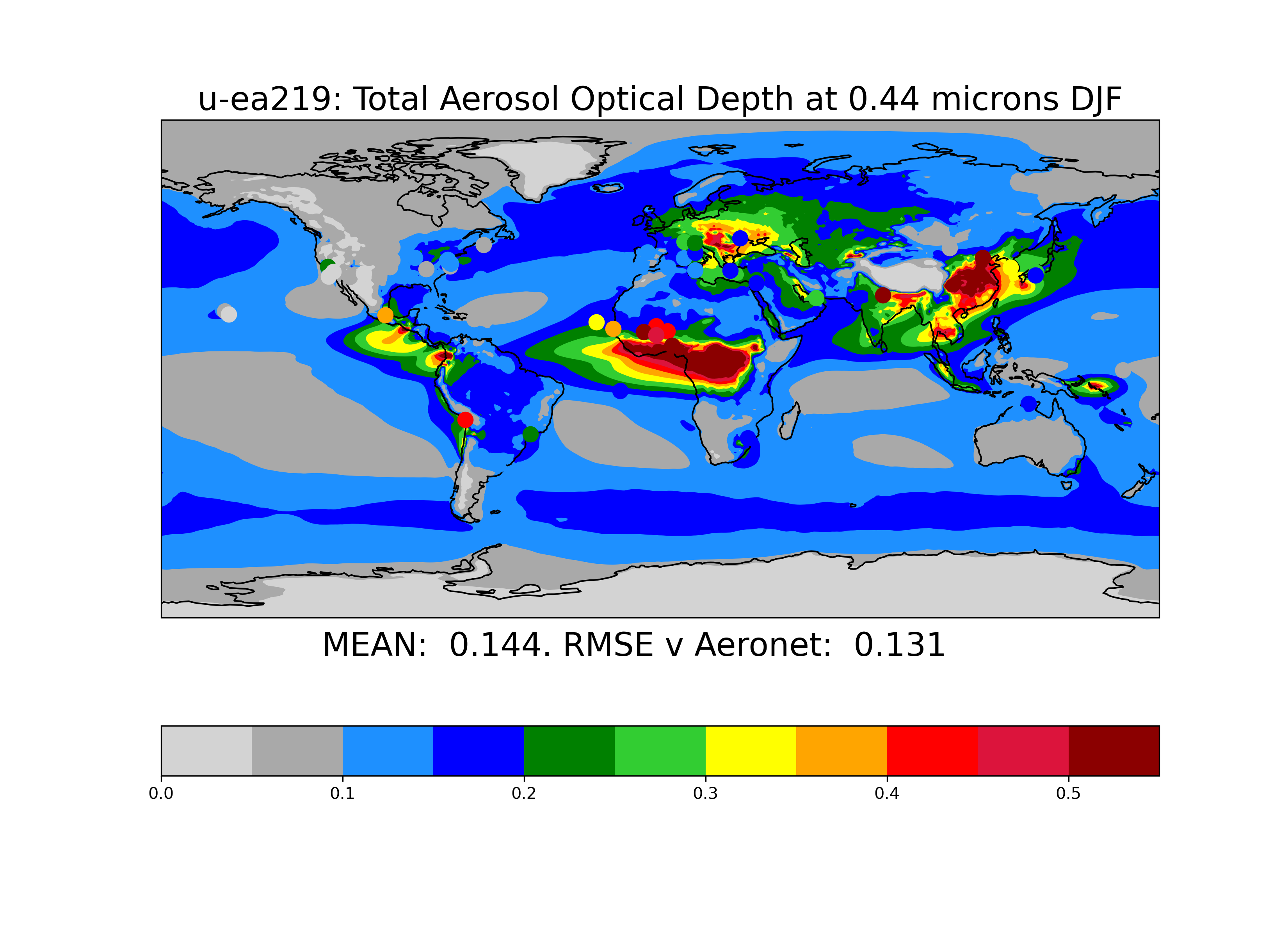
Global surface plot comparing Total Aerosol Optical Depth at 0.44 microns vs AERONET stations
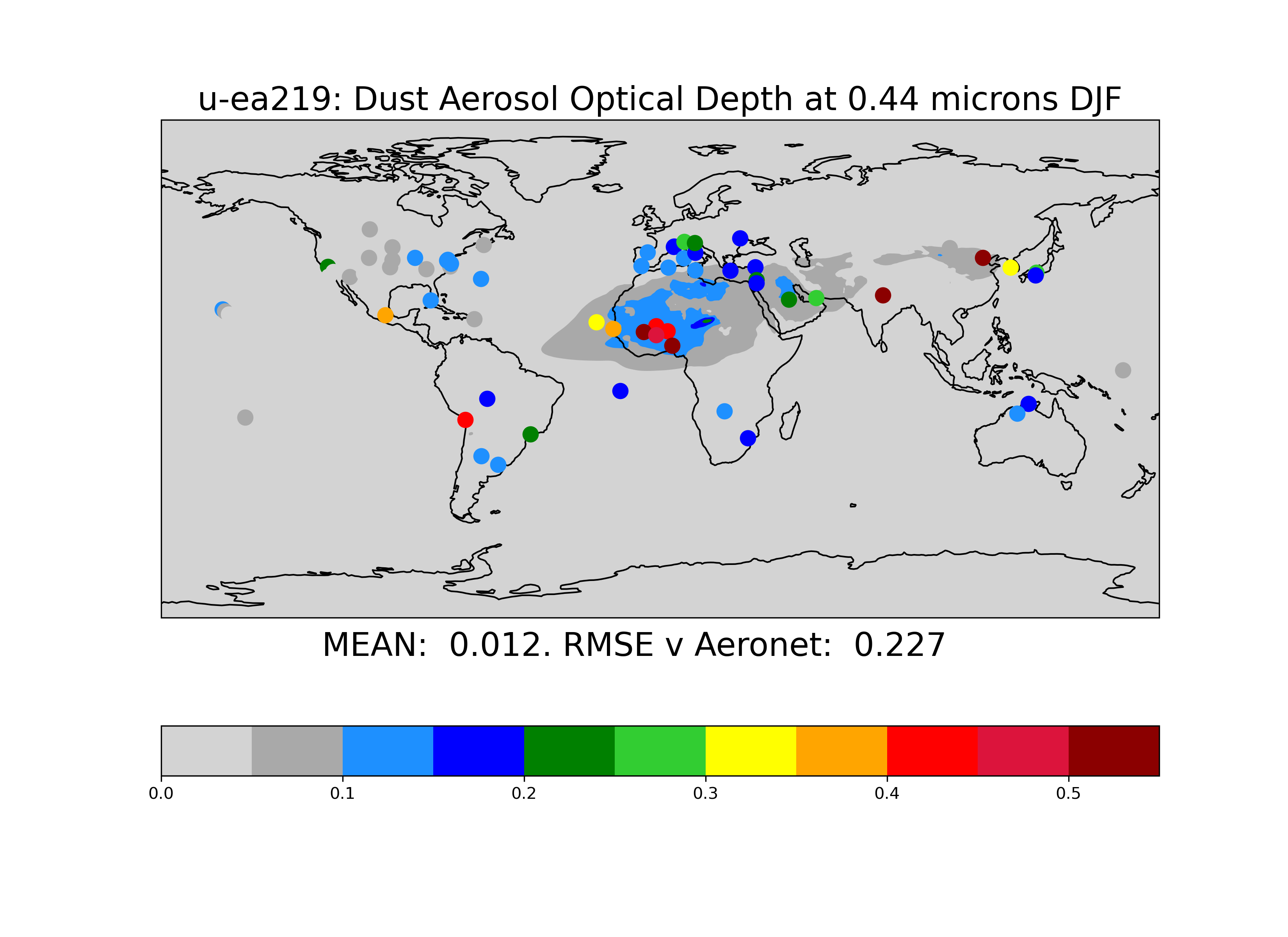
Global surface plot comparing Dust Aerosol Optical Depth at 0.44 microns vs AERONET stations
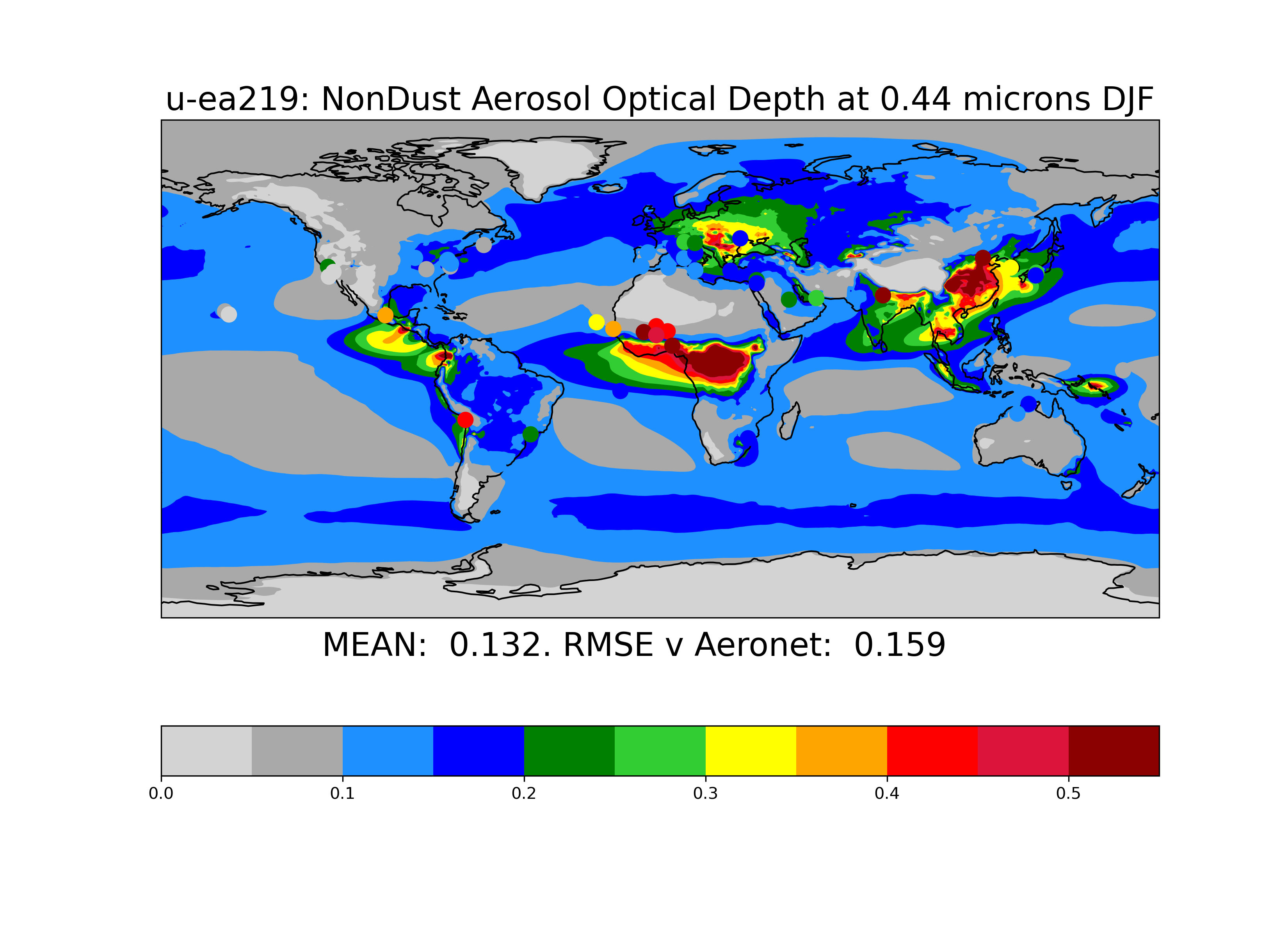
Global surface plot comparing Non-dust Aerosol Optical Depth at 0.44 microns vs AERONET stations
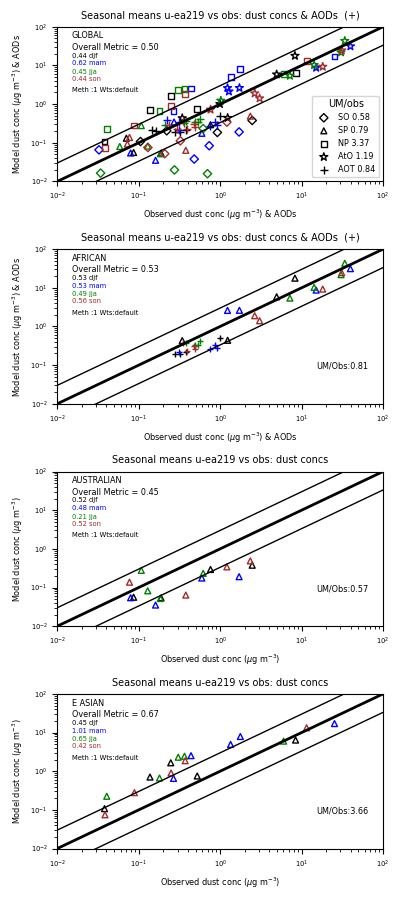
Scatter plots of Model vs Obs for Dust concentration and AODs on Global and Regional scales over all seasons