

Attention
This documentation has been transferred directly from the UM to LFRic; It is still a work in progress. There are still UM-specific references and terminology that are yet to be updated.
The PC2 Cloud Scheme#
- Author:
D. Wilson, A. Bushell, C. Morcrette, V. Varma\(^{1}\), M. Whitall
PC2 developers#
We would like to acknowledge those who developed the PC2 cloud scheme: Damian Wilson, Andrew Bushell, David Gregory, Amanda Kerr-Munslow, John Edwards, Jeremy Price, Cyril Morcrette, Martin Sharpe, Thomas Mirfield, Ian Boutle. Many others offered considerable help, advice and analysis, including Roy Kershaw, Malcolm Brooks, Richard Forbes and Alejandro Bodas-Salcedo, and we would like to thank them all for their input.
Introduction#
This document describes the PC2 (prognostic cloud, prognostic condensate) cloud scheme. It should be seen as a complete reference source for the scheme’s physical assumptions, numerical techniques, application to the Unified Model and coding within the Unified Model. It does not describe results from the scheme, please refer to the various reports and papers written on this. Except where commented on explicitly, the description applies to the PC2:66 version of the PC2 scheme, which is the version that will be available at UM6.5. The version available at 6.4 is PC2:64.
This paper will first introduce the concepts that underlie cloud schemes, before developing a study of the theoretical behaviour of the prognostic PC2 scheme under certain, well-defined, situations. The next sections shows how the theory can be applied to the physical and dynamical processes represented in the Unified Model. Finally, we outline the way in which the PC2 scheme is implemented within the code of the Unified Model.
Cloud schemes#
The basic requirements of any cloud scheme within a large-scale model are to:
calculate the amount of condensation (from water vapour to liquid water or vice-versa) within each gridbox each timestep
to calculate or update the cloud fractions for use by the radiation and large-scale precipitation schemes (or any other physics scheme).
Depending on the model involved, cloud schemes may also treat the deposition / sublimation process from vapour to ice. The problem is straightforward to solve if one is allowed to assume that there is no variability of moisture or temperature on a scale of a model gridbox. In this case the cloud fraction scheme is redundant and only the condensation part remains, which may be solved diagnostically using the instantaneous condensation assumption in section The ‘s’ distribution. However, the ‘no-variability’ assumption is poor until very high resolutions close to, or maybe exceeding, 1 km in the horizontal are reached. Although we may eventually assume that computer power will enable such resolutions to be reached globally, for many years we will need a subgrid-scale cloud scheme to properly account for the variability in the atmosphere. This is the principal challenge of cloud parametrization.
There are several approaches to take to the solution of the problem, although they are not as independent as often portrayed, since they nearly all require the same instantaneous condensation assumption (discussed in section The ‘s’ distribution). Hence there are mathematical links between all the approaches. The following are all valid structures to use in this respect.
One may diagnose cloud fractions and condensate contents from knowledge of gridbox mean variables. This forms the basis of the Smith (1990) scheme, which is described in .
A mixed scheme, such as Sundqvist (1978) uses a prediction of condensate contents, but a diagnostic cloud fraction.
Alternatively, one may predict cloud fraction and condensate content changes as a result of each modelled process. This forms the basis of the Tiedtke (1993) scheme and the PC2 scheme.
Hybrid schemes, such as Tompkins (2002), will predict various moments of the subgrid-scale variability, and use this knowledge to diagnose the cloud fraction and condensate contents.
Many years of experience of the results from the Smith (1990) scheme have highlighted deficiencies in the diagnosis of cloud from this scheme, which we feel can only be tackled by adding the memory of cloud history available by using a prognostic based scheme. We chose to develop a scheme that directly specified the impacts on observable prognostics (condensates and cloud fractions, as in Tiedtke (1993)) rather than on moments of a probability density function (as in Tompkins (2002)). This is because we believe it is easier to physically relate (and hence parametrize) the effect processes to quantities such as cloud fraction and condensate rather than to the more abstract quantities of moments of a probability density function of moisture. However, although the PC2 scheme is similar to Tiedtke (1993) in its very basic prognostic variable structure, the assumptions behind the formulation of the prognostic terms in PC2 are very different and much improved. The PC2 scheme should not be considered to be merely an extension of Tiedtke (1993).
In particular, we wish to use a prognostic formulation in order to link the detraiment of moisture from convection directly to cloud fraction, and to break the hard diagnostic link between cloud fraction and condensate. These major features of the Tiedtke (1993) scheme provide the motivation to develop the PC2 cloud scheme.
The ‘s’ distribution#
Most cloud schemes are based on the concept of a distribution of fluctuations of moisture and temperature in the gridbox. Here we mathematically formalize this concept, since it is used both in the PC2 scheme and the Smith (1990) scheme.
This method was first formulated by Mellor (1977) and Sommeria and Deardorff (1977) for large-eddy simulations. It can also be applied to larger scale models. It allows us to calculate vapour and liquid contents and liquid cloud fraction from knowledge only of the combined vapour+liquid content, \(\overline{q_T}\), and the liquid temperature, \(\overline{T_L}\). These variables are unchanged during condensation processes, so it is useful to write the cloud scheme in terms of these variables.
In this derivation we will consider only liquid condensate. We assume, as above, that, locally, the water content in a cloud is such as to remove any supersaturation. This gives the equation
assuming that \(q_T > q_{sat}(T,p)\) (\(q_{cl}\) will be zero otherwise). \(q_T\) is the local total water content, equal to the sum of the condensate \((q_{cl})\) plus the vapour \((q)\), \(T\) is the temperature, \(p\) is the pressure and \(q_{sat}(T,p)\) is the saturation specific humidity at temperature T and pressure p with respect to liquid water. (Many earlier diagnostic cloud schemes use a similar instantaneous condensation assumption for ice, which would mean that \(q_{sat}\) must be taken with respect to ice when \(T < 0 ^{\circ} C\), but the Unified Model does not). We now introduce the liquid temperature (\(T_L\)), where \(T_L\) is given by
and \(L\) is the latent heat of vaporization and \(c_p\) is the heat capacity of air. Note that \(T_L\) is unaffected by changes of phase between vapour and liquid. We now write (1) as an equality
where
Using (2) in (3) gives the expression
or
where \(a_L\) is given by
Thus (1) has been rewritten exactly in terms of the conserved variables, \(q_T\) and \(T_L\), although the temperature, \(T\), does remain in the definition of \(a_L\). We will need to consider variations across a gridbox for a parametrization scheme, so we expand the expression for condensate (5) into terms relating to the gridbox mean and variation from the gridbox mean.
where \(\overline{\phi}\) represents the mean of a distibution of \(\phi\) and \(\phi = \overline{\phi} + {\phi}'\). The expression (7) is exact when using the definition of \(\alpha\) given in (4).
The idea of a PDF scheme is to calculate the first (mean) term, \(\overline{\phi}\), from the known gridbox mean parameters, \(q_T\), \(T_L\) and \(p\), and to parametrize the distribution of the second, variable term, \({\phi}'\). Unfortunately, the mean term is difficult to write in terms of the gridbox mean variables \(\overline{q_T}\) and \(\overline{T_L}\) because \(q_{sat}(T_L,p)\) is not a linear function of \(T_L\) (or of \(p\)). In order to proceed, we will now make an approximation that \(q_{sat}(T,p)\) is a linear function of \(T_L\) and \(p\). This equivalently implies that \(a_L\) and \(\alpha\) are approximated as being constant across the gridbox. The expression now becomes more tractable, (7) becoming:
where \(\beta = {\frac{\partial q_{sat}}{\partial p}}\) at constant temperature. The first term is connected with the mean properties of the gridbox, and is written as \(Q_c\), the second term is connected with the deviation of the local conditions from the mean and is written as \(s\).
This gives the equation
with the assumption that \(s \ge -Q_c\) (i.e. \(q_{cl} \ge 0\)). If \(s < -Q_c\) then \(q_{cl} = 0\). The term \(a_L\) can be calculated using (6) from (4) with gridbox mean temperatures, i.e.
This definition of \(\alpha\) and \(a_L\) will retrieve an exact value for the gridbox mean \(\overline{q_{cl}}\) if the distribution is monodispersed. Hence it is the sensible form to use for a purely diagnostic representation such as Smith (1990) where we explicitly consider distributions of \(s\). Strictly, the linear approximation implies that other approximations for \(\alpha\) are valid: PC2 will do this (see section Numerical application) since we are concerned in PC2 with the best estimate of the changes to \(\overline{q_{cl}}\), not the best estimate of \(\overline{q_{cl}}\) itself.
We now assume that within any particular gridbox a distribution \(G\) of \(s\) occurs (with mean, by definition, of zero). Considering cloud to be where the water content is greater than zero (i.e. where \(s > -Q_c\)) gives an expression for the liquid cloud volume fraction, \(C_l\), within the gridbox as
and the expression for mean condensate, \({\overline{q_{cl}}}\), using (11) to expand \(q_{cl}\), is
If we know (parametrize) the PDF given by \(G(s)\) then we can solve for \(C_l\) and \(\overline{q_{cl}}\). Note that this distribution is in terms of \(s\), there is no need to know the three-dimensional distribution in terms of three separate variables \(q_T\), \(T_L\) and \(p\). This is the method used by Smith (1990), where a symmetric triangular distribution function is used. For further information on the Smith (1990) scheme, please refer to . Physics and dynamics schemes hence only need to provide increments to \(\overline{q_T}\) and \(\overline{T_L}\), provided that a diagnostic scheme (such as Smith (1990)) is called at some point in the timestep to partition \(\overline{q_T}\) into \(\overline{q}\) and \(\overline{q_{cl}}\), to calculate the dry bulb temperature \(\overline{T}\) (from \(\overline{T_L}\) and \(\overline{q_{cl}}\)) and to calculate the liquid cloud fraction, \(C_l\). The diagnostic scheme effectively allows a calculation of condensation associated with any physical process. However, its results remain tied to the distribution of \(G(s)\) that is chosen in (13) and (14) and it is this tie that we seek to break by the use of a prognostic scheme.
Concept of PC2#
The PC2 scheme develops prognostic expressions for the rates of change of cloud fraction and condensate contents as a result of each process that acts in the model. We consider ice and liquid condensate as two distinct aspects of clouds, which may or may not overlap Figure 1 provides a schematic summary of the PC2 scheme. The equations for the five prognostic cloud variables can be written schematically:
where \(\overline{q_{cf}}\) is the ice water specific humidity, \(C_l\) is the liquid cloud volume fraction, \(C_i\) is the ice cloud volume fraction, and \(C_t\) is the combined ice or liquid cloud volume fraction. The amount of mixed phase cloud, \(C_{mp}\), can be calculated by the overlap of the ice and liquid fractions:
The idea is to parametrize each of the terms in the above equations. This approach removes the diagnostic method, hence it will be critical that we can write expressions for \(\frac{\partial \overline{q_{cl}}}{\partial t}\) and \(\frac{\partial C_l}{\partial t}\) for each process that alters :math:`overline{T}`, :math:`overline{p}`, :math:`overline{q}`, or :math:`overline{q_{cl}}` in the model (and similarly for the ice terms). In doing so, we will not lose sight of underlying PDF approach given by (13) and (14) since we will still use the concept of instantaneous condensation for liquid clouds. Equations (13) and (14) will form the basis of the homogeneous forcing methods discussed in section Homogeneous forcing. We note in particular that the convective cloud fraction, previously a quantity that is diagnosed separately from the large-scale cloud fraction calculated by the Smith (1990) scheme, may, in PC2, be included as part of the large-scale cloud fraction. This aspect is similar to the Tiedtke (1993) approach.
The final aim of PC2 is that the parametrization of each term in (15) is performed by each part of the model that alters \(\overline{T}\), \(\overline{p}\), \(\overline{q}\), \(\overline{q_{cl}}\) or \(\overline{q_{cf}}\) as an integral part of that physics or dynamics scheme. However, in this PC2 scheme we acknowledge that this will not be possible, at least, not to begin with. Hence we have specifically developed generic approaches that can be used to calculate expressions for \(\frac{\partial \overline{q_{cl}}}{\partial t}\) and \(\frac{\partial C_l} {\partial t}\) . These are referred to as Homogeneous forcing (section Homogeneous forcing), Injection source (or inhomogeneous forcing, section Injection forcing) and Width Changing (section Changing the width of the PDF - PC2 erosion). Two additional modules are available to assist with PC2, liquid cloud initiation (section Initiation of cloud) and the calculation of total cloud fraction changes (section Ice cloud and mixed phase regions). At the present time, only the large-scale precipitation (section Large-scale precipitation) scheme has been rewritten fully to use the PC2 concept of prognostic cloud fractions. The existing mass-flux convection scheme has been modified to enable calculation of the detrained condensate, but direct modification to the cloud fraction is not included. All other physics schemes use one of the generic approaches below.
A note on convective cloud fraction#
It was the original intention that PC2 be able to replace the two separate diagnostic cloud fractions (large-scale and convective) with a single cloud fraction, as in Tiedtke (1993). The hypothesis was that by detraining cloud directly from the convection scheme we would no longer need a separate representation of this cloud type. Our experience with PC2 is that this is not necessarily the case. We suspect that the basic reason is that we are unable to truly represent the extreme PDF shapes that result from convective activity. Additionally, we only create cloud associated with the detrainment part of the convection scheme, assuming that cloud associated with the active updraughts in convection is small. This assumption is not necessarily applicable. Similar arguments, and model results, come from analysis of the Tiedtke (1993) and Tompkins (2002) scheme (Ben Johnson, personal communication). We also note that with two cloud fraction types and two different optical depths it is possible to have a basic degree of representation of cloud inhomogeneity.
Hence the code still exists to enable PC2 to be run with or without a diagnostic convective cloud fraction, although PC2:66 does not include a diagnostic term. More details are in section Convection.
Physical basis of the PC2 prognostic cloud scheme#
In this section we will develop the physical models that PC2 uses in order to calculate its prognostic increment terms. We will also consider the numerical solution of the models. The way in which these are incorporated into the Unified Model will be discussed in section Implementation in the Unified Model
Instantaneous condensation#
Liquid clouds in PC2 use the concept of instantaneous condensation. Hence the ‘s’ distribution methods are fully applicable to the development of the equations that govern the parametrization of liquid cloud in PC2. We will start by looking at changes to \(\overline{q_{cl}}\) and \(C_l\) when a uniform forcing is applied to a gridbox, under the assumption of instantaneous condensation.
Homogeneous forcing#
We define the expression uniform forcing (or homogeneous forcing) to refer to changes in local values of \(T_L\) and \(q_T\) that occur at a rate independent of the part of the gridbox in which they are located. This implies that \(G(s)\) will not alter due to such a process. Uniform forcing simply alters \(Q_c\) in (13) and (14). In the Unified Model, this concept will be applied to several different sets of physics increments in order to calculate the condensation and cloud fraction changes associated with each one, where the physics routine does not allow the explicit calculation of condensation and cloud fraction changes by another method. Large-scale ascent may be considered a meteorological example of such a process. By differentiating (13) and (14) with respect to time, assuming uniform forcing (so \({\frac{\partial G}{\partial t}}\) terms are zero), we obtain
The quantity \(G(-Q_c)\) is the value of the PDF of \(G\) at \(s=-Q_c\), which defines the boundary between the saturated and unsaturated parts of the distribution.
If we wish to consider a prognostic cloud scheme with equations for the rate of change of condensate and cloud fraction based upon (18) and (17) then we need to close (17) by specifying the value of \(G(-Q_c)\). We will choose to develop a parametrization for this quantity based upon the quantities \(C_l\), \(\overline{q_{cl}}\) and the saturation deficit, \(SD\), rather than tie \(G(-Q_c)\) to a process. The saturation deficit is defined here in the ‘s’ framework to be the first moment of the PDF for ‘s’ values less than \(-Q_c\). In this way it is analogous to the liquid water content, \(\overline{q_{cl}}\). Appendix A of Wilson and Gregory (2003) writes this definition as
and shows this is equivalent to
The basis behind the parametrization for \(G(-Q_c)\) is to consider an underlying form of the distribution \(G(s)\) near the \(+b_s\) and \(-b_s\) ends. We borrow the notation of Smith (1990) and refer to a quantity \(b_s\) that is the value of \(s\) when a monomodal distribution \(G(s)\) just equals zero. We suppose that the distribution G can be described as a power law near \(s=b_s\).
provided \(s<b_s\), where \(b_s\) represents the ‘width’ of the distribution (so \(G(-Q_c)\) = 0 at \(-Q_c\) = \(b_s\)) and n is a power. From (21) it can be shown (see appendix B of Wilson and Gregory (2003)) that
An important feature is that the proportionality between \(G(-Q_c)\) and \({\frac{C^2}{\overline{l}} }\) holds for any power law description. Also, this relationship is independent of the value of \(b_s\). The triangular Smith (1990) scheme obeys this relationship (for \(C_l\) less than 0.5) with \(n\)=1, as does a ‘top hat’ function which is a limiting case of \(n\) tending to zero. This invariant functional form can be exploited in deriving a generalized \(G(-Q_c\)) closure. If we assume a similar power law for the other end of the distribution we can write a second estimate of \(G(-Q_c)\) as:
We note that if n tends to zero then (23) is identical to the expression used by Jakob et al. (1999). This is because Jakob et al. (1999) also uses a similar description of a ‘top-hat’ PDF of fluctuations.
In order that the closure of \(G(-Q_c)\) is reversible, we take a linear combination of \(G_1(-Q_c)\) and \(G_2(-Q_c)\). To close our parameterisation, we must choose suitable weights to apply to the two solutions, and there are currently 2 options for the choice of weights, discussed below.
The equations (18), (17) and either (24) or (25) below form a complete mathematical set for the solution of \(C_l\) and \(\overline{q_{cl}}\) under homogeneous forcing, provided that the initial value of \(C_l\) is not identically 0 or 1. If \(C_l\) is 0 or 1 then \(G(-Q_c)\) remains at zero. The equation set then needs to be initiated in some way. This is discussed further in Wilson and Gregory (2003) and in section Initiation of cloud. If \(G(-Q_c)\) is defined, then application of the above equation set may be used to trace out an underlying PDF for any input values of \(C_l\), \(\overline{q_{cl}}\) and \(SD\). Although we never need to define the complete PDF in PC2 (just the value of \(G(-Q_c)\) from equation (24)), a PDF can be inferred off-line if required.
Wilson and Gregory (2003) analyse the performance of this parametrization under idealised tests, and shows it performs well against other cloud parametrizations used in large-scale models. After extensive analysis including observed PDF shapes and moments from balloon, performance in the Unified Model, and numerical stability tests, the value of the shape parameter \(n\) has been chosen to be 0.0, corresponding to a top-hat distribution shape.
Weight as a function of cloud-fraction#
This option is selected by setting i_pc2_homog_g_method=1 in the UM large-scale cloud namelist.
Under this closure, we choose the weights such that \(G_1(-Q_c)\) (22) is used when cloud fractions are small, and \(G_2(-Q_c)\) (23) is used when cloud fractions are large (a small cloud fraction indicates that the saturation boundary is close to the right-hand end of the PDF, which \(G_1(-Q_c)\) is based on). We choose relative weights of \({{(1-C_l)}^{m}}\) and \({C_l^m }\) respectively, where \(m\) is a power currently set to 0.5. Hence the complete suggested closure of \(G(-Q_c)\) is:
A problematic property of equation (24) is that it goes to infinity if either \(q_{cl}\) or \(SD\) goes to zero (and \(C_l\) is not zero or unity). There are realistic scenarios in which this limit will be approached; e.g. if heavy rain falls through a layer of cloud, nearly all of the cloud liquid water content maybe removed by accretion, without reducing the cloud-fraction. In this situation, any subsequent homogeneous forcing applied to the cloud will result in a huge tendency in cloud-fraction in equation (17), due to the term \(\frac{C_l^2}{\overline{q_{cl}}}\) in (24) becoming huge.
Note that for a homogeneous forcing acting to dry the layer / reduce the cloud, a huge negative tendency is the “right” answer; if there is only an infinitessimally small amount of liquid water content left within the cloud, then the cloud fraction should indeed vanish extremely rapidly under a negative forcing. However, for a positive homogeneous forcing, the cloud-fraction will very rapidly increase in this scenario, for no physical reason. This might not be a problem if one exactly integrated the differential equations (17) and (18), since \(q_{cl}\) would immediately increase away from zero, so that (24) immediately becomes well-defined (an infinitely large tendency maintained for an infinitely small period of time can yield a finite, sensible increment!) Unfortunately, PC2 uses an explicit numerical method, and a finite (often quite large) model timestep, so an instantaneous very large tendency will yield a very large increment, even if the continuous differential equations would not have done.
In practice, the code that implements (24) simply sets \(G(-Q_c)\) to zero if either \(q_{cl}\) or \(SD\) falls below 1.0E-10 kg kg\(^{-1}\), to avoid a floating-point error. This in itself can be problematic, since leaving \(C_l\) unmodified under a homogeneous forcing can allow unrealistic states to develop.
Weight in proportion to PDF width#
This option is selected by setting i_pc2_homog_g_method=2 in the UM large-scale cloud namelist.
Morcrette (2020) proposed an alternative choice of weights applied to \(G_1(-Q_c)\) (22) and \(G_2(-Q_c)\) (23), so-as to make each one’s weight go to zero in the limit that it goes to infinity, reliably yielding a sensible, finite solution for \(G(-Q_c)\).
We choose the weights to be \(\frac{\overline{q_{cl}}}{C_l}\) applied to \(G_1(-Q_c)\), and \(\frac{SD}{1-C_l}\) applied to \(G_2(-Q_c)\), yielding:
This is equivalent to weighting the saturated and subsaturated solutions for \(G(-Q_c)\) by their respective PDF-widths. Note that everything cancels-out in the numerator, so this reduces to:
In full UM tests, Morcrette (2020) found that this closure removed occasional spurious very large cloud-fraction increments that occur when using (24), but did not significantly impact the performance of the model forecast.
Numerical application#
The timestepping methods that are used in the homogeneous forcing were developed off-line using a single gridbox model, to ensure smooth, accurate and convergent behaviour of the solution, rather than as a result of a mathematical analysis of the problem.
We need to timestep forward (18) and (17) using a timestep of \(\Delta{t}\), knowing values of \(\Delta{\overline{T}}\), \(\Delta{p}\), \(\Delta{\overline{q}}\) and \(\Delta{\overline{q_{cl}}}\), which are provided by an existing physics scheme in the model. We assume that the physics scheme we are applying this to has not already calculated its condensation and cloud fraction increments by another means.
Firstly, we need to calculate the forcing term \(\Delta{Q_c}\). From (9) we can write
assuming that \(a_L\) does not change (see below). This can be expanded, using a linear approximation for \(q_{sat}(T+\Delta{T},p+\Delta{p})\) in terms of \(q_{sat}(T,p)\) as
where \(\alpha\) is the rate of change of \(q_{sat}\) with respect to temperature at constant pressure (\(\frac{\partial q_{sat}}{\partial T}\)), and \(\beta\) is the rate of change of \(q_{sat}\) with respect to pressure at constant temperature (\(\frac{\partial q_{sat}}{\partial p}\)). Using (2) to expand \(T_L\) in terms of \(T\) and \(q_{cl}\) and gathering terms together we obtain
We must now note the method we use here to calculate \(a_L\), defined in (6), uses a gradient expansion value of \(\alpha\) that corresponds to \(\frac{\partial{q_{sat}}} {\partial{T}}\) at constant pressure and not the chord expression in (4). This is because we are trying to find the best estimate of the increments, not the absolute value. We have seen errors arise in simple numerical tests when the chord expression is used. We need to define the temperature around which this calculation of \(\frac{\partial{q_{sat}}}{\partial{T}}\) is made. Throughout PC2 we choose the dry-bulb temperature \(\overline{T}\), and not the liquid-temperature (\(\overline{T_L}\)), since \(q_{sat}\) locally is defined by the local dry-bulb temperature (\(T\)) and we need to consider changes in the condensate. This has been confirmed using simulations using a single gridbox model. contains a longer discussion of this issue, but we note here that the Smith (1990) scheme performs best when it does not use \(T\) to calculate \(\alpha\) but the gradient of the chord between \((\overline{T_L}, q_{sat}(\overline{T_L}))\) and \((\overline{T}, q_{sat}(\overline{T}))\), as in (4). The best choice is dependent on the method of implementation. PC2 uses (6) with the standard thermodynamic relationships (e.g. Rogers and Yau (1989), chapter 2)
where \(R\) is the gas constant for dry air, and
The right hand side of (28) now contains forcing values which we know from the physics scheme we are applying the homogeneous forcing to.
We next estimate \(G(-Q_c)\) from the parametrization (24) and the expression for the saturation deficit (20). The change in \(C_l\) is then estimated using a simple forward step of (17) using (28):
The final value of \(C_l\) is then limited to lie between 0 and 1.
where \([n]\) and \([n+1]\) label the timesteps. The timestepping of \(\overline{q_{cl}}\) is more involved. We will use a mid-timestep estimate of \(C_l\) in the discrete form of (18).
This completes the homogeneous forcing routine. We note that it is possible for \(\overline{q_{cl}}^{[n+1]}\) to be negative if the forcing is strong enough. Originally, it was not deemed desirable to prevent homogeneous forcing processes from doing this, in order not to interfere with the possible cancellation of positive and negative increments from different physics schemes. A checking routine is applied, however, in the Unified Model to remove any negative values that are generated, which is discussed in section Bounds checking. However, the checking routine (Q-Pos) involves a lot of communication between processors and can significantly increase the run-time of the model. The option to “Ensure consistent sinks of qcl and CFL” performs a check at the end of the homogeneous forcing routines to ensure that we are not trying to remove more condensate than was there to start with.
Note that (32) and (33) include the contribution of the forcing itself, it is not just the reactionary condensation. If we wish to isolate the condensation associated with the forcing, then we must subtract any liquid forcing from the final solution. The net change in \(\overline{q}\) as a result of the homogeneous forcing is simply the net change in \(\overline{q_T}\) minus the net change in \(\overline{q_{cl}}\). The net change in \(\overline{T}\) is calculated simply to account for the latent heat released due to the condensation.
Changing the width of the PDF - PC2 erosion#
Another basic change to the PDF that can be mathematically analysed is if the PDF shape is kept constant but its width (and therefore height) is altered. This is, perhaps, the simplest method of representing a process that changes the shape of the PDF, and we will, in PC2, apply it to represent mixing of air within a gridbox, although this is a significant approximation of the process. Its application fulfils the role of the “cloud erosion” term in the Tiedtke (1993) scheme. By linking the term to the PDF shape we can place this term on a stronger mathematical footing than the simple reduction term parametrized by Tiedtke (1993). Equivalent arguments enabled Wang and Wang (1999) to retrieve the same result as presented here.
We can consider a change in the width of the PDF to alter its form according to
where \(G^{[n+1]}(s)\) is the distribution after the change in width, \(G^{[n]} (s)\) is the distribution before the change in width and \(\xi\) is a scaling factor. If \(\xi > 1\) then the distribution is narrowed. For the liquid cloud fraction we therefore have
If we transform variables to \(s' = \xi s\) we can rewrite this integral as
Hence the expression for \(C_l^{[n+1]}\) is equivalent to using the same distribution function \(G(s)\) as for \(C_l^{[n]}\) except that the saturation boundary has been moved from \(-Q_c\) to \(-Q_c \xi\). The result is the same as applying a homogeneous forcing (31) with a modified forcing,
or the continuous version
We can write \(\xi\) in a slightly more informative way by linking it to the relative change in width of the PDF \(\frac{1}{b_s} \frac{\partial b_s}{\partial t}\). For a PDF that changes its width, \(\xi\) is defined as
For an infintessimal timestep \(\delta t\) we therefore have
and hence, by expanding (40) to give \(\xi = 1 - \frac{1}{b_s} \frac{\partial b_s}{\partial t} \delta t\) and using the homogeneous forcing expression (17) with the modified forcing (38), we retrieve the continuous form
A similar analysis can be performed for \(\frac{\partial \overline{q_{cl}}} {\partial t}\) from (18) to give
Again, this is equivalent to using the homogeneous forcing with the modified forcing (38), but it also includes a scaling term \(\frac{1}{\xi}\). In the infinitessimal limit, this scaling gives a second term that is proportional to the value of the integral (i.e. \(\overline{q_{cl}}\)). Hence we obtain the final continuous solution
To close the solution, we need to parametrize \(\frac{1}{b_s} \frac{\partial b_s}{\partial t}\) , which could be linked to the physics of the process that is occuring. Note we don’t need to calculate \(b_s\) separately, just its fractional rate of change. Options for the parameterisation of \(\frac{1}{b_s}\frac{\partial b_s}{\partial t}\) due to turbulent “erosion” are described in section PC2 erosion, along with the numerical methods used to integrate the equations.
Initiation of cloud#
In section Homogeneous forcing we commented that the closure (24) for \(G(-Qc)\) is only valid if \(C_l\) is not identically 0 or 1. If \(C_l\) is 0 or 1 we know that \(G(-Q_c)\) is equal to 0 but we have lost the information that will tell us when \(G(-Q_c + \Delta Q_c)\) starts differing from 0. Hence the homogeneous forcing equation set (17), (18) and (24) is not complete if we start from a position where \(C_l\) is 0 or 1. To complete this set, we will need to define a width, \(b_s\), to the PDF and provide an initiation increment to \(C_l\) and \(\overline{q_{cl}}\) when the value of \(-Q_c\) crosses the limit of the distribution. There is more discussion in Wilson and Gregory (2003).
To initiate new partial cloud-cover (or new partial clear-sky), we essentially call a diagnostic cloud scheme to initialise the prognostics \(C_l\) and \(\overline{q_{cl}}\). In the UM there is currently a choice of 2 different diagnostic cloud schemes that can be used for this; either a version of the Smith scheme (see UMDP 029), or the bimodal scheme (see UMDP 039). These two options are described below…
Initiation using a “Smith-like” method#
This option is selected by setting the UM namelist switch i_pc2_init_method = 1 (Smith).
We will assume the same form of the PDF at its boundaries as is assumed in the derivation of the \(G(-Q_c)\) closure. For the high ‘\(s\)’ end of the PDF distribution we integrate the power law description in (21) to obtain the expressions
We now need to parametrize the PDF width \(b_s\). Unlike the Smith (1990) scheme, this is the only location in the PC2 cloud scheme where the width needs to be defined for the liquid cloud (although see section Deposition and sublimation for a discussion of an equivalent width in the deposition / sublimation relationship for ice cloud). We still choose to define \(b_s\) in terms of a critical relative humidity parameter, \(RH_{crit}\). Like the Smith (1990) scheme (see ), we define the value of \(b_s\) as
Hence, if the parameter \(n\) was the same in PC2 as the equivalent in Smith (1990), the initial creation of liquid cloud would follow precisely that diagnosed by the Smith (1990) scheme (assuming that the numerical implementation of the calculation is the same). Its subsequent behaviour in PC2, though, would be different, because the subsequent physical processes that act are parametrized in different ways. Note: for some reason, the implementation in the UM uses a fixed value of \(n = 0\) (corresponding to a top-hat distribution) if a constant \(RH_{crit}\) profile is used, but instead sets \(n = 1\) (a triangular distribution) in the PC2 initiation calculation if a TKE-based variable \(RH_{crit}\) is used. In the latter case, \(n = 0\) is still hardwired in the PC2 homogeneous forcing calculations, so it is not handled consistently.
An equivalent initiation scheme is required if \(C_l\) is 1 and \(Q_c\) is being reduced - at some point we need to introduce clear sky into the solution. Because we make the choice of symmetry (which could be relaxed if we used different \(RH_{crit}\) values for \(C_l\) of 1 and \(C_l\) of 0), the problem is entirely equivalent to that of initiating from \(C_l = 0\), with the exception that \(\overline{q_{cl}}\) is replaced by \(SD\), \(C_l\) is replaced by \((1-C_l)\), and \(Q_c\) is replaced by \(-Q_c\). We hence have the solution
The conversion between \(SD\) and \(\overline{q_{cl}}\) follows (20). We will choose, as we do throughout PC2, to define \(\alpha\) (and hence \(a_L\)) in terms of \(\frac{\partial q_{sat}(\overline{T})}{\partial t}\), although within this diagnostic calculation of SD it might actually be better to use the representation (4) used by the diagnostic Smith (1990) scheme.
Numerical Application of the Smith method#
In order to calculate and compare the state of the model to \(b_s\), we first calculate \(T_L\), \(q_{sat}(\overline{T_L})\) and calculate the mean relative total humidity, \(RH_T\), where
We then assess whether initiation is required. There are only two circumstances in which we wish to proceed further:
If the current cloud fraction \(C_l\) is 0 and \(-Q_c < b_s\). By dividing the second condition by \(a_L q_{sat} (\overline{T_L})\) we see, using the definitions (9) and (46), that this second condition is equivalent to \(RH_T > RH_{crit}\).
If the current cloud fraction \(C_l\) is 1 and \(-Q_c > -b_s\) (or, equivalently, \(RH_T < 2 - RH_{crit})\).
Note: in the UM implementation, the actual conditions for when initiation may occur are more complicated than this, and there are several options depending on a namelist switch. See section Initiation for details…
In the second case, we then make the temporary transformation of variables in order to use the same solution set as in the first case: \(C_l'\) takes the value \((1-C_l)\) and \(RH_t'\) takes the value \((2-RH_t)\) (which is equivalent to the replacing of \(Q_c\) by \(-Q_c\)). In the first case, \(C_l'\) and \(RH_t\) take the same values as \(C_l\) and \(RH_t\) respectively.
We then solve for the initiated cloud fraction \(C_l'\), using the similar methods as described in , except that we allow the solution to vary with the PDF shape \(n\). We first write \(Q_N\) as
and then use \(Q_N\) to solve the initiated cloud fraction. We assume a PDF described by a power law as in (21) (and the equivalent for the other end of the distribution, the two expressions switching at \(Q_c=0\)), which is normalized. The solution to (13) is hence
where \(C_l^{init'}\) is the initiated value of liquid cloud fraction. If we had performed the variable transformation we then we need to transform back, so \(C_l^{init} = 1 - C_l^{init'}\), otherwise \(C_l^{init} = C_l^{init'}\).
In practice, it is likely to be only the second of the options in (51) that the scheme uses, since we will be at that end of the distribution function, unless previous parts of the model timestep have resulted in large forcings to \(Q_c\).
The solution for the initiated liquid water, \(\overline{q_{cl}}^{init}\) is more difficult, since it depends on the width of the distribution \(b_s\), hence on \(a_L\) and \(\alpha\), and \(\alpha\) is a function of the dry-bulb temperature \(\overline{T}\), which is not known until we know the amount of condensation. Hence we will need to iterate to a solution.
We first calculate \(q_{sat}(\overline{T})\), \(\alpha\), \(a_L\) and \(b_s\), using (29), (6) and (46). We then solve for the liquid water content:
If we have been working in transformed variables we now transform back, so the initiated saturation deficit, \(SD^{init}\), takes the value of \(\overline{q_{cl}}^{init'}\). We then use (20) to estimate \(\overline{q_{cl}}^{init}\) using our initial estimates of \(q_{sat}(\overline{T})\) and \(a_L\). If we are not in transformed variables, we have the first estimate \(\overline{q_{cl}}^{init}=\overline{q_{cl}}^{init'}\).
We now use this estimate of \(\overline{q_{cl}}^{init}\) to calculate a more accurate estimate of \(a_L\) etc. by iteration. In order to achieve a faster convergence of the iteration, we do not use (52) directly in the estimation of \(a_L\) etc., but use a combination of this value and the one from the previous iteration.
where the superscript \([i]\) labels each iteration. We find that 10 iterations is effective for convergence, with the weighting \(f\) given by \(a_L^{[i]}\).
Initiation using the bimodal scheme#
This option is selected by setting the UM namelist switch i_pc2_init_method = 2 (Bimodal).
First, the diagnosis of entrainment zones is performed at all grid-points, as described in UMDP 039. The parameters of the moisture PDF are then constructed, assuming either a sum of two Gaussian modes from the top and bottom of an inversion layer (when within an entrainment zone), or a single symmetric Gaussian mode (when not in an entrainment zone). The variance of each Gaussian mode is estimated based on the TKE and other information output by the boundary-layer scheme (with a minimum limit applied to the PDF width, consistent with \(RH_{crit}\) = 99%. Crucially, each Gaussian mode is truncated to zero at plus and minus 3 standard deviations; this sets the overall width of the moisture PDF at each point.
The positions of the upper and lower truncated bounds of the moisture PDF relative to the saturation threshold are expressed in terms of a normalised \(Q_N\) = \(Q_c\) over PDF-width (see equation (50). In entrainment zones, the sum of the two Gaussian modes can lead to a highly skewed distribution; hence \(Q_N\) can have different values for the upper and lower bounds, each normalised by the different widths on either side of the PDF. The upper and lower values of \(Q_N\) are then compared to -1 and 1 respectively, to determine whether the saturation boundary lies within the PDF bounds. This is the basic condition for initiation to occur (though there are additional conditions and various options for these in the soure code; see section Initiation).
If the initiation conditions are met, the diagnostic bimodal cloud scheme code is then called (see UMDP 039), and the diagnosed \(C_l\) and \(q_{cl}\) are used to set the prognostic \(C_l\) and \(q_{cl}\).
Injection forcing#
Injection forcing (sometimes referred to as inhomogeneous forcing) uses another concept of how the underlying moisture PDF may change in order to calculate a change in cloud fraction as a result of a known injection of condensate into a gridbox. The term was developed in order to be coupled with a modified mass-flux convection scheme, but is first presented here in its basic form.
We will assume a physical model whereby saturated air, containing condensate, randomly replaces already existing air in the gridbox. (Such a formulation is designed to represent air detrained from convection replacing pre-existing air when averaged over a large horizontal domain). Bushell et al. (2003) discusses the situation in more detail. Briefly, we consider two parts to the distribution function \(G(s)\). One part represents the background air. This maintains its PDF shape (in terms of absolute \(q_T\) and \(T_L\) values) because we assume it is randomly replaced, but will reduce in amplitude as it is replaced by a second PDF representing the injected air.
The fractional rate at which existing air is replaced by the injected source air we will write as \(\frac{\partial{C_S}}{\partial{t}}\). Provided that only the liquid phase exists (see section Multiple phases in the injection source for the extention to multiple phases), we then note that the rate of change of liquid cloud fraction and liquid water content in the gridbox can be written in two parts: firstly the change due to the background, and secondly the change due to the source.
where \(q_{cl}^S\) is the liquid water content of the injected air. Eliminating \(\frac{\partial{C_S}}{\partial{t}}\) gives the relationship
where \(Q4_l\) is the net (including the liquid water in the background distribution that was randomally replaced) injection source change of \(\overline{q_{cl}}\):
We see that we do not need to know anything about the nature of the two PDFs involved, except the assumption that the injected PDF contains completely cloudy air. This equation allows one to calculate the change in \(C_l\) associated with an injection source change of \(\overline{q_{cl}}\) for the example of convection. Modifications to the mass-flux convection scheme for PC2 (far from trivial and discussed in depth in section Convection) allow \(Q4_l\) to be calculated (\(q_{cl}^S\) is already available), and (56) can then be used to calculate the equivalent \(C_l\) change. We note at this stage that the denominator in (56), being the difference in two terms that may be close to each other, may cause problems when we attempt to numerically apply this equation.
It is reasonable to ask what happens to the air in the distribution that was replaced. In this mathematical representation of a single gridbox we need not know anything other than that the air is displaced into a neighbouring gridbox. In practical use with a mass-flux convection scheme we know more that this air is displaced downwards in the column. We could reasonably calculate the change in cloud fraction following the same methods as used to calculate the change in \(\overline{q}\) or the change in a tracer and we discuss this later.
Multiple phases in the injection source#
The injection source formulation can be extended to multiple phases of condensate. In practice, this will simply be the two phases ice and liquid, although we need to recognize that they can overlap with each other. Wilson (2001) provides the background to the derivation and it is briefly presented below.
We firstly rewrite (55) but use the net condensate (\(\overline{q_c} = \overline{q_{cl}} + \overline{q_{cf}}\)) instead of just the liquid water expression, and the net cloud amount \(C_t\), instead of the liquid cloud amount \(C_l\). The same argument as before leads to the expressions
and
The left hand side of (59) is written as \(Q4_c\). \(q_{c}^S\) is the in-cloud condensate content (ice plus liquid) of the source.
Hence eliminating \(\frac{\partial{C_S}}{\partial{t}}\) we obtain
We will assume that the proportion of the injected volume that contains liquid cloud can be written as \(g_l\), and the proportion that contains ice cloud can be written as \(g_i\). Note that it is not necessary to have \(g_l + g_i = 1\) if there is mixed phase cloud injected. We can write the change in liquid cloud fraction equivalently to (54) as
Combining (61) and (58) by eliminating \(\frac{\partial{C_S}}{\partial{t}}\) gives
and hence from (60) we have the result
An equivalent expression holds for the ice cloud. Hence the change in the amount of cloud for each phase may be calculated assuming we know the volume proportions of the source term that contain each of the phases and the net increase in the amount of condensate, \(Q4_c\) (regardless of phase). This expression is coded for use in a generically available inhomogeneous forcing module. However, we can also write this in a slightly more accessible form by noting the ratio of (59) and (55) with the \(Q4\) definitions following (57).
Using (64) in (63) gives the final expression
and similarly for the ice. Note that this expression accounts for the possibility that liquid cloud is displaced from the gridbox by added ice cloud. We can further write \(q_{cl}^S\) as a fraction of \(q_{c}^S\)
where \(h_l\) is the factor between them (i.e. the mass fraction of the injected condensate that is liquid). It is not necessary in this theory to have \(h_l\) equal to \(g_l\): if a mixed phase plume exists \(g_l + g_i\) need not equal 1, but since \(h_l\) and its ice equivalent, \(h_i\), refer to mass, \(h_l + h_i\) must equal 1. However, if we do not allow a mixed phase injection (which is the case in the current mass-flux convection scheme, where only one phase can be injected), \(h_l\) and \(g_l\) are equal (and either zero or one in the current mass-flux convection scheme) and we can write (65) as
where \(\delta_{xl} = h_l = g_l\). Equivalent expressions exist for the ice cloud fraction and total cloud fraction.
with \(\delta_{xi} = h_i = g_i\). These are the expressions that are used within the convection scheme. It still remains to parametrize \(\delta_{xl}\), which is given by the convection scheme itself. This is discussed in section Phase of condensate.
Numerical application#
The numerical application using (63) may be performed with a basic forward timestep. Each of the three cloud fractions can be incremented, assuming we know \(\Delta{\overline{q_{cl}}}\) and \(\Delta{\overline{q_{cf}}}\), as
The application from within the convection scheme is slightly different. We start with (67), but enforce two numerical restrictions to avoid the equation set becoming ill-conditioned. Firstly, we limit the denominator \(q_c^S - \overline{q_{cl}}\) to a minimum value if we are considering changes of the same phase as the injected source.
where \(q_c^{S0}\) is specified as \(5 \times 10^{-5} kg \, kg^{-1}\). The denominator also has an additional check. If its absolute value is less than a tolerance value of \(1 \times 10^{-10} kg \, kg^{-1}\) then no change in cloud fraction will be considered. A similar equation is used for the ice cloud and the change in total cloud fraction
We now limit the change in cloud fraction to ensure that the cloud fraction remains within its physical bounds.
and similar equations are used for \(C_i^{[n+1]}\) and \(C_t^{[n+1]}\).
A note on the implementation of the cloud fraction change#
Equation (56) has been derived assuming that the only change in the cloud properties within the gridbox comes from the detrainment of air from the convective plume (so that the injection source is an appropriate model). Attention should be drawn to the fact that this is not the only source of change from the convection scheme. Two other terms require consideration, namely advection of the environmental air downwards by compensating subsidence and the condensation resulting from the adiabatic warming due to this subsidence. The former is considered correctly in the calculation of \(\frac{\partial \overline{q_{cl}}}{\partial t}\), which corresponds to \(Q4\). However, the calculation of \(\frac{\partial C_l}{\partial t}\) is then performed using (56) and incorrectly assuming that all the \(\overline{q_{cl}}\) change comes from the detrainment. It is possible to calculate directly the change in \(C_l\) that should occur due to the detrainment and compensating subsidence treated together, in the same way that \(\Delta \overline{q_{cl}}\) is calculated (see section Calculation of Grid-Box Averaged Condensate Rate (Q4)), and this is the way in which the cloud fraction change should be done. It is an unfortunate historical emphasis in the early development of PC2 on the derivation of (56) that has led to the treatment used within the Unified Model for the change in cloud fractions due to convection.
The change in \(\overline{q_{cl}}\) and \(C_l\) due to the adiabatic warming associated with the compensating subsidence is considered explicitly in the model implementation (see section Background condensation) for both \(\overline{q_{cl}}\) and \(C_l\) after the rest of the convective process has been calculated. It is perhaps arguable that if (56) is going to be applied then the value of \(Q4\) used in (56) should include this term.
Any major future developments of PC2 for a mass-flux convection scheme would be advised to consider whether it is appropriate to use (56) at all.
Ice cloud and mixed phase regions#
The homogeneous forcing, initiation and PC2 erosion sections described above have only considered the generation and dissipation of liquid clouds. Although the forcing methods will not influence the generation and dissipation of ice cloud (which is primarily performed in the large-scale precipitation scheme, section Large-scale precipitation) we are still left with the issue of how created or dissipated liquid cloud overlaps with existing ice cloud in the gridbox. The opposite situation, where changes in ice cloud are specified and changes in the overlap with liquid cloud need to be calculated, is also possible in PC2 (e.g. in the boundary layer, see section Boundary Layer).
Here we need a simple assumption to close the problem. The assumption that we now choose is that liquid cloud fraction changes are minimally overlapped with ice cloud fraction changes. This choice is based upon observational evidence that mixed phase cloud is relatively rare, and also on results from earlier PC2 development that indicated less supercooled liquid water cloud than is observed from ground-based lidar.
With this assumption, the equation set becomes straightforward to write down. We firstly consider that a change in liquid cloud fraction \(\Delta C_l\) is known and we wish to estimate the resulting change in the total cloud fraction. There is, of course, no change in the ice cloud fraction \(C_i\), since, from our definitions in (15) and (16), this includes the mixed phase contribution. Hence we write
The change in the total cloud fraction, \(C_t\) will depend upon the sign of the change of the liquid cloud fraction. If \(\Delta C_l > 0\), then \(\Delta C_t\) is going to be the same as \(\Delta C_l\) (\(C_l\) is being added with minimum overlap to \(C_i\)), unless the gridbox becomes completely covered in cloud, when there is no choice but to generate mixed phase cloud. Hence we have
If \(\Delta C_l < 0\), then we still consider minimum overlap of the changes (this is so that the solution is reversible as much as possible). Hence \(\Delta C_t\) is going to be the same as \(\Delta C_l\) unless \(C_l\) is reduced below the existing \(C_i\), in which case no more change to \(C_t\) is possible.
remembering that both quantities in the maximum expression in (79) have negative values.
We can write similar expressions if a known amount of ice cloud is added or removed, and we need to calculate the effect on \(C_t\). Similar to the results above we have:
and
For completeness, we also present here the equation set for random overlap of changes in liquid cloud with existing ice cloud. We have, as before,
For \(\Delta C_l > 0\) additional liquid cloud is added randomly to any location outside that of the current liquid cloud. A proportion \(\frac{1-C_t}{1-C_l}\) of this will be additionally outside that of existing ice cloud. Hence the net change in total cloud fraction can be written as
Similarly, if \(\Delta C_l < 0\), the liquid cloud is removed randomly from the existing liquid cloud. A proportion \(\frac{C_t - C_i}{C_l}\) of this is from liquid cloud that does not overlap with existing ice cloud. Hence,
Equivalent equations to (83) and (84) but with \(C_l\) and \(C_i\) swapped apply when we need to estimate changes in \(C_t\) from a known \(\Delta C_i\), when assuming random overlap.
Numerical Implementation#
In general, although the situation does not occur within the current implementation of PC2 , we might have increments to both \(C_l\) and \(C_i\) simultaneously. Hence the implementation is to calculate \(\Delta C_t\) from the sum of that predicted by (78) or (79), and (81). For the random overlap situation we also need to apply a check on the denominator in (83) and (84) before calculation, with the result set to the limit \(\Delta C_t = 0\) if the denominator is 0. For the minimum overlap situation a final check is made that \(C_t\) lies between 0 and 1, with the value being reset to 0 or 1 if not.
Forced convective cloud#
Forced convective clouds are clouds that form at the top of a convective boundary layer but are too shallow to reach their level of free convection (and become fully fledged cumulus clouds). These clouds currently require special treatment because initiation in PC2 uses the Smith scheme with a specified value of \(RH_{crit}\) while the large \(RH\) variability associated with these clouds implies much lower values than are typically used.
A profile of “forced cloud fraction”, \(C_{forced}\), is parametrized as linearly varying with height between a cloud-base value, at the lifting condensation level (LCL) from the convection diagnosis parcel ascent, and a cloud-top value of 0.1 at the top of the capping inversion, \(z_i^{top}\). The cloud-base value of \(C_{forced}\) varies linearly between 0.1 and 0.3 for cloud depths between 100 m and 300 m based loosely on SGP ARM site observations Zhang and Klein (2013). The inversion top is taken to be the boundary layer depth, \(z_h\) plus the inversion thickness, \(\Delta z_i\) parametrized following Beare (2008) as:
where \(w_m\) is the boundary layer velocity scale (\(w_m^3 = u_*^3 + 0.25 w_*^3\)) and \(b\) is the parcel buoyancy that is integrated over the depth of the inversion assuming a piece-wise linear variation between grid-levels. Note that the constant in (85) is the same as in Beare (2008) because \(6.3 = 2.5 * 4^{2/3}\) and \(w_m^3\) differs by a factor of 4.
The in-cloud water content at the top of the inversion is estimated using the water content from the diagnostic parcel ascent (used to diagnose boundary layer type and trigger convection), with linear interpolation used between the lifting condensation level and inversion top. To allow for sub-adiabatic water content (due to lateral mixing or microphysical processes) the in-cloud water content can be reduced by a factor, forced_cu_fac, that has been set to 0.5 in GA7.
These cloud fraction and water content profiles are then used as minimum values and increments to \(C\) and \(\overline{q_{cl}}\) calculated if necessary. This methodology can also optionally be applied to cloud layers diagnosed as cumulus, if the boundary layer option to mix across the lifting condensation level is selected that generates a cloud base transition zone thickness which is then treated analgously to the inversion thickness above.
Also, there is an option to treat the calculated forced cumulus cloud fraction and water content as diagnostic quantities passed directly to the radiation scheme as part of the “convective” cloud, instead of using them to modify the prognostic “large-scale” cloud variables \(C\) and \(\overline{q_{cl}}\). If this option is used, the convective cloud fraction \(CCA\) and water content \(CCW\) output by the convection scheme are updated, by taking the forced cumulus profiles as their minimum allowed values. Note that only the convective cloud fields passed to radiation are updated (i.e. the versions of \(CCA\) and \(CCW\) that are stored in the model dump / D1 array). The UM code contains other copies of the convective cloud fields that are only used for diagnostics; these are not updated.
The different options for how to treat forced cumulus cloud are controlled by the cloud namelist input \(forced\_cu\), and are summarised below:
\(forced\_cu = 0\): No treatment of forced cumulus clouds.
\(forced\_cu = 1\): Forced cumulus cloud applied to \(C\) and \(\overline{q_{cl}}\) only in dry-convective boundary-layers.
\(forced\_cu = 2\): Forced cumulus cloud applied to \(C\) and \(\overline{q_{cl}}\) in both dry-convective and cumulus-capped boundary-layers.
\(forced\_cu = 3\): Forced cumulus cloud applied to \(CCA\) and \(CCW\) in both dry-convective and cumulus-capped boundary-layers.
Turbulence-driven production of subgrid scale liquid cloud#
Introduction#
Field et al. (2014) developed a model for subgrid liquid water production by turbulent motions. Their method uses an exactly soluble stochastic process to describe subgrid relative humidity (RH) fluctuations. The probability density function (PDF) of the fluctuations can be diagnosed in terms of the local turbulent local state and any pre-existing ice cloud. The liquid cloud properties (cloud fraction and liquid water content) can be then be calculated as truncated moments of the PDF.
Field et al. (2014) initially used their model to understand and parametrize the results of Large Eddy Simulations (LES) of shear-induced, Altostratus clouds. They obtained excellent agreement between their theoretically predicted predicted mean cloud properties and the bulk properties of the LES clouds. Subsequently, their model has been used as the basis of subgrid cloud initiation method for use in the Unified Model in conjunction with the PC2 prognostic cloud scheme. In Section Model description we outline the model of Field et al. (2014). In Section Model implementation and closure relations we described its implementation in the GCM.
Model description#
Field et al. (2014) started from the equation for the dynamics of ice supersaturation \(S_i=e_v/e_{sat\;ice}-1\):
where \({\cal M}_1\) is the first moment of ice particle size distribution (PSD), \(\varepsilon\) is the turbulent dissipation rate, \(L\) is a prescribed mixing length for the turbulence, \(S_{\rm E}\) is the ice supersaturation of the environment surrounding the cloud and \(b_i,B_0\) and \(a_i\) are function of \(p\) and \(T\) given by
The first term on the right hand side of Eq. (86) is the sink of vapor due to depositional growth of ice crystals, the second term models entrainment (mixing) of environmental air into the cloudy volume and the third term is a source term due to vertical air motions.
Field et al. (2014) modeled vertical velocity as a white-noise process with autocorrelation function:
where \(\delta\) is the Dirac distribution and the intensity of the noise, \(\sigma_w^2\), will be called the standard derivation of the vertical velocity fluctuations (due to the white nature of noise, a true expectation value \(\overline{w^2}\) is not defined) and \(\tau_{\rm d}\) a Lagrangian decorrelation time define here by the relation used by Rodean (1997):
where \(C_0\) is a known constant.
Because it is linear in \(S_i\), Equation (86) can be solved exactly, for any given realisation of the noise term. By averaging the solutions over the the noise and taking a steady-state limit (see Field et al. (2014) for details) it can be shown that the solution PDF is Gaussian with mean and variance given by:
Equation (88) and (89) completely specify the PDF, \(F(S_i)\), of steady-state humidity variations for the subgrid model. The liquid cloud fraction and liquid water mass mixing ratio are given by
where \(S_{i,wat} = e_{sat\;wat}/e_{sat\;ice}-1\) is the value of ice supersaturation at water saturation. We use the superscription ‘\(sgt\)’(=‘subgrid turbulence’) to indicate that \(C_l^{sgt}\) and \(q_{cl}^{sgt}\) are values of cloud fraction and water content diagnosed from a parametrization of small-scale turbulent processes.
Model implementation and closure relations#
To implement the model of Section Model description in the Unified Model, closure relations are needed for the quantities \(\sigma_w^2\), \(\varepsilon\), \(L\), \(\tau_{\rm d}\) and \(S_E\), subject to the constraining relationship given by Eq. (87). In each model grid box, these parameters specify the subgrid PDF, \(F(S_i)\), and from this the liquid cloud fraction and water content produced by turbulence can be found using Eqs (90) and (91).
In addition we need to make some assumptions about how the diagnosed values \(C_l^{sgt}\) and \(q_{cl}^{sgt}\) relate to the model prognostic fields, \(C_l\) and \(q_{cl}\). Two methods are available for doing this. In the simplest case, the diagnosed values \(C_l^{sgt}\) and \(q_{cl}^{sgt}\) are just treated as increments to model prognostics (option one, in Sec. Options for incrementing model prognostics below). A more complex option (see option two, below) is to increment the model fields via the PC2 Erosion functionality.
Closure relations#
The vertical velocity variance, \(\sigma_w^2\), is available as a diagnostic from the Boundary Layer scheme. Because the Boundary Layer scheme is called after the Microphysics on each model timestep, the diagnostic value is stored in a (non-advected) model prognostic field. The scheme will operate only where there is diagnosed turbulence, i.e., non-zero \(\sigma_w^2\).
We take the mixing length scale, \(L\), to be proportional to the vertical grid spacing in each grid box: \(L=\beta_{mix} \Delta z\), where \(\Delta z\) is calculated as the height different between the \(\rho\)-levels adjacent to the given \(\theta\)-point. The parameter, \(\beta_{mix}\), is an adjustable constant that the user can define (see Section Other user options below), however it should be of order one.
To obtain \(\tau_{\rm d}\) we impose an eddy size constraint:
Eq. (87) then determines the dissipation rate, \(\varepsilon\), that is consistent with the other parameters. The constant \(C_0=10\) by default, but can be adjusted by the user.
The scheme is limited to act only in grid boxes where \(\tau_{\rm d}\) is less than a prescribed value, \(\tau_{d}^{max}\). The default is \(\tau_d^{max}=1200\;{\rm sec}\), which typically coincides with a couple of model timesteps. The motivation for this is that a motion that takes longer than a few timestep to decorrelate will be partially resolved by the dynamics and therefore cannot be considered as ‘subgrid’ turbulence.
Finally, where \(T\), \(p\) and \(q\) appear in the expressions for \(C_l^{sgt}\) and \(q_{cl}^{sgt}\), these are taken to be the grid box mean values. The first moment of the ice PSD, \({\cal M}_1\), is found from the parametrization, due to Field et al. (2005), described in Section 4.1 of UMDP26.
Options for incrementing model prognostics#
Using the information in Section Closure relations to obtain closed expressions for the subgrid PDF of \(S_i\)-fluctuations allows \(C_l^{sgt}\) and \(q_{cl}^{sgt}\) to be calculated. These will be non-zero only where there is turbulence as diagnosed by the Boundary Layer scheme (and hence non-zero \(\sigma_w^2\)). To calculate \(C_l^{sgt}\) and \(q_{cl}^{sgt}\) the integrals in Eqs (90) and (91) are evaluated numerically using discretisation based on user-specified number of bins.
Given \(C_l^{sgt}\) and \(q_{cl}^{sgt}\), two options are available for relating these to changes in the model prognostics:
Option one: direct increments#
The values of \(C_l^{sgt}\) and \(q_{cl}^{sgt}\) can be added as increments to the model prognostic fields, \(C_l\) and \(q_{cl}\). In this case
where the left hand sides denote the increments to \(C_l\), \(q_{cl}\), \(T\) and the total cloud fraction, \(C\), due to the subgrid scheme. Some bounds-checking is then applied to ensure that: (a) the resultant cloud fractions to not exceed one; (b) the scheme does not condense out more liquid than there is available moisture.
Option two: PC2 Erosion method#
Option one gives a simple method for incrementing the model prognostics, but it gives rise to a potential inconsistency with the PC2 cloud scheme. This arises because the subgrid production scheme can elevate cloud fraction to unity in grid boxes that are subsequently diagnosed by PC2 Initiation to meet the criteria for clear-sky initiation. PC2 then counteracts the scheme by removing some of the liquid cloud. To try to mitigate against this issue, cloud fraction increments can be applied using PC2 Erosion. In this case:
where \(q_{cl}\) is the liquid cloud amount prior to calling to the turbulent production scheme. The cloud fraction increments are calculated by calling PC2 Erosion with \(\left( \Delta q_{cl} \right)_{sgt}\) as input. See Section PC2 erosion for details on how the PC2 Erosion process works. This method gives cloud fraction increments that are consistent with PC2 cloud scheme.
Other user options#
The following variables and logical switches are optional inputs:
The logical
l_dcfl_by_erosionprovides a switch to apply cloud fraction increments using PC2 Erosion. Defaults to FALSE.Setting the logical
l_mixed_phase_t_limitto TRUE allows the user to use the variablemp_t_limitto define a temperature limit, \(T_{max}\), above which the scheme is not applied. The default is \(T_{max}=0^\circ\;{\rm C}\), so the scheme is only applied to cold clouds.The input variable
mp_tau_d_limdefines the upper limit, \(\tau_d^{max}\), on the value of \(\tau_d\) above which the scheme is not applied. The default value is \(\tau_d^{max}=1200.0\), so the scheme is not applied in grid boxes where the decorrelation time scale exceeds \(1200\) seconds.nbins_mpis the number of bins used in the discretisation of the integrals in Eqs (90) and (91) for \(C_l^{sgt}\) and \(q_{cl}^{sgt}\). The default value is \(100\) bins.mp_dz_scalis the scale parameter, \(\beta_{mix}\), in the definition of the mixing length, \(L=\beta_{mix}\Delta z\).mp_czerodefines the constant parameter \(C_0\) (defaults to \(C_0=10\)).
Application to the Unified Model#
This section describes the way in which the physical concepts described in the above section are applied to the sections of the Unified Model, in order to build up the complete prognostic scheme. Description of the actual subroutines themselves follow in section Code Structure. Note that the large-scale precipitation and convection schemes have considerable documentation below, since these schemes have been heavily modified for PC2. The other schemes use generic forcing scenarios, hence their desciption here is much shorter. Remember, whenever a signficiant \(\overline{T}\) or \(\overline{q}\) change occurs, PC2 must be able to represent the corresponding condensation and changes in cloud fractions.
Radiation#
The shortwave and longwave radiation schemes both alter the temperature of the atmosphere, hence we need to calculate the corresponding condensation and cloud fraction changes. For both shortwave and longwave, we use the homogeneous forcing routines (section Homogeneous forcing) for \(\overline{q_{cl}}\) and \(C_l\), (using eqn. (28) to calculate the \(Q_c\) forcing) and then the method in section Ice cloud and mixed phase regions to calculate \(C_t\) changes. There is no \(\overline{q_{cf}}\) change associated with this process since the deposition / sublimation process is performed within the large-scale precipitation scheme (as it also is in the absence of PC2).
It is reasonable to question whether homogeneous forcing is a reasonable model to use when we know that a large proportion of the heating associated with radiative transfer in the atmosphere comes from the cloudy air and is not evenly spread across the gridbox. Possible developments are discussed in section Homogeneous forcing section improvements.
Large-scale precipitation#
Precipitation processes have a large effect on cloud fractions. Here we present the simple physical models that are applied to the transfer terms included in the large-scale precipitation scheme. They are also presented within the large-scale precipitation documentation ().
The basis of the physical model is that microphysical transfer processes can be calculated separately in different partitions of the model cloud (i.e. mixed phase cloud, liquid phase cloud, ice phase cloud or clear sky). However, processes may change the size of these partitions. We consider here separately each process that is modelled in the large-scale precipitation scheme. The changes in \(\overline{q_{cl}}\), \(\overline{q_{cf}}\) and \(\overline{q}\) remain mathematically the same as in the non-PC2 version of the code (), we only need to introduce calculations for the changes in cloud fractions. We will see that many of these changes can be well modelled by assuming no change to the cloud fractions, and the others by using simple assumptions.
Although the model may use two ice prognostic ice categories, only a single ice cloud fraction is stored, the assumption being that the two ice categories are completely overlapped with each other. Graupel is not considered to contribute to the ice cloud fraction.
Fall of ice#
The fall of ice is the process that contributes most to the growth of ice cloud fraction in the model. The model results are therefore sensitive to the formulation of this process. We will make the basic assumption that a trail of falling ice does not reduce the horizontal spread of ice cloud fraction at a particular level (hence \(\overline{q_{cf}}\) that leaves a gridbox does not reduce \(C_f\) in that gridbox). The in-cloud ice content simply reduces due to the fall out of ice - it is the sublimation term (section Deposition and sublimation) that erodes the fall streaks. However, ice that falls into a clear layer from above may increase the ice cloud fraction. We parametrize this by considering the horizontal overlap of ice clouds between two model layers, and the fall speed of ice between them. We will assume an overlap that is nearly, but not quite, maximum, the difference being dependent upon the windshear and the time taken for ice to fall between the levels.
where \(O^{[k,k+1]}\) is the amount of ice cloud ‘overhanging’ the current (i.e. \(k\)‘th) layer from the layer above, \(w\) is a parameter that is closely related to the windshear, \(\Delta z^{[k]}\) is the model layer thickness and \(v_i^{[k]}\) is the fallspeed of ice in the layer. \(v_i^{[k]}\) is calculated in the microphysics scheme and, if two ice prognostics are used, is the mass-weighted average fall speed of the two categories. The factor \(\frac{\Delta z}{v_i}\) is simply the time taken for the ice to fall through one model layer. Multiplying this by the windshear would give an estimate to the amount of overlap between a cloud source and its fall streak in the layer below (it is an estimate since we assume that the cloud source is continuous and unbroken). Although it is quite possible within PC2 to do this, to date we have not programmed this link, and we use a constant, but tunable, value of \(1.5 \times 10^{-4} s^{-1}\) for \(w\).
The change in \(C_i\) over the timestep is then given by the overlap proportion multiplied by the how much (in the vertical dimension) of the layer below can be filled by ice in the timestep:
where \(\Delta t\) is the timestep. We now choose to assume a minimum overlap between the liquid and the ice phases (as in section Ice cloud and mixed phase regions).
where \(A_{clear}\) is the proportion of the gridbox that has neither ice nor liquid cloud present.
An inconsistency has been found in the way that the fall-of-ice term is linked to the globally constant “wind-shear value” when calculting the ice cloud fraction overhang. Consequently, the option not to use the “wind shear value” when calculating the overhang is available in the UMUI (from version 7.6 onwards).
Homogeneous nucleation#
This will freeze all supercooled liquid water when a temperature threshold is exceeded. Hence we turn all existing liquid and mixed phase cloud to ice cloud. The cloud fraction changes are:
Heterogeneous nucleation#
This process will freeze a small amount of supercooled liquid water, regardless of the previous presence of ice cloud. This will mean that previously existing ‘liquid-only’ cloud is converted to mixed phase cloud. These give the following changes:
Deposition and sublimation#
This term exerts one of the most important influences on the ice cloud in the whole model (this applies to the control as well as for PC2). Contained in the formulation is a subgrid-scale assumption that causes equivalent effects to that for a moisture PDF under the ‘\(s\)’ framework (section The ‘s’ distribution). However, since \({q_{cf}}\) changes slowly in response to local changes in \(q\) and \(T\), we cannot base the \(q_{cf}\) response on the same instantaneous condensation framework. It would be useful to investigate in the future whether the two descriptions of the moisture variability could be brought together. Because of its importance, we describe the method below, although we note it is also described in .
We can calculate the local rate of change of \(q_{cf}\), given local \(T\) and \(q\) etc. using the standard microphysical growth equations (see ). However, it is critical to know the way in which the moisture is correlated with the ice in the gridbox. We will assume there exists a distribution of vapour in the gridbox. We know that the regions where liquid cloud exists must be saturated with respect to liquid water, hence we need only consider the part of the gridbox that does not have liquid water present. The average value, \(q_a\), of \(q\) within the liquid-free part of the gridbox is thus
where we have assumed that the fluctuation of \(q_{sat~liq}\) across the gridbox due to temperature fluctuations is not significant compared to the fluctuation of \(q\) described below. We then parametrize a width, \(b_i\), to the \(q\) (not \(s\)) fluctuations across the non-liquid cloud part of the gridbox, based upon \(RH_{crit}\). This is like that for the ‘\(s\)’ distribution width, \(b_s\) but modified:
where the factor \(( 1 - \frac{1}{2} \frac{\overline{q_{cf}}} {i ~ q_{sat \, liq}(\overline{T})})\) should be limited to a minimum value of zero, but, for numerical reasons, is limited to a minimum value of 0.001. We note that \(b_i\) has a similar form to \(b_s\), except the multiplier \(a_L\) and the factor in brackets. If we remember from (10) that the definition of ‘\(s\)’ includes a factor \(a_L\) we see that the absence of the \(a_L\) factor in (99) is consistent. The factor in brackets is a parametrization of the effect that, when ice is present, deposition in the moistier parts and sublimation in the drier parts of the gridbox must reduce the width of the distribution of \(q\) across the gridbox. It is a simple linear function of \(\frac{\overline{q_{cf}}}{q_{sat~liq}(\overline{T})}\), and is tunable using the factor \(i\), which takes the value of 0.04.
We note that this formulation isn’t totally consistent with the liquid cloud formulation, which considers an underlying PDF across the whole gridbox and does not have, in general, its width prescribed. Remember that we do not calculate on-line the whole of the liquid - vapour PDF, we only parametrize the single point \(G(-Qc)\), using equation (24).
The width is then limited further to be no greater than \(\overline{q}\), to make sure that there are no negative values of \(q\) predicted within the gridbox (possible at low temperatures where \(q_{sat~liq}(\overline{T})\) diverges from \(q_{sat~ice}(\overline{T})\)).
We then calculate the average value of \(q\) in the ice-only and clear-sky partitions of the gridbox. To do this, we make the further assumption that the ice is correlated with the moistest part of the distribution (an instantaneous condensation formulation would make the same assumption). Some algebra retrieves the expressions:
where \(A_{ice}\) is the proportion of the gridbox with ice cloud but not liquid cloud and \(A_{clear}\) is the proportion of the gridbox without cloud. The numerical application will set \(q_{clear}\) to \(q_a\) if \(A_{ice}\) is zero. We now have a representation of the \(q\) values in each of the gridbox cloud partitions, and can solve the microphysical transfer equation in each partition.
The cloud fraction changes now need to be parametrized. We use the model that deposition will not adjust the ice cloud fraction (increases will be done within the fall-of-ice microphysics section). However, deposition can decrease the liquid cloud fraction (locally, \(q\) can be reduced by deposition to below \(q_{sat~liq}\), hence this is not inconsistent with the assumptions for the riming term below. This is the principal sink of supercooled liquid cloud fraction in the model. Sublimation will be allowed to decrease the ice cloud fraction (since sublimation cannot act in liquid cloud, there is no impact on the liquid cloud). To solve for these models, we will need to further split the ice-only partition to give the proportion of that partition that is above and below ice saturation. This gives, in general, an area of the gridbox \(A_{ice1}\) that contains ice and is above saturation where
having assumed that \(A_{ice1}\) is between 0 and \(A_{ice}\). If not, it is trivial to partition the gridbox, since the moisture in the ice-only partition is either completely above or completely below \(q_{sat~ice}(\overline{T})\). The corresponding area that contains ice and is below saturation is given by \(A_{ice2} = A_{ice} - A_{ice1}\). We can now parametrize the change in cloud fractions. For deposition, we shall assume a uniform distribution of local values of \(q_{cl}\) about the local mean. If we assume a uniform removal of local \(q_{cl}\) then, with a little algebra, we can obtain an expression for the change in \(C_l\):
.
Since this occurs only in the mixed phase part of the gridbox, we can say that \(\Delta C_t = 0\). We will also note that the change in \(\overline{q_{cl}}\) due to deposition is limited by the amount of \(\overline{q_{cl}}\) that is in the mixed phase partition in the gridbox, hence (102), although it formally allows removal of \(C_l\) from an ice-free partition, will be unlikely to do so.
The sublimation forms the main method by which ice cloud is destroyed in PC2, hence PC2 results are relatively sensitive to its formulation. Here we make a similar assumption to that used for liquid in the deposition term, except that we limit the changes only to the region of the gridbox where ice is subliming.
.
The term \(\overline{q_{cf}} ( \frac{A_{ice2}}{C_i} )\) is the amount of \(\overline{q_{cf}}\) that is present in the subliming ice region, hence its ratio with \(\Delta \overline{q_{cf}}\) is the fractional change in that region. The change in the total cloud fraction must also be equal to the change above, since sublimation cannot occur in the presence of liquid cloud:
Riming#
This process acts only where mixed phase cloud occurs - although, in theory, it could remove any supercooled liquid totally, the air would remain saturated with respect to liquid water. Hence any subsequent cooling would regenerate the same amount of liquid cloud. Hence we choose to model this process as having no effect on the cloud fractions.
Capture#
This is the freezing of raindrops onto ice crystals by collision. This does not alter the ice cloud fraction in the gridbox (although it does alter \(\overline{q_{cf}}\), and it has no interaction with the liquid cloud. Again, we therefore choose to model this process as having no effect on the cloud fractions.
Evaporation of melting ice#
Here we simply assume that ice cloud fraction is removed in proportion to the ice content that is removed.
Because the evaporation cannot occur in the liquid part of the gridbox, there is no change to \(C_t\) (or to \(C_l\)).
Melting#
Again, the change in \(C_i\) is calculated using the method in (105).
The change in \(C_t\) is calculated assuming that there is no correlation in the gridbox between where the ice melts and the liquid cloud. Hence we must multiply (106) by the proportion of ice cloud fraction that exists without liquid cloud (i.e. \(\frac{A_{ice}}{C_i}\)).
Evaporation of rain#
Evaporation of rain will not, on its own, generate liquid cloud, since a large-scale lifting process will be required in order to condense water from the moistened air. We cannot, therefore, allow any change in cloud fractions to occur as a result, subsequent changes are calculated elsewhere in the model (e.g. by the lifting process, section Response to pressure changes).
Accretion#
Accretion is the sweep-out of liquid water droplets by rain. We argue in a similar way to the riming term, that this will not remove any liquid cloud fraction, since a small amount of lifting will regenerate the same amount of liquid cloud. Hence we choose to model this process as having no effect on the cloud fractions. The arguments underlying the formulation of the evaporation of rain and the accretion cloud fraction changes may appear to be inconsistent in their limiting cases and the subsequent response to lifting. However, when the limiting case is not reached the formulations are both correct. For the moment, it is not considered necessary to increase the complexity of the current, simple representations.
Autoconversion#
As for accretion, the generation of rain directly from collision and coalescence of liquid water droplets will not alter the cloud fractions.
Other microphysics terms#
There are already (i.e. also in the control) two numerical tidy-up terms at the end of the microphysics section that remove small rain amounts and provide an additional melting term for the snow. These do not change the cloud fractions.
If there are small amounts of ice present at the end of the microphysics then these are removed at the end of the microphysics timestep (also in the control). PC2 responds by resetting the cloud fractions appropriately, so \(C_t\) is reset to \(C_l\) etc.
Numerical implementation#
Note that after each process has been applied, we do not recalculate the sizes of the ice-only, liquid-only and mixed phase partitions, but use the values at the start of the microphysics (this includes the values of \(C_i\) used in the calculation of ‘in-cloud’ water contents above. However, we do update the cloud fractions themselves sequentially. We also recalculate after each process the overlaps between the rain fraction (see ) and the cloud fractions.
There is also a final set of checks that \(C_l\) and \(C_i\) lie between 0 and 1 and that \(C_t\) is bounded between \(\text{Max}(C_l, C_i)\) (maximum overlap of liquid and ice) and \(\text{Min}(C_l+C_i,1)\) (minimum overlap of liquid and ice).
We should note in particular, that these parametrizations allow a considerable reduction in \(\overline{q_{cl}}\) without a corresponding large reduction in \(C_l\). This is an underlying feature of the PC2 scheme (discussed in Wilson and Gregory (2003)), and necessarily implies the skewing of the underlying moisture PDF. Subsequent parts of the model (e.g. the width narrowing, section Changing the width of the PDF - PC2 erosion) will, of course, act on the modified fields to adjust the cloud fractions further, but remember that these are separate processes and modelled elsewhere in the timestep.
PC2 erosion#
Original width-narrowing method#
(selected by setting i_pc2_erosion_method = 1 in the UM namelist).
In parallel with the homogeneous forcing part of the PC2 response to convection, we introduce a new block of code that allows a background change of the PDF width. At earlier versions of PC2 (PC2:65 and earlier) this block was included as a separate section of code that was called in as part of the atmphya parallel timestepping. This was later moved to better numerically balance increments from the convection scheme with the cloud fraction erosion term. From VN8.1 onwards, a further option was introduced to implement the erosion prior to the microphysics parametrization. This was primarily to allow PC2 to be run at convection-resolving scales, at which the convection scheme is not called and therefore the erosion is not called. We have empirically selected a rate of change of width that depends upon the relative total humidity of the grid box, such that there is more erosion in drier gridboxes. This promotes more rapid erosion of shallow convective cloud, which is the main effect that we seek to include, although the physical implication that dry air is more turbulent than moist air does not match the way the real atmosphere works, especially in the stratosphere. No doubt the link can be improved upon with more research. The formulation used is:
where the 0.2 factor is chosen to be closely equivalent to \(1 - RH_{crit}\) and the value of 2.01 has been selected through tuning. The code merges the two numerical values into a single quantity (dbsdtbs-exp), equal to 10.05. We note that in PC2:64 (the library 6.4 code, a value of 0.62 is used rather than 2.01). As a guide to the \(RH_T\) dependence, note that when the value of \(RH_T\) is 0.85, the value of \(\frac{1}{b_s} \frac{\partial b_s}{\partial t}\) is close to \(1 \times 10^{-4} s^{-1}\).
Note: the source-code for this erosion method (pc2_hom_conv, pc2_homog_plus_turb, pc2_delta_hom_turb) includes an additional term “dbsdtbs1” which scales with the rate of homogeneous forcing \(\frac{\partial Q_c}{\partial t}\). However this term is always set to zero on input to these routines so is never used.
The width-narrowing formulation of section Changing the width of the PDF - PC2 erosion is used to calculate increments in \(\overline{q_{cl}}\) and \(C_l\). Using the liquid - ice cloud overlap ideas of section Ice cloud and mixed phase regions then gives the associated \(C_t\) change. This background narrowing term, \(\Upsilon\), is originally based upon work by Stiller and Gregory (2003), although it is a parameter that has been extensively tuned during PC2 development, a typical value would be \(\Upsilon=-2.25 \times 10^{-5} s^{-1}\).
Numerical application of the original width-narrowing method#
Because of the strong link the mathematical expressions for width narrowing (section Changing the width of the PDF - PC2 erosion) have with the expressions for the homogeneous forcing (section Homogeneous forcing), we choose to represent the timestepping of this process in exactly the same way as for the homogeneous forcing (in fact, in the Unified Model code we use the same subroutine, see section Code Structure). As before, we use a simple forward timestepping of \(C_l\), with \(Q_c\) given by (9) and \(a_L\) defined as discussed in section Numerical application and discretize eq (41) as:
Similarly to (32), we then limit the cloud fraction to 0 and 1 and then apply a mid-point value of \(C_l\) to calculate the change in \(\overline{q_{cl}}\) (discretizing eq (43):
In this case the value of \(\Delta q_{cl}\) is limited to ensure that no more \(\overline{q_{cl}}\) is removed than the model has available. This was chosen to ensure that the erosion process itself contains this physical limit, not a numerical tidying-up process.
The option “l_fixbug_pc2_qcl_incr” ensures that qcl is set to zero if the CFL has reached zero.
Cloud-surface-area hybrid erosion method#
(selected by setting i_pc2_erosion_method = 3 in the UM namelist).
Morcrette and Petch (2010) showed that changes to the erosion parameter (\(\Upsilon\) in Eqn. (108) did not have as significant an impact on the global work done by the erosion process as might be expected. This was due to a feedback process whereby, reducing the erosion parameter leads to more cloud water, more autoconversion of cloud water to rain, more fall-out of rain and more drying of the layer, hence increasing the \(exp ( - \frac{2.01 Q_c}{0.2 a_L q_{sat liq}(T_L)} )\) part of Eqn. (108). Although the feedback is physically plausible it crucially depends on the formulation of Eqn. (108) and the dependence of the rate of narrowing of the PDF on the moisture, a dependence that was developed from a pragmatic rather than theoretical stand-point. The option for an alternative way of calculating the erosion was introduced at vn8.0
We use equation 30 from Tiedtke (1993) to specify the sink of \(q_{cl}\) due to erosion, i.e.
(note we have changed the sign as we have replaced the evaporation rate \(E_2\) in Tiedtke (1993) with \(-\frac{\partial q_{cl}}{\partial t}\) on the left-hand-side). In the Tiedtke (1993) scheme, \(A\) is set to the cloud fraction (i.e. \(A=C_l\)). Here we recall that “cloud erosion” is meant to represent the evaporation of cloud water due to the mixing of clear and cloudy air and that this can only happen on the edges of cloud, where saturated air is exposed to sub-saturated air. If the cloud fraction is small (e.g. 5\(\%\)), then there are not many clouds, so there is only a small surface area from which evaporation can occur. Similarly if the cloud cover is very high (e.g. 95\(\%\)) then there is again not much surface area exposed to clear sky. A maximum in exposed surface area is expected when the cloud cover is 50\(\%\).
By imagining that the grid-box is broken up into cubes whose horizontal dimension equal the layer depth it is possible to work out what the maximum lateral surface area would be, as a function of cloud fraction, for different arrangements of cloudy cubes. The maximum lateral surface area, is when the clear and cloudy cubes are arranged in a chess-board pattern, and the minimum is when then are all grouped together into a circular clump. Numerical tests using randomly distributed cloudy cube shows that the variation in lateral surface area, \(S\), as a function of cloud fraction can be expressed as:
The maximum normalised surface area of 0.5 occurs at a cloud fraction of 0.5. Using a cloud mask derived from satellite imagery shows that real cloud fields do follow this kind of dependence, but that the peak surface area is nearer to 0.35, meaning that real clouds are not as randomly distributed as random ones and that there is some kind of clumping together, which is what we might have expected. When it comes to implementing such a scheme in the model, there will need to be a tunable parameter to govern the rate of evaporation. This will not affect the shape of the lateral surface area function. As a result the details of whether the peak lateral surface area is 0.5 or 0.35 are simply absorbed into the tunable parameter \(K\), which is supplied from the UMUI (using the same text box as was used for supplying \(\Upsilon\)).
The exposed surface area associated with the tops and bottom of the clouds is calculated assuming maximum overlap in adjacent layers and is added to the lateral surface area to give a total surface area,
it is this value of \(A\) which we use in Eqn. (111).
Note that the contributions from the top and bottom interfaces of the current model-level \(max(C_l(k)-C_l(k+1),0.0)\) and \(max(C_l(k)-C_l(k-1),0.0)\) may optionally either be included or excluded, depending on the UM namelist switch i_pc2_erosion_method. Further note: at present these contributions are hardwired to be excluded, as they prevented the erosion calculations from being parallelised in the vertical direction using OpenMP, and no operational model configurations were using them.
Having calculated a reduction in \(q_{cl}\) using the Tiedtke-surface-area method, we then work out the relative rate of narrowing that would have given the same sink of \(q_{cl}\). This value of \(\frac{1}{b_s} \frac{\partial b_s}{\partial t}\) is then used to calculate the change in \(C_l\) using the same moisture PDF assumptions as were used in the original PC2 erosion formulation. To achieve this, we combine equations (41) and (43) from section Changing the width of the PDF - PC2 erosion to eliminate \(\frac{1}{b_s} \frac{\partial b_s}{\partial t}\) and write \(\frac{\partial C_l}{\partial t}\) as a function of \(\frac{\partial \overline{q_{cl}}}{\partial t}\):
Where the change in liquid water content \(\frac{\partial \overline{q_{cl}}}{\partial t}\) is given by eq (111) above.
This combination of a Tiedkte sink term for \(q_{cl}\), a PC2 term for \(C_l\) and the introduction of some surface area dependence leads to this formulation being referred to as a “hybrid” cloud-surface-area erosion method.
Numerical application of the hybrid erosion method#
Next, we consider how to numerically discretise equations (111) and (114) to compute cloud increments due to erosion. The simplest approach is an explicit forwards-in-time discretisation:
i.e. the increment is calculated by evaluating the term \(A\) from equations (112) and (113) using the value of cloud-fraction \(C_l\) before erosion has been applied.
However, when the environment is significantly subsaturated (so that the term \((q_{sat}-q_v)\) is large and negative), and long timesteps \(\Delta t\) are used (e.g. order 1000 s used in global climate simulations), this discretization can suffer severe numerical overshoot. i.e. the increment based on \(C_l^n\) is large enough to reduce \(q_{cl}\) (and hence also \(C_l\)) to less than zero within a single timestep. If the continuous equation were solved analytically this wouldn’t happen; as \(C_l\) declines due to the erosion, so will \(A(C_l)\) and hence the erosion rate, so that \(q_{cl}\) and \(C_l\) smoothly decline towards zero.
Three options are available in the code to address this problem, selected by the UM namelist switch i_pc2_erosion_numerics, detailed below. Single-Column Model tests indicate that the 2nd and 3rd options yield much less timestep sensitivity for detrained cloud in shallow cumulus regimes.
Retain the explicit discretization, but limit the resulting erosion increments to ensure :math:`q_{cl}` and :math:`C_l` don’t go negative. (i_pc2_erosion_numerics=1) Also, to ensure that some cloud remains at end-of-timestep where shallow cumulus is detraining into dry environments, the erosion calculation is fed copies of the fields with the current timestep’s convection increments subtracted off. This means any cloud detrained by convection during the current timestep cannot be eroded until the following timestep, and so is still present at end-of-timestep. As discussed in section Time-stepping, this leads to a problematic timestep sensitivity, since the amount of cloud not subject to erosion is the convection increment, which scales with the timestep length.
Having computed the erosion \(q_{cl}\) increment using (115), the consistent \(C_l\) increment is computed by discretising (114) as:
(116)#\[\frac{\Delta {C_l}_{ero}}{\Delta t} = - \frac{ G(-Q_c)^n Q_c^n \frac{\Delta \overline{{q_{cl}}_{ero}}}{\Delta t} } { (- C_l^n Q_c^n + ( \overline{q_{cl}^n} + \frac{1}{2} \Delta \overline{{q_{cl}}_{ero}} ) ) }\]i.e. all terms are treated explicitly (using the values before erosion), except for \(\overline{q_{cl}}\) which takes the mid-point interpolated half-way between its values before and after erosion, to give some improvement in accuracy.
Use an approximate implicit discretisation, which intrinsically yields a positive solution for :math:`q_{cl}` and :math:`C_l`. (i_pc2_erosion_numerics=2) The copies of the fields passed to the erosion calculation are fully updated with the convection increments. We then write equation (111) in the form:
\[\frac{\partial q_{cl}}{\partial t} = q_{cl} f(q_{cl},C_l,(q_{sat}-q_v))\](where the term \(f(q_{cl},C_l,(q_{sat}-q_v)) = \frac{A K(q_{sat}-q_v)}{q_{cl}}\) will be treated explicitly, under the assumption that this ratio will evolve more slowly while erosion rapidly reduces both the numerator and the denominator).
We then take a backwards-in-time implicit discretisation in terms of the leading factor \(q_{cl}\):
\[\frac{ q_{cl}^{n+1} - q_{cl}^{n}}{\Delta t} = q_{cl}^{n+1} f^n\]Now, the problem is somewhat complicated by the fact that in the code, erosion is calculated in parallel with the homogeneous forcing by convection, and we need to account for the homogeneous forcing increment \(\Delta q_{cl}^{hom}\) in our implicit solution. We therefore write the above as:
\[\Delta q_{cl}^{ero} = \Delta t ( q_{cl}^n + \Delta q_{cl}^{hom} + \Delta q_{cl}^{ero} ) f^n\]Rearranging:
\[\Delta q_{cl}^{ero} = \Delta t f^n q_{cl}^n \frac{ q_{cl}^n + \Delta q_{cl}^{hom} } { q_{cl}^n - \Delta t f^n q_{cl}^n }\]Note that the term \(\Delta t f^n q_{cl}^n\) is the erosion increment we would obtain from the purely explicit discretisation, \(\Delta q_{cl}^{ero\,expl}\). The implicit discretisation is implemented by first calculating \(\Delta q_{cl}^{ero\,expl}\) using equation (115) (as we do for i_pc2_erosion_numerics=1) but then rescaling it using the above expression, which becomes:
(117)#\[\Delta q_{cl}^{ero} = \Delta q_{cl}^{ero\,expl} \frac{ q_{cl}^n + \Delta q_{cl}^{hom} } { q_{cl}^n - \Delta q_{cl}^{ero\,expl} }\]Provided erosion is acting to reduce cloud-water (\(\Delta q_{cl}^{ero\,expl} < 0\)), and homogeneous forcing by convection has not already completely removed the cloud (\(q_{cl}^n + \Delta q_{cl}^{hom} > 0\)), (117) is guaranteed to yield a stable, positive solution for \(q_{cl}\).
We also apply exactly the same argument to the equation for the cloud-fraction increment \(C_l\), and obtain:
(118)#\[\Delta C_l^{ero} = \Delta C_l^{ero\,expl} \frac{ C_l^n + \Delta C_l^{hom} } { C_l^n - \Delta C_l^{ero\,expl} }\]Where \(\Delta C_l^{ero\,expl}\) is computed using eq (116), except that the term \(\frac{1}{2} \Delta \overline{{q_{cl}}_{ero}}\) is omitted (interpolating to the mid-point value of \(\overline{q_{cl}}\) in the denominator would be “double-counting” if we are already making an implicit correction to the full increment).
In the case where the homogeneous forcing increments have already removed all of the cloud water content or fraction, erosion is not performed, and \(q_{cl}\) and \(C_l\) are both set to zero. In the case where erosion is actually acting to increase cloud-fraction, the code defaults to retaining the explicit discretisation solution \(\Delta q_{cl}^{ero\,expl}\) and \(\Delta C_l^{ero\,expl}\). Otherwise, equations (117) and (118) are applied to yield the implicit solution.
Use an analytic solution to the integration of the time-derivatives in ((111)) and ((114)) for greater accuracy. (i_pc2_erosion_numerics=3)
Two problems have been identified with the above implicit numerical method:
The implicit correction is applied completely independently to the increments for \(q_{cl}\) and \(C_l\). So as with the explicit method, differing numerical error in the increments for the two variables can lead to them becoming inconsistent with eachother. It was found by experimentation that even with the implicit correction, it is possible for erosion to reduce \(C_l\) by a bigger fraction than \(q_{cl}\), so that the in-cloud water content \(\frac{q_{cl}}{C_l}\) is increased. Narrowing the PDF should only decrease the in-cloud water-content; occasional large increases due to numerical error can lead to spurious precipitation being produced by the microphysics scheme.
The implicit correction makes it impossible for erosion to reduce \(q_{cl}\), \(C_l\) to zero. As we will show below, the analytic solution to the equations posed does in fact go to zero after a finite time under grid-mean subsaturation (although the erosion rate declines with \(C_l\) as it approaches zero, \(C_l\) approaches zero more slowly than \(q_{cl}\), so that both variables decrease following power-law curves not exponentials). When erosion (wrongly) can never entirely remove cloud, this allows tiny values of \(q_{cl}\) and \(C_l\) to spuriously spread across the domain via numerical diffusion from the model’s advection scheme.
Under this option, we attempt to compute an analytic solution to the simultaneous differential equations (111) and (114) so that \(q_{cl}\) and \(C_l\) both decrease smoothly and consistently. The equations lead to somewhat different behaviour depending on whether the grid-mean state is subsaturated (\(Q_c < 0\)), supersaturated (\(Q_c > 0\)), or close to saturation (\(Q_c\) near-zero). We can employ different approximations to integrate the equations in each case. In the code, we first test the value of \(Q_c\) and compute the erosion increments as follows:
Grid-mean subsaturation (:math:`Q_c < 0`):
The relation between the erosion tendencies in liquid-cloud-fraction and liquid water content (114) can be expressed in terms of fractional rates of change (dividing the top and bottom by \(-C_l Q_c\), and dividing both sides by \(C_l\)):
(119)#\[\frac{1}{C_l} \frac{\partial C_l}{\partial t} = \frac{ G(-Q_c) \frac{q_{cl}}{C_l^2} }{ 1 - \frac{q_{cl}}{C_l Q_c} } \; \frac{1}{q_{cl}} \frac{\partial q_{cl}}{\partial t}\]Under homogeneous forcing (section Homogeneous forcing), we defined the PDF height at the saturation boundary when near the cloudy end of the PDF as \(G(-Q_c) = \frac{n+1}{n+2} \frac{C_l^2}{q_{cl}}\) (eq (22). In fact, \(G(-Q_c)\) is set to some blend between this and the value near the clear end of the PDF (eq (23). But we will assume that when eroding cloud under grid-mean subsaturated conditions (\(Q_c < 0\)), \(G(-Q_c)\) follows this scaling with \(\frac{C_l^2}{q_{cl}}\) even if its value differs somewhat from eq (22). Therefore the quantity \(c_1 = G(-Q_c) \frac{q_{cl}}{C_l^2}\) remains constant during the erosion process, and eq (119) becomes:
(120)#\[\frac{1}{C_l} \frac{\partial C_l}{\partial t} = \frac{ c_1 }{ 1 - \frac{q_{cl}}{C_l Q_c} } \; \frac{1}{q_{cl}} \frac{\partial q_{cl}}{\partial t}\]The term \(1 - \frac{q_{cl}}{C_l Q_c}\) (which is \(> 1\) since we are considering grid-mean subsaturation \(Q_c < 0\)) usually remains close to 1 in practice, so we can assume its fractional variation over the timestep is small compared to the other terms, and treat it explicitly. We can therefore straightforwardly integrate eq (120) to obtain the scaling of \(C_l\) with \(q_{cl}\) as both are reduced by erosion:
(121)#\[\frac{C_l}{{C_l}_0} = \left( \frac{q_{cl}}{{q_{cl}}_0} \right)^{b_1}\]where \({C_l}_0\), \({q_{cl}}_0\) are the values before erosion is applied, and the exponent is \(b_1 = \frac{ c_1 }{ 1 - \frac{q_{cl}}{C_l Q_c} }\). When \(G(-Q_c)\) takes its value from the cloudy end of the PDF, we have \(c_1 = \frac{n+1}{n+2}\). Since the PDF power \(n > 0\) and \(Q_c < 0\) under the considered grid-mean subsaturation, we always have \(b_1 < 1\). This ensures that erosion reduces \(C_l\) at a slower fractional rate than \(q_{cl}\), so that in-cloud water content \(\frac{q_{cl}}{C_l}\) always decreases.
Next we derive an integral solution for the decline of \(q_{cl}\) with time. Ignoring the cloud surface-area contributions from the levels above and below (they are disabled in the code anyway), the erosion liquid water content tendency is obtained by combining (111) and (112):
(122)#\[\frac{\partial q_{cl}}{\partial t} = -K \, 2 C_l (1 - C_l) \, (q_{sat}(T)-q_v)\]From eq (20), \(q_{sat}(T)-q_v = \frac{SD}{a_L}\), where \(SD\) is the saturation defecit, and \(a_L\) is the dimensionless factor defined in eq (6). Following the derivation in section “Smooth” initiation logic (eq (186), we can write this in terms of the liquid-water content: \(SD = q_{cl} - Q_c\) (where \(Q_c\) was defined in eq (9), and corresponds to the grid-mean supersaturation converted to an equivalent liquid water content). Substituting this into (122) above, we obtain:
(123)#\[\frac{\partial q_{cl}}{\partial t} = -\frac{K}{a_L} \, 2 C_l (1 - C_l) \, (q_{cl}-Q_c)\]Substituting eq (121) for the leading factor of \(C_l\) on the right-hand-side and rearranging:
\[\left( \frac{q_{cl}}{{q_{cl}}_0} \right)^{-b_1} \frac{\partial q_{cl}}{\partial t} = -\frac{K}{a_L} \, 2 {C_l}_0 (1 - C_l) \, (q_{cl}-Q_c)\]In significantly subsaturated conditions the r.h.s. has only weak dependence on \(C_l\) and \(q_{cl}\) (\(C_l << 1\), \(q_{cl} << -Q_c\)), so we can treat the whole r.h.s. explicitly (i.e. neglect its variation during each timestep), so that the above integrates to:
\[\left[ \frac{{q_{cl}}_0}{1-b_1} \left( \frac{q_{cl}}{{q_{cl}}_0} \right)^{1-b_1} \right]_{{q_{cl}}_0}^{{q_{cl}}_{\Delta t}} = -\frac{K}{a_L} \, 2 {C_l}_0 (1 - C_l) \, (q_{cl}-Q_c) \Delta t\]Inserting the limits of the integral on the l.h.s. and rearranging, we obtain our analytical solution for \(q_{cl}\) after time \(\Delta t\):
(124)#\[{q_{cl}}_{\Delta t} = {q_{cl}}_0 \left( 1 - \frac{1-b_1}{{q_{cl}}_0} \frac{K}{a_L} \, 2 {C_l}_0 (1 - C_l) \, (q_{cl}-Q_c) \Delta t \right)^\frac{1}{1-b_1}\]Note that \(q_{cl}\) falls to zero after a finite time \(\frac{{q_{cl}}_0}{1-b_1} \frac{a_L}{K} \frac{1}{2 {C_l}_0 (1 - C_l) \, (q_{cl}-Q_c)}\). If the timestep \(\Delta t\) is longer than this time, then erosion completely removes the cloud during the current timestep.
We first set \({q_{cl}}_0\) and \({C_l}_0\) to the values already updated by homogeneous forcing, and then sequentially compute the updated \(q_{cl}\) after erosion using (124). Then we substitute this value into (121) to compute the consistent updated value of \(C_l\). Finally, to improve accuracy, a small number of iterations are performed to find the solution with the explicitly-treated terms (the exponent \(b_1 = \frac{ c_1 }{ 1 - \frac{q_{cl}}{C_l Q_c} }\) and the terms \((1 - C_l)\) and \((q_{cl}-Q_c)\) in eq (124) adjusted to values linearly-interpolated to half-way between the start and end of the erosion timestep.
Grid-mean supersaturation (:math:`Q_c > 0`):
In this case, erosion does not act to reduce \(C_l\) and \(q_{cl}\) towards zero. Instead, the narrow PDF limit it adjusts towards has no remaining subsaturated air, so that \(C_l = 1\) and \(q_{cl} = Q_c\). In this case, we can repeat the above derivation, but considering the equations for the clear-fraction \(1-C_l\) in place of \(C_l\), and the saturation defecit \(SD = q_{cl}-Q_c\) in place of \(q_{cl}\). Assuming that \(G(-Qc)\) follows the scaling for the clear end of the PDF (23), this leads to a similar equation to (121) but for the scaling as erosion reduces \(1-C_l\) and \(SD\) towards zero .:
(125)#\[\frac{1-C_l}{1-{C_l}_0} = \left( \frac{SD}{SD_0} \right)^{b_2}\]with \(b_2 = \frac{ c_2 }{ 1 + \frac{SD}{(1-C_l) Q_c} }\) and \(c_2 = G(-Q_c) \frac{SD}{(1-C_l)^2}\) (note we must have \(0 < b_2 < 1\)).
And then the tendency equation for \(SD\) is:
(126)#\[\frac{\partial SD}{\partial t} = -\frac{K}{a_L} \, 2 (1 - C_l) C_l \, SD\]The one asymmetry between this and the \(q_{cl}\) tendency equation (123) is that for \(SD\) the r.h.s. is directly proportional to the quantity in the time-derivative, whereas for \(q_{cl}\) there is an additional \(Q_c\) term which is constant during erosion. Substituting (125) for the leading factor of \((1 - C_l)\) in (126), integrating over time \(\Delta t\) (neglecting the fractional variation of \(C_l\) over the timestep) and rearranging, we obtain:
(127)#\[{SD}_{\Delta t} = {SD}_0 \left( 1 + b_2 \frac{K}{a_L} \, 2 (1-{C_l}_0) C_l \, \Delta t \right)^{-\frac{1}{b_2}}\]Note that the additional power of \(SD\) on the r.h.s. of (126) leads to the integral solution having a negative exponent. This means that under grid-mean supersaturation, erosion makes \(SD\) and \(1-C_l\) approach but never quite reach zero, which is quite different behaviour to grid-mean subsaturation where \(q_{cl}\) and \(C_l\) go to zero over a finite time. This asymmetry is because the erosion rate is parameterised to be proportional to \(SD\), and this tends to zero as the PDF is narrowed under supersaturation, but remains finite positive under subsaturation.
We first set \({SD}_0 = {q_{cl}}_0 - Q_c\) (where as above \({q_{cl}}_0\) is the value already updated by homogeneous forcing), then compute the value of \(SD\) updated by erosion using (127). Then we substitute this value into (125) to compute the consistent updated value of \(1-C_l\). A small number of iterations are then performed to find the solution with the explicitly-treated terms (the exponent \(b_2 = \frac{ c_2 }{ 1 + \frac{SD}{(1-C_l) Q_c} }\) and the term \(C_l\) in eq (127) adjusted to values linearly-interpolated to half-way between the start and end of the erosion timestep. Then the final values of \(SD\) and \(1-C_l\) are used to increment \(q_{cl} = Q_c + SD\) and \(C_l\), as prognosed by the rest of the model.
grid-mean saturation (:math:`Q_c` near-zero):
In this case, the PDF is centred on the saturation boundary, so that narrowing it does not change the cloud-fraction. In the limit \(Q_c = 0\), we have \(q_{cl} = SD\), and (123) or (126) becomes:
\[\frac{1}{q_{cl}} \frac{\partial q_{cl}}{\partial t} = -\frac{K}{a_L} \, 2 C_l (1 - C_l)\]where everything on the r.h.s. is constant under erosion. This simply integrates to give exponential decline of \(q_{cl}\) (and \(SD\)) towards zero:
\[{q_{cl}}_{\Delta t} = {q_{cl}}_0 e^{ -\frac{K}{a_L} \, 2 C_l (1 - C_l) \Delta t }\]
Orographic and Gravity Wave Drag#
The Orographic and Gravity Wave Drag sections do not alter the temperature or moisture content of the model gridboxes, hence PC2 assumes no change in the condensate and cloud fractions as a result of these processes.
Advection#
The advection of \(\overline{q_{cl}}\) and \(\overline{q_{cf}}\) are already performed separately by the semi-Lagrangian advection scheme. Advection of the three cloud fractions \(C_l\), \(C_i\) and \(C_t\) are all performed by PC2 in the same way.
Note that ascent or subsidence by advection entails a pressure change following each parcel, which will cause an accompanying adiabatic temperature change. These advective pressure and temperature changes imply a homogeneous forcing, which yields a change in \(\overline{q_{cl}}\) and \(C_l\) in addition to their transport by the winds. This is described in section Response to pressure changes.
If the UM namelist switch l_pc2_sl_advection is turned on, the PC2 homogeneous forcing response to advection is calculated straight after the call to Semi-Lagrangian advection. Otherwise, the pressure change from advection is combined with the Eulerian pressure change from the dynamics Helmholtz solver, and the resulting homogeneous forcing of liquid cloud is computed at the end of the timestep.
Boundary Layer#
At a basic level, the boundary layer scheme works by mixing \(\overline{q_T}\) and \(\overline{T_L}\), and tracer mixing \(\overline{q_{cf}}\). The condensation and \(C_l\) changes are represented using the homogeneous forcing representation. The forcing of \(Q_c\) can be written in \(\Delta \overline{q_T}\) and \(\Delta \overline{T_L}\) terms using (27).
\(\overline{q_{cf}}\) is already mixed using the tracer mixing scheme. PC2 will calculate the corresponding \(C_i\) change assuming the inhomogeneous forcing scenario. Although this is not necessarily an appropriate physical model to use, it is the only generic physical model we have currently developed in order to convert increments in a condensate to increments in a cloud fraction. We use a value of the in-cloud water content \(q_c^S\) based upon a linear combination of the current in-cloud ice water content, \(\frac{\overline{q_{cf}}}{C_i}\), and a fixed value.
where \(q_{cf0 \, BL}\) is a specified value of \(1 \times 10^{-4} \, kg \, kg^{-1}\). We then use the inhomogeneous forcing equation based upon (56) but for ice water content to write
Since the physical model will have \(C_i\) tend to 1 if the denominator is small, we will, to avoid numerical problems, set \(C_i\) to 1 if \(q_C^S - \overline{q_{cf}} < 1 \times 10^{-10} kg kg^{-1}\). Note that we do not use the multiple phases injection source expressions (section Multiple phases in the injection source and equation (72). This is because the liquid water changes are not associated with the plume model.
Equation (128) assumes that the change to the ice water content has led to an increase in ice water content. However, if the ince water content has reduced, the change to the ice cloud fraction is not consistent. The option to “Use consistent formulation of ice cloud fraction changes due to boundary-layer processes” ensure that if the ice water content is reduced, the ice cloud fraction is reduced, in such as way as to maintain the same in-cloud ice water content.
The \(C_t\) changes are calculated using the minimum overlap method of section Ice cloud and mixed phase regions.
In ni-imp-ctl the control code inhibits the call to the diagnostic cloud scheme if there is deep or shallow convection occurring and the model level is less than or equal to the layer immediately above the top of the boundary layer mixed layer (i.e. level ntml+1). This is in order to ensure that there is no large-scale cloud present below the base of the convective cloud, but additionally performs this calculation at the level above, probably in order that latent heating from large-scale condensation does not inhibit the convection. A similar thing is performed for PC2, with any large-scale cloud being evaporated if the same criteria are met, except that it is not performed on the level above the boundary layer mixed layer. This choice (i.e. ntml) is seen to give improved results in PC2, and is arguably a more physical reasonable choice anyway than using ntml+1.
Convection#
This section concentrates specifically upon the PC2 interface to the convection scheme. In the current formulation of the UM, only a mass-flux convection scheme exists, and this is what is described below. Work to interface PC2 to the developing turbulence based convection scheme is commented upon in section Turbulence based convection scheme.
An alternative way of calculating cloud fraction increments is currently under development and is described in section Tidier way of coupling convection and PC2.
A traditional view of convective parametrization is a scheme that transports vapour, \(q\), heat, \(\theta\), and momentum, \(u\) and \(v\) winds within a single column. It does not consider transport sideways to adjoining columns, and (at least in the Gregory-Rowntree scheme used in the UM) is considered independent of any resolved scale vertical air motions. This necessitates the view of compensating subsidence within the column, whereas some conceptual models of tropical convection would have the bulk of the ascent in the convective cores and the associated descent thousands of miles away in the downward branch of the Hadley circulation. The parametrization schemes traditionally overlook the existence of condensate in the model column. The non-PC2 version of the mass-flux convection scheme used in the UM would have the same large-scale liquid and ice prognostics before and after convection occurs (apart from a bolt-on evaporation below convective cloud base), with no regard at all to what happens to it or its effect on the rest of the convection. Within PC2 we have had to work to more fully incorporate the condensate into the convection scheme.
Introduction to the convective mass flux scheme#
Within the mass flux scheme the net change in \(\overline{q_{cl}}\) and \(C_l\) etc. comes from two distinct sources. Firstly, the condensate and cloud fraction injected from the plume (the \(Q4\) terms, section Injection forcing); secondly, the condensation response to the vapour and heat changes associated with the detrainment and compensating subsidence. Strictly, we will see that the \(Q4\) terms also include the contribution to the condensate transport by the compensating subsidence - this casts doubt on the validity of the application of the injection forcing scenario to calculate the equivalent cloud fraction change, since ideally the cloud fractions ought to be transported by the compensating subsidence in a similar way to the condensate transport (which is documented below).
We therefore split the convective contribution in (15) into two parts:
where \(Q_{environment}\) is the condensation associated with changes in the vapour and temperature from the detrainment and compensating subsidence. Similar splits are made for the cloud variables, where the injection forcing, section Injection forcing, is used to calculate the first term from \(Q4_l\). Section Calculation of Grid-Box Averaged Condensate Rate (Q4) looks at the issue of the calculation of \(Q4_l\) etc., and section Background condensation looks at the calculation of \(Q_{environment}\), and its associated cloud fraction change. We first look at the basic transport equations in a mass flux convection scheme.
Basic Equations for a Convective Mass Flux Scheme#
We first consider a generic mass-flux scheme before its application to PC2. As discussed by Grant and Stirling (personal communication), the equations for convective tendencies are most simply applied to a variable, \({\chi}\), that is conserved under moist adiabatic processes (e.g. total water content). In this case,
To parametrize (131), the current UM convection scheme takes a mass flux approximation
which can be differentiated to give
The bulk cloud model plume equations for mass and \({\chi}\) are:
Equations (133), (134) and (135) can then be substituted into (131) to give:
while \({\chi}_{\rm{}}^{\rm{P}}\) is obtained from the vertical gradient derived by combining (134) and (135) :
Within the model, eqn (136) would take a discretized form which actually depends upon whether the model level, k, is above or at the lowest cloud level (k = cb). Note that the formal cloud base lies at the half-level below, i.e. on the layer boundary which is also the top of the turbulent mixed boundary layer. A simple discretized form of (136), setting \({ \mu = 0 }\), is:
where the initial parcel value \({\chi}_{\rm{i,cb}}^{\rm{P}}\) may be chosen to produce a fixed increment or place a closure condition on the cloud base flux. In fact, the convection equations (see ) differ from (138) and (139) because a different discretization is used, but the principle is unaltered.
The model convection variables are NOT conserved under moist adiabatic processes because precipitation processes deplete the column moisture and condensation processes affect the temperature, specific humidity and cloud condensate variables. Surprisingly, however, the form of eqn (136) is retained even though the basic equation (131) acquires additional terms for temperature and specific humidity:
where \({\overline{Q}}_{\rm{par}}\) is the rate of condensation which occurs in the ascending plumes.
The reason that (140) and (141) retain this form is due to cancellation from the bulk cloud terms equivalent to (135) which are modified in the same way as (140) and (141). The change is seen in the vertical gradient equations based upon (137)
The final calculation of rates in the current condensation scheme (, section 10) assumes a further condensation term, \({\overline{Q}}_{\rm{reset}}\), which acts to make the net rate of change of condensate equal zero, and a final assumption is made that the environment values of condensate remain zero (and also that \(l_{\rm{ }}^{\rm{R}}\) = \(l_{\rm{ }}^{\rm{P}}\)). The result is basic equations
By analogy with equations (140) and (141), we can define a \(Q4\) from (147) and state that for the control convection scheme \(Q4 = 0\). The PC2 scheme requires a reassessment of these assumptions because we wish to allow non-zero environment condensate values and to allow them to change.
Calculation of Grid-Box Averaged Condensate Rate (Q4)#
The PC2 condensation scheme allows convection to feed cloud condensate (ice or liquid) directly into the large scale and to update the cloud amount accordingly.
Define
where the PC2 assumption thus far has been that \({\overline{Q}}_{\rm{l, reset}} = 0 = {\overline{Q}}_{\rm{f, reset}}\).
The current convection scheme assumes that parcel condensate is single phase (ie. either all liquid or all frozen) and this is seriously hard-wired into the code. Thus we can treat the precipitation and parcel condensation processes in \(Q4_{\rm{l}}\) and \(Q4_{\rm{f}}\) separately without worrying about cross-transfer between the two because at most only one set will ever be active in a given grid box at one time. However, even for the inactive (zero parcel condensate) phase, convection mixes environmental air into the parcel and can therefore maintain a non-zero \(Q4\). Enablement of multiple phase condensate in the current scheme is a task requiring great caution as the formulations are extremely sensitive to errors in assignment of condensate phase.
Based on (144), the vertical dependence of condensate is calculated as
Following , equations (134), (150) and (151) are discretized:
where \(EPSS_{\rm{k}} = \left({1 + \varepsilon_{\rm{k} + 3 / 4} \, \Delta p_{\rm{k} + 3 / 4}} \right)\, \left({1 + \varepsilon_{\rm{k} + 1 / 4} \, \Delta p_{\rm{k} + 1 / 4}} \right)\).
The condensation and precipitation terms in equations (152), (153) and (154) make the equations implicit. They are therefore solved by starting with an ascent in which condensation and precipitation terms are suppressed:
At the base of the convective plume (ie. the level immediately above cloud base), \(l_{\rm{l \, k}}^{\rm{P}}\) is initialized to \(l_{\rm{l \, i}}^{\rm{P}}\) and \(l_{\rm{f \, k}}^{\rm{P}}\) to \(l_{\rm{f \, i}}^{\rm{P}}\), where the initial values are chosen such that the modified form of (139) produces zero fluxes at cloud base:
As the convection scheme makes the single phase assumption for parcel condensate, it may be necessary to melt or freeze entrained condensate at this point and adjust the temperature accordingly.
Once a final value for the condensation term \({\overline{Q}}_{\rm{x} \, \rm{k} + 1} \, / \, M_{\rm{k} + 1}\) has been calculated from the parcel specific humidity equations, it can then be added to the parcel condensate to give a final pre-precipitation value.
In practice, the rates \({\overline{Q}}_{\rm{x} \, \rm{k} + 1}\) and \(PPN\) are not calculated explicitly in the code. Instead, their effect is applied directly as increments to the temperature and moisture fields.
The precipitation calculation is unaltered.
where \(l_{\rm{k + 1}}^{\rm{P}}\) = \(l_{\rm{l \, k + 1}}^{\rm{P}}\) + \(l_{\rm{f \, k + 1}}^{\rm{P}}\).
Actually, given that the precipitation calculation appears to be based upon the hydrostatic equation, it is debatable whether it is even suitable for use with the New Dynamics model and I guess therefore that this needs revisiting at some point.
This reduces the parcel condensate to :
The final parcel condensate values are then used in the rate calculation based upon eqn (147):
Note that, as a side-effect, the environment equations for potential temperature and specific humidity are also altered because the condensate is no longer re-evaporated at the end (\({\overline{Q}}_{\rm{l, reset}} = 0 = {\overline{Q}}_{\rm{f, reset}}\)):
and
Similarly, eqns (164) and (165) have a discretized form as follows:
and
Background condensation#
The modification to the convective plume will result in the transport, detrainment and entrainment of condensate, in addition to the transport of vapour and heat. Although condensation processes within the plume are treated, it does not treat condensation in the environment, which is forced by the compensating subsidence. We wish to relate the environmental increments of vapour and temperature to a forcing that can be applied in the environment. Because we know that any detrained air associated with detrained liquid water from the plume must be saturated with respect to liquid water, we are able to translate the environmental changes into forcings.
Here we will consider that the vapour change in the gridbox is as a result of saturated with respect to liquid water air being injected from the plume and background air being displaced. We do not consider whether the background air is at saturation yet, for we wish to derive the expression for the required condensation if this is not the case. We consider only liquid water clouds, ice clouds have no background condensation applied as we do not make the instantaneous condensation assumption.
Hence we can write
where \(\Delta C_S\) is the volume of plume air that is detrained into the gridbox, as discussed by Bushell et al. (2003). \(T_s\) is the temperature of the air injected into the gridbox by the plume. The first term is simply the difference between the value of \(q\) in the plume and what was previously in the gridbox, and the second term is the effect of a background change of \(q\) that will be applied across the part of the gridbox that is not associated with the injected air. We write this as:
Now we recognise that
where \(Q2\) is the rate of moistening of the whole gridbox due to convection. Remember that, at this stage, we haven’t done any condensation outside of the plume. Hence to calculate the condensation we should apply the background change in \(\overline{q}\) as a uniform forcing for the background air. Hence (170) becomes, using (171),
where \(A_q |_{background}\) is the currently unknown background forcing of \(q\) (see Gregory et al. (2002)) and \(\Delta t\) is the timestep. We can do the same analysis for the temperature change, and obtain
where Q1 is the rate of warming in the gridbox due to convection and \(A_T |_{background}\) is the currently unknown background forcing of temperature.
The full change of liquid water content in the gridbox is that injected, \(Q4~\Delta t\), plus the amount of condensation in the background from the uniform forcings (see Wilson and Gregory (2003)). Note that the uniform forcings are only applied across a proportion \(1 - \Delta C_S\) of the gridbox. Hence these two terms give, using the homogeneous forcing equations (18) and (28),
Using (172) and (173) to expand the forcing terms in (174) gives
We now note that
and hence the final result
There is thus an extra term, \(-\Delta C_S (q_{sat}(\overline{T})-\overline{q} )\), which needs to be included in addition to the standard application of the homogeneous forcing of \(Q1\) and \(Q2\) (this is represented by the second term of the expression). This has arisen from the requirement that the vapour injected by the plume is saturated. We need simply to retrieve the value of \(\Delta C_S\) to complete the parametrization. This can be straightforwardly obtained from (61), which links the net change of liquid cloudy volume due to the injection, \(\Delta C_{injection}\), with \(\Delta C_S\).
where \(g_l\) is 1 if the injected cloud is of liquid phase and 0 if it is of ice phase. We already know \(\Delta C_{injection}\) from the injection forcing arguments (67) above that link it to \(Q4\). We therefore complete the parametrization by calculating \(\Delta C_S\) based on whether \(\Delta C\) is positive or negative. If \(\Delta C\) is positive, we assume that the plume must be of liquid phase and hence
If \(\Delta C_l\) is negative, we assume that the plume must be of ice phase and hence
Here we have still assumed that the vapour content in the detrained plume is equal to \(q_{sat liq}\). A better assumption may be to replace the \(q_{sat liq}\) term in (175) with a \(q_{sat}\) expression that depends on the volume fraction of detrained condensate that is liquid phase, \(g_l\).
If \(\Delta C_{injection}\) is zero, we assume that \(\Delta C_S\) is 0 also. Equations (175),:eq:eqn:cs1, and (177) form the parametrization for \(\Delta \overline{q_{cl}}|_{convection}\). The representation of \(\Delta C_{convection}\) is similar in form to \(\Delta \overline{q_{cl}}|_{convection}\):
where the specification of \(G(-Q_c)\) follows (24). Note that the code includes the numerical limit restriction that \(\Delta C_S\) is between 0 and 1.
Thus we are able to parametrize the net condensation and cloud changes associated with the \(Q1\) and \(Q2\) terms in a physically more consistent way than using simple homogeneous application of these terms.
As an aside, we note that in the Tiedtke (1993) scheme the condensation and cloud fraction change associated with the compensating subsidence is taken out of the convection term by adding the vertical motion associated with the compensating subsidence to the large-scale vertical velocity before the Tiedtke (1993) equivalent of the homogeneous forcing term is applied. By doing so it ensures that any balance between these two terms (as the tropical circulation is commonly analysed to show) is removed before the net effect is calculated, leading to more accurate numerical behaviour.
Homogeneous forcing of the environment by convective-subsidence pressure change#
To this end, the code includes an option to perform the homogeneous forcing of liquid cloud by convection using the “pressure forcing” from the convective subsidence, consistent with the pressure forcing by large-scale advection (see sections Advection and Response to pressure changes). This approach replaces the above method of homogeneous forcing by convection if the UM namelist switch l_pc2_homog_conv_pressure is turned on. By applying the same homogeneous forcing method for advection and convectively-forced subsidence, we should get the correct zero net change in liquid cloud in the common situation where the large-scale ascent and convective subsidence are in balance (implying no net vertical displacement of environment parcels).
Under this option, the increments to \(\overline{q_{cl}}\) and \(C_l\) produced by the convection scheme are assumed to already include the effects of entrainment, detrainment (i.e. injection) and compensating subsidence (i.e. vertical advection) as expressed by equation (136), but exclude the effects of homogeneous forcing of clouds in the enviroment. Note that taking equation (136) with \(\chi\) set to water vapour \(q\), detrainment of saturated air into a subsaturated environment will imply a positive tendency of \(\overline{q}\), but this is not a homogeneous forcing, since the increase in \(\overline{q}\) is entirely due to injecting new parcels of saturated air without altering the existing environment parcels. Setting \(\chi\) to be \(\overline{q_{cl}}\) or \(C_l\) in equation (136), there is a simply-calculated source of cloud water and fraction wherever the detrained air is cloudy (\(C_l=1\) in the detrained parcel), and we assume these terms have been calculated this way inside the convection scheme.
Since entrainment and detrainment do not constitute a homgeneous forcing and are already accounted for in the convection scheme, the only component of the convective forcing of liquid cloud that needs to be done by the PC2 call after convection is the homogeneous forcing by the subsidence term. This is in essence a vertical advection (environmental forced descent by updrafts, or forced ascent by downdrafts). The homogeneous forcing can be calculated from the expected pressure change (and accompaying adiabatic temperature change) following the environment as it is vertically displaced. Conveniently, the UM already holds the convective mass-flux in units of Pa s\(^{-1}\), so it already expresses the pressure vertical velocity forced by subsidence in the environment:
where \(M_{up}\) is the updraft mass-flux, \(M_{dwn}\) is the downdraft mass-flux, and \(\Delta t\) is the model timestep length. The adiabatic temperature change following an environment parcel subsided from pressure \(p - \Delta p^E\) to \(p\) is then given by:
where \(\theta^E\) is the environment potential temperature, \(p_{ref}\) is the reference pressure used to define potential temperature, and \(\kappa = \frac{R_d}{c_p}\) is the ratio of the gas constant for dry air over its heat capacity at constant pressure. (178) and (179) are passed into the PC2 homogeneous forcing routine after convection as the forcings to be applied (with the forcings to all other variables set to zero).
Convective cloud amount#
It is a debatable point whether the convective cloud fraction should be set to zero. Although this was one of the original key concepts of PC2, the cloud that is detrained from the convection scheme is into the environment, and does not represent the tower cloud. However, it should be able to represent recently detrained cloudy air in a more accurate way than by simply appealing to a diagnostic large-scale cloud scheme. There are similar issues associated with the cloud fraction predicted from the Tiedtke scheme. Probably the most consistent interpretation is the inclusion of a tower cloud fraction within PC2, but not an anvil cloud. However, we need to consider carefully any double counting (or non-counting) implications. In the PC2:64 formulation, we can represent the large optical depths associated with new anvils, although we also tend to overestimate the optical depth of shallow convective clouds. Hence we choose to apply neither a diagnostic anvil or tower cloud, so similar to Tiedtke, and let the large-scale cloud fraction represent the convection completely.
Strictly speaking these choices are independent of the PC2 scheme, being simply choices that are available as part of the existing convection scheme, but they are clearly directly related to the rest of the cloud scheme formulation.
CAPE scaling#
The CAPE scaling option in the mass-flux convection scheme scales its increments by the calculated values of \(\frac{1}{CAPE} \frac{dCAPE}{dt}\). This applies also to all the PC2 calculated condensate and cloud fraction increments. Additionally, in order to achieve reasonable mass flux profiles, it has proved necessary to adjust the calculation of \(\frac{dCAPE}{dt}\) to use increments of \(\Delta \theta\) (potential temperature) and \(\Delta q\) calculated using a non-PC2 calculation of these terms. Hence we consider any detrained condensate to have been evaporated when we calculate \(\frac{dCAPE}{dt}\).
Convective precipitation#
The amount of condensate detrained from convective plumes, and hence the amount of moisture in the upper levels of the atmosphere, is very dependent upon the amount of convective precipitation that is allowed to fall from the column. The standard parametrization of this is that any condensate greater than a specified value (dependent on \(T\)) is precipitated, leaving the rest to be detrained.
PC2 incorporates a tuning to this function of temperature by applying the additional restriction that the limit may not fall to less than \(2 \times 10^{-4}~kg~kg^{-1}\). This implies a difference at temperatures less than around \(-42 ^{\circ} C\), with the tuning allowing less precipitation and greater detrainment. This change is necessary in order to produce thick enough anvil clouds.
Phase of condensate#
The phase of the convective condensate carried in the plume is determined by a single phase change temperature TICE, with condensate entirely in the ice phase at colder temperatures and condensate entirely in the liquid phase at warmer temperatures. For PC2:66, this temperature is -10 \(^{\circ}\) C.
Tidier way of coupling convection and PC2#
This area is still under development. But in brief, work is udner way to ensure that the convective plume smoothly transitions from detraining liquid to detraining ice, rather than using the abrupt change implied by the current formulation of the convection scheme. Additionally, rather than using inhomogeneous increments to condensate (combining detrainment and subsidence advection) to calculate cloud fraction increments, an alternative is to use the detrainment of condensate to simply grow cloud fraction to ensure a specified in-cloud liquid water content. The cloud fraction are then advected downwards byt he subsidence advection. The increments to cloud fraction from detrainment and subsidence are then combined.
Prognostic dust approach#
A prognostic dust approach is implemented in the micro-physics scheme under large-sale-precipitation where by the heterogeneous nucleation temperature can be defined to vary three dimensionally globally as an arc-tangent function of the mineral dust distribution in the model (documented in ). By default, both liquid and ice are detrained simultaneously at the same height, and the fraction of condensate that is ice linearly ramps as a function of temperature. i.e. condensate is assumed to be all-liquid when T is greater than one tuneable threshold; all-ice when T is less than another tuneable threshold, and vary linearly in-between (the threshold values are given by starticeTkelvin and alliceTdegC in the UM cloud-scheme namelist. The new heterogeneous nucleation temperatures calculated in the large-scale-precipitation are passed to the convection scheme and are used as the above detrainment temperature thresholds by maintaining a similar linear ramp. For e.g., condensate is assumed to be all-liquid for T \(\geq\) \(tnuc_n\) and all-ice for T \(\leq\) \(tnuc_n\) - 10.0
Condensation adjustment in the profiles input to the convection scheme#
The convection scheme itself is highly sensitive to the input environment temperature and moisture profiles before the convection increments (or PC2 response) are calculated. In particular, the parcel buoyancy (and hence the CAPE and mass-flux scaling) maybe radically different depending on whether a “large-scale” condensation / evaporation adjustment is performed before the convection call.
Where there is large-scale ascent, the profiles after Semi-Lagrangian advection may have become supersaturated and unrealistically unstable, until the expected condensation adjustment is performed. If the convection scheme “sees” these unrealistic intermediate profiles, it is likely to predict an excessive, unrealistic mass-flux.
To address this problem, there are two namelist switches that enable additional condensation adjustments from PC2 before the convection call:
l_pc2_sl_advection: performs homogeneous forcing response to Semi-Lagrangian advection immediately after the advection calculation, instead of at the end of the timestep (see section Response to pressure changes).
l_cloud_call_b4_conv: performs an additional call to PC2 initiation (and PC2 checks) before the convection scheme (see section Initiation). This should catch any instances where large-scale ascent or other processes have brought the profiles after advection to near or beyond saturation, in grid-points where there was no liquid cloud already present (and so no homogeneous forcing response).
Response to pressure changes#
A pressure change following the parcel during the timestep will result in an adiabatic temperature change which will force condensation, hence we must include this temperature change forcing within PC2. The majority of this pressure change comes from vertical advection (although not all). Remember that the advection (section Advection), on its own, does not cause condensation, it merely moves the existing cloud field.
Using the semi-Lagrangian advection in the same way as is performed for \(\overline{q_{cl}}\) etc., the PC2 scheme will obtain the value of the model prognostic Exner, (\(\prod\)) on the departure points (\(\prod_{dep}\)). Exner is defined as
where \(\theta\) is the potential temperature, \(p_{ref}\) is a reference pressure set to 1000 hPa, and \(\kappa = \frac{c_p - c_v}{c_p}\) , where \(c_v\) is the heat capacity of dry air at constant volume. The Exner quantity is kept as a prognostic variable in the model (this is unchanged from the control model), and the value of \(\prod\) on the departure points represents the initial value in the timestep, since there is no update to \(\prod\) until the end of the timestep. After the second physics updates have been performed (atmos-physics2), the model (including the control) recalculates the value of Exner (\(\prod^{[n+1]}\)). From \(\prod_{dep}\) and \(\prod^{[n+1]}\) we can calculate, using the definition (180), the values of departure pressure and temperature:
Hence we obtain the net forcing values
and
where \(\overline{T}^{[n+1]}\) and \(\overline{p}^{[n+1]}\) are the temperature and pressure at the arrival point, after the dynamics call. (181) and (182) are passed to the homogeneous forcing routine in order to calculate the condensation and cloud fraction changes associated with the pressure change.
We include this forcing towards the end of the timestep. There are two reasons for this: firstly, values of \(\prod^{[n+1]}\) are not calculated by the control model until after the physics is complete; secondly, it makes sense to locate this process in the timestep in a similar location to where the large-scale cloud scheme is included in the control (i.e. after the implicit part of the boundary layer has finished).
However, there is a counter argument that says we should include this process immediately after the dynamics, since we can then apply a forcing on an initial state that has not already been modified by the dynamics, boundary layer and convection schemes. This improves the numerics of the problem, since the homogeneous forcing is designed to take time level n values as inputs.
These issue are optionally addressed by turning on the UM namelist switch l_pc2_sl_advection. Under this switch, the PC2 homogeneous forcing response to pressure change is split:
Forcing by the Lagrangian component of pressure change, performed immediately after the Semil-Lagrangian advection scheme (before the call to atmos_physics2). This calculates the pressure change from the departure point value of Exner described above, to the start-of-timestep value of Exner at the arrival point.
Forcing by the Eulerian component of pressure change, performed at the end of the timestep (after the dynamics Helmholtz solver). This calculates the pressure change from the start-of-timestep Exner at the arrival point, to the end-of-timestep Exner.
Having to calculate the pressure forcing twice obviously adds some computational cost, but has several advantages:
As noted above, the PC2 homogeneous forcing calls can now take as input the temperature and water-vapour content before the pressure change has been applied, as intended. This should improve the numerical accuracy.
Most of the condensation or evaporation from the dynamics comes from the Lagrangian component of the pressure change, which has now moved from the end of the timestep to before the dynamics Helmholtz solver. This means that any latent heating from condensation forced by ascent is now accounted for by the solver within the same timestep. This improves the numerical accuracy of the dynamics-physics coupling.
If the condensation forced by resolved ascent is only added on at the end of the timestep, the profiles passed into atmos_physics2 can contain out-of-balance thermodynamic states (e.g. if the profile has been lifted by advection, it maybe supersaturated / unrealistically unstable before the resulting condensation is added on). This may adversely affect the convection scheme, which must act upon the profiles passed into atmos_physics2.
The splitting of the pressure forcing call under the l_pc2_sl_advection switch was originally implemented to make the profiles passed to convection more realistic.
Initiation#
As discussed in section Initiation of cloud, there are occasions when \(\overline{q_{cl}}\) and \(C_l\) need to be initiated from 0 or 1. The application of the initiation is given in section Initiation of cloud. The initiation forms a new, separate block of PC2 code to perform this calculation, and is located immediately following the pressure change response (section Response to pressure changes). Also, if the UM namelist switch l_cloud_call_b4_conv is set to true, an additional call to PC2 initiation is performed before the convection scheme, to ensure that the condensation response to advection and other forcings earlier in the timestep has been accounted for in the profiles passed to the convection scheme, even if there was no cloud already present for homogeneous forcing to act upon. (see section Condensation adjustment in the profiles input to the convection scheme).
There are currently 3 options for the conditions under-which initiation may occur. For all of these options, if using the bimodal cloud scheme to do initiation within PC2, then the tests on \(RH_T\) relative to \(RH_{crit}\) are replaced by equivalent tests for whether the saturation boundary lies within the bounds of the bimodal scheme’s assumed PDF, as described in section Initiation using the bimodal scheme.
“Original” initiation logic#
This option is selected by setting the UM namelist switch i_pc2_init_logic = 1 (Original)
The initiation will be called if the liquid cloud fraction is either 0 or 1 and appropriate \(RH\) criteria hold, along with other restrictions. \(C_l\) is initiated away from 0 if
\(RH_T > RH_{crit} + RH_{crit \, tol}\) and
Cumulus convection has not been diagnosed from the boundary-layer in the current column and
The current level is not below the surface mixed-layer LCL and
\(C_l = 0\) and
\(RH_T^{[n+1]} > RH_T^{[n]}\) ,
where \(RH_{crit \, tol}\) is a specified tolerance parameter, of value 0.01, and \(RH_T\) is defined in (49). \(RH_T^{[n]}\) is the start of timestep value of \(RH_T\) (i.e. at time level n) and \(RH_T^{[n+1]}\) is the value when initiation is called. Additionally, there is another possibility for the last of the relations. This second option also allows initiation when the water is supercooled:
\(C_l < 0.05\) and \(\overline{T} < 0 ^{\circ} C\) .
Equivalently, \(C_l\) is initiated away from 1 if
\(RH_T < 2 - RH_{crit} - RH_{crit \, tol}\) and
\(C_l = 1\) and
\(RH_T^{[n+1]} < RH_T^{[n]}\) .
“Simplified” initiation logic#
This option is selected by setting the UM namelist switch i_pc2_init_logic = 2 (Simplified)
Under this option, the conditions for initiation are:
Either:
\(RH_T > RH_{crit} + RH_{crit \, tol}\) and
\(C_l < C_{tol}\) and
The current level is not below the surface mixed-layer LCL and
\(RH_T^{[n+1]} > RH_T^{[n]}\)
Or:
\(RH_T < 2 - RH_{crit} - RH_{crit \, tol}\) and
\(C_l > 1 - C_{tol}\) and
\(RH_T^{[n+1]} < RH_T^{[n]}\)
where \(C_{tol}\) can be set via the UM namelist; its original standard value is 0.005. Note this threshold is also used to remove small cloud-fractions after initiation; see section Additional checks after PC2 initiation.
This is very similar to the “Original” initiation logic described above, but with the following differences:
The condition that the boundary-layer hasn’t diagnosed cumulus convection in the column is removed. Note that this condition spuriously suppressed initiation in the free troposphere above any cumulus cloud produced by the convection scheme.
\(C_l\) only needs to be within a numerical tolerance \(C_{tol}\) from 0 or 1, rather than having to be exactly 0 or 1.
The different threshold when initiating super-cooled cloud is removed.
“Smooth” initiation logic#
This option is selected by setting the UM namelist switch i_pc2_init_logic = 3 (Smooth)
There is a fundamental numerical problem with the above options, in that the initiation process is not permitted to have any effect at all unless \(C_l\) goes to (near) 0 or 1, but can predict values of \(C_l\) very different to 0 or 1 when it does activate. This leads to unphysical sudden noisy jumps in \(C_l\) and \(q_{cl}\) when initiation occurs. For example, if erosion causes \(C_l\) to steadily decline, it will continue to decline (even when the grid-mean \(RH_T\) exceeds \(RH_{crit}\)) until it reaches the threshold (0 or \(C_{tol}\)). At this point, initiation suddenly increases \(C_l\) and \(q_{cl}\) to the values predicted by the diagnostic cloud scheme. Erosion may then gradually remove them again, and the cycle repeats. There is no physical reason for this internal mode of variability in the scheme.
Another problem arises if we consider the sensitivity to model resolution. Suppose we have many adjacent small grid-boxes with similar \(RH_T\), a few containing cloud, the rest containing no cloud. If the whole region cools to the point where \(RH_T > RH_{crit}\), then new cloud will initiate in the cloud-free grid-boxes, but not in the cloudy grid-boxes. Now suppose we run a coarse-grained version of the same simulation; the many small grid-boxes are replaced by a single grid-box containing the average \(C_l\) over the small grid-boxes. Since we now have just one grid-box already containing partial cloud-cover, initiation of new cloud can no longer occur anywhere.
To address these problems, there is an option to use a much simpler / numerically better-posed initiation method; always allow the diagnostic cloud scheme to be called (provided it is expected to predict nonzero cloud water, i.e. \(RH_T > RH_{crit}\) in the case of the Smith scheme). The \(q_{cl}\) predicted by the diagnostic cloud scheme is then taken as a minimum limit applied to the prognostic \(q_{cl}\). This amounts to taking the diagnostic cloud scheme’s assumed PDF as a minimum allowed width to the actual prognostic moisture PDF. The prognostic \(C_l\) and \(q_{cl}\) are incremented as follows:
If \({q_{cl}}_{diag} > q_{cl}\):
(183)#\[\Delta q_{cl} = {q_{cl}}_{diag} - q_{cl}\]Otherwise:
\[\Delta q_{cl} = 0\]\[\Delta C_{l} = 0\]
where the subscript \(_{diag}\) denotes the liquid cloud water content and fraction predicted by the diagnostic cloud scheme (either Smith or Bimodal).
Equation (184) simply sets the cloud-fraction to a weighted mean of the pre-existing and diagnostic-scheme cloud-fractions, in proportion to the fraction of the water content that was created by initiation versus that which was already there. If the pre-existing \(q_{cl}\) is zero, (183) and (184) simply set \(q_{cl}\) and \(C_l\) to their new diagnosed values, as in the previous options. Crucially, in the limit that the pre-existing \(q_{cl}\) approaches \({q_{cl}}_{diag}\), the increments to \(q_{cl}\) and \(C_l\) smoothly go to zero. This is important to make the initiation process numerically well-posed, so that it yields a smooth, continuous solution.
Note that when we are initiating from \(C_l = 1\) instead of \(C_l = 0\), we expect the pre-existing \(q_{cl}\) to be nonzero even when there is no pre-existing sub-grid PDF width. In this case, the completely uninitiated state will have zero saturation deficit \(SD\), rather than zero \(q_{cl}\). Therefore, in this case the increment to \(C_l\) is calculated based on the fractional increase in \(SD\) from initiation (equation (185), instead of the fractional increase in \(q_{cl}\).
Whether to increment \(C_l\) based on the increase in \(q_{cl}\) or \(SD\) is determined based on the sign of \(Q_C\), which is defined as in equation (9) (reproduced here for clarity):
The saturation deficit \(SD\) is defined by equation (20):
Under the reasonable approximation that \(q_{sat}\) varies linearly between \(\overline{T}\) and \(\overline{T_L}\), so that the values of \(\alpha\) and \(a_L\) are the same in both of these equations, and:
we obtain:
It can be seen that when \(Q_C > 0\) (total-water super-saturation), it represents the value \(q_{cl}\) would have if the whole grid-box were saturated (\(SD = 0\), \(C_l = 1\)). Note that \(q_{cl}\) cannot fall below \(Q_C\), since \(SD\) cannot be negative. Since \(Q_c\) is invariant under condensation / evaporation, we must have \(\Delta SD = \Delta q_{cl}\) (hence the implementation of (185) in the code simply uses \(q_{cl} - Q_c\) in place of \(SD\), and \(\Delta q_{cl}\) in place of \(\Delta SD\)).
Additional checks after PC2 initiation#
The initiation is followed immediately by a section of resetting code. For numerical reasons, it is possible to obtain very low, but non zero, values of \(C_l\) (and equivalently values very close to, but not equal to, 1). The code will reset these clouds to either a fraction of 0 or 1, as appropriate. We choose to apply these terms here and not in the Bounds Checking part of the code (section Bounds checking) because these are not required to obtain consistency between fields, but are ‘tidying up’ pieces of code, although they may reasonably also be applied in the Bounds Checking. Care needs to be taken when choosing the thresholds, since we do not wish to reset small values that are genuinely created by a physics scheme in the model.
We first calculate \(RH_T\) using (49) and compare this to the critical relative humidity, \(RH_{crit}\). The liquid cloud fraction will be reset to 1 if:
\(RH_T > 2 - RH_{crit}\) and \(C_l \ge C_{high}\)
or \(C_l \ge C_{high 2}\)
where \(C_{high}\) and \(C_{high 2}\) are defined in (187). The evaporation is done by calculating \(SD\) using (20) with (6) and (29) and evaporating the equivalent amount of liquid into the gridbox to take it to saturation, according to (188) below.
Similarly, the equivalent check for low values of \(RH_T\) is performed. The liquid cloud fraction will be reset to 0 if:
\(RH_T < RH_{crit}\) and \(C_l \le C_{low}\)
or \(C_l \le C_{low 2}\) .
The remaining \(\overline{q_{cl}}\) is evaporated into the gridbox using (190) below.
The thresholds \(C_{high}\), \(C_{high 2}\), \(C_{low}\) and \(C_{low 2}\) are set using the parameters \(C_{tol}\) and \(C_{tol 2}\), according to:
where the parameters \(C_{tol}\) and \(C_{tol 2}\) can be set via the UM namelist variables cloud_pc2_tol and cloud_pc2_tol_2. The original standard values of these parameters are \(C_{tol} = 0.005\) and a lower value \(C_{tol 2} = 0.001\).
Investigations in SCM runs using the comorph convection scheme (which behaves more smoothly and so typically gives smaller increments to \(C_l\) over a single timestep than other schemes which exhibit intermittent behaviour) suggested these thresholds are too high to avoid spuriously resetting physical values of \(C_l\) to zero. Detrainment from sparse shallow cumulus, or advection of cloud into a neighbouring grid-box under light winds, commonly give increments which increase \(C_l\) from zero to a value less than \(0.005\) in one timestep (but would eventually increase \(C_l\) to a significant value over subsequent timesteps if the checks did not keep resetting \(C_l\) to zero).
Note that if these checks are relaxed by lowering the thresholds \(C_{tol}\) and \(C_{tol 2}\) to near-zero, similar checks are still performed independently by the bounds checking described in section Bounds checking, but with a much lower threshold of \(C_{tol 3} = 1 \times 10^{-12}\).
Bounds checking#
Ideally, model prognostics would never become inconsistent with one another. However, even although the mathematical solution of the governing equations may be well behaved, due to numerical inaccuracies values may become inconsistent. For the cloud and condensate quantities, there are a number of consistencies that must apply. The bounds checking forms a subroutine that will, if necessary, adjust \(\overline{q}\), \(\overline{q_{cl}}\), \(\overline{q_{cf}}\), \(C_l\), \(C_i\), \(C_t\) and, for latent heating, \(\overline{T}\), to ensure consistency between these values.
The bounds checking is performed three times during the timestep. Firstly, after the parallel part of the physics (atmos-physics1) is complete; secondly, before the initiation (section Initiation of cloud) is called; thirdly, after the initiation is called.
Firstly, if \(C_l > 1 - C_{tol 3}\) then \(C_l\) is set to 1. Accordingly, \(C_t\) is set to 1 as well. \(C_{tol 3}\) is a tiny numerical tolerance set to \(1 \times 10^{-12}\), a value intended to be in the realm of floating point rounding error rather than anything that represents a physical solution.
The second check is to reset \(\overline{C_l}\) to zero. This may be performed for two reasons. Firstly, if the amount of \(\overline{q_{cl}}\) is very small (\(\overline{q_{cl}} < q_{c0}\), where \(q_{c0} = 1 \times 10^{-10} kg kg^{-1}\)), so we avoid carrying negligible, but non-zero values of \(\overline{q_{cl}}\) and \(C_l\). Secondly, if \(C_l < C_{tol 3}\) then we reasonably reset \(C_l\) to zero. \(C_t\) gets reset, as it must if there is no liquid cloud, to be equal to \(C_i\).
The next check complements the first but updates the moisture fields. We firstly calculate \(SD\) using (20) and (29). We then check whether \(SD < 0\). This check catches instances where we have grid-mean supersaturation, which ought to be impossible (under the instantaneous condensation assumption made by PC2, condensation should occur to instantly adjust any supersaturated regions of the gridbox to saturation, so we must always have \(SD \ge 0\). When this condition is violated, we condense water vapour to adjust to grid-mean saturation. \(-SD\) corresponds to the amount of vapour that must be condensed to achieve this, so we have:
The original version of this check on \(SD\) (which may increase \(\overline{q_{cl}}\)), made no accompanying changes to liquid cloud fraction. However, increases in \(\overline{q_{cl}}\) without any increase in \(C_l\) can lead to spurious high in-cloud condensate which is then converted to rain by the microphysics at the next time-step. There are currently 4 options for how to treat \(C_l\) when increasing \(\overline{q_{cl}}\) under this saturation adjustment, selected by the UM large-scale cloud namelist switch i_pc2_checks_cld_frac_method:
i_pc2_checks_cld_frac_method = 0 - Original method; \(C_l\) is left unaltered.
i_pc2_checks_cld_frac_method = 1 - Set \(C_l\) and \(C_t\) to 1.
i_pc2_checks_cld_frac_method = 2 - If \(\overline{q_{cl}}\) and \(C_l\) were already nonzero before the adjustment, increase \(C_l\) at the same fractional rate as \(\overline{q_{cl}}\), so that the in-cloud water content \(\frac{\overline{q_{cl}}}{C_l}\) is conserved. Otherwise, increase \(C_l\) so-as to yield a prescribed in-cloud water content set to 0.5 g kg\(^{-1}\). \(C_t\) is then increased by the same amount as \(C_l\), to maintain consistency.
i_pc2_checks_cld_frac_method = 3 - This is the same as option 2 above, except in the case where \(\overline{q_{cl}}\) or \(C_l\) was zero before the adjustment. In this case, \(C_l\) is set based on an empirical power-law function of \(\overline{q_{cl}}\).
Next we check whether \(SD > 0\), and \(C_l = 1\) (the first of our checks has ensured that \(C_l\) is no greater than 1). This check catches instances where we have total cloud-cover in a subsaturated grid-box, which ought to be impossible (if the whole grid-box is full of liquid cloud, then it must be at grid-mean saturation, i.e. \(SD = 0\)). When this happens, we adjust \(\overline{q}\) and \(\overline{q_{cl}}\) to take \(SD\) to zero, provided that \(\overline{q_{cl}} > SD\). Remember that \(SD\) corresponds to the amount of vapour that must be evaporated into the gridbox to give saturation, so we simply make exactly the same adjustments as we do for removing supersaturated states above (188), except that here \(SD\) is positive rather than negative.
Our proviso that \(\overline{q_{cl}} > SD\) ensures that we do not make \(\overline{q_{cl}}\) negative by this adjustment. If \(\overline{q_{cl}} < SD\), then we cannot bring the gridbox to saturation, but it is still wrong to allow \(C_l = 1\) in a subsaturated gridbox! This was identified as a bug in the bounds-checking code, which sometimes caused instances of \(C_l = 1\) to spuriously persist in dry environments. This behaviour is currently controlled by a temporary logical in the temp_fixes namelist:
If l_pc2_checks_sdfix is set to false, the code simply does nothing when it finds instances of \(C_l = 1\), \(SD > 0\) and \(SD > \overline{q_{cl}}\), allowing such artefacts to persist.
If l_pc2_checks_sdfix is set to true, in these instances we simply evaporate all the remaining liquid water, and reset \(C_l\) to zero:
\[\overline{q} \leftarrow \overline{q} + \overline{q_{cl}}\]\[\overline{T} \leftarrow \overline{T} - \frac{L_c}{c_p} \overline{q_{cl}}\]\[\overline{q_{cl}} \leftarrow 0\]\[C_l \leftarrow 0\](189)#\[C_t \leftarrow C_i\]
The next check is similar to above but for the \(C_l = 0\) situation.
If \(\overline{q_{cl}} < q_{c0}\) or \(C_l = 0\) then we evaporate the small amount of \(\overline{q_{cl}}\) that remains in the gridbox:
Next, if \(C_i > 1\) then \(C_i\) is set to 1. Accordingly, \(C_t\) is set to 1 as well.
The following check is on the ice water content, \(\overline{q_{cf}}\), and the ice fraction \(C_i\). If \(\overline{q_{cf}} < q_{c0}\) we simply condense some vapour to remove the negative quantity.
However, instead of removing small amounts of \(\overline{q_{cf}}\) when \(C_i = 0\) but \(\overline{q_{cf}} > 0\), we choose instead to create some \(C_i\) to keep consistency. This is to allow small, but significant, amounts of \(\overline{q_{cf}}\) created by the microphysics scheme to be maintained.
where the ‘in-cloud’ ice content \(q_{cf0} = 1 \times 10^{-4} kg kg^{-1}\).
The next two checks are on the total cloud fraction, \(C_t\), to ensure that it takes on a value that is physically possible, given the values of \(C_l\) and \(C_i\). We have, firstly, the maximum overlap situation and then the minimum overlap situation.
Finally, there is a homogeneous nucleation term applied, similar to that in the large-scale precipitation (section Homogeneous nucleation). This is a fast microphysics process, and must act to ensure that no liquid cloud created by the initiation is allowed to persist in this phase if the temperature is cold enough. Hence, if \(\overline{T} < T_{homo}\) then
Qpos checks#
The implementation of the PC2 code includes an additional bounds check after the atmos-physics-2 part of the model timestep has been completed. This check is necessary to trap a rare failure, and uses the Qpos subroutines to check that \(\overline{q_{cl}}\) is greater or equal to 0.
During trialling prior to operational implementation, it was found that relying on Q-Pos to deal with negative condensate values was very expensive, as the Q-Pos routine does a lot of communications between different processors. It may be preferable to deal with the cause of negative condensate amounts at their source. The option to “Ensure consistent sinks of qcl and CFL” prevents the QCL increment from trying to remove too much liquid condensate and hence reduces the models reliance on Q-Pos to deal with the inconsistencies.
Data Assimilation#
The data assimilation section in the model will output assimilation increments that represent changes to \(\overline{q}\) and \(\overline{T}\) which include the condensation contributions. We hence need to calculate equivalent increments to \(\overline{q_{cl}}\), \(C_l\) and \(C_t\). We assume that the assimilation has not calculated these using a different method. We consider the homogeneous framework and assume that there is a forcing value of \(Q_c\) that exists that will produce the known increment to \(\overline{q}\) and \(\overline{T}\).
Discritising (18) we have, using (27) and expanding \(\Delta T_L\) in terms of \(\Delta T\) and \(\Delta q_{cl}\),
Remember that \(Q_c\) (and hence \(\Delta Q_c\)) is independent of condensation. Rearranging, we obtain
and hence an expression for the condensate increment, \(\Delta \overline{q_{cl}}\), that accompanies the known increments to \(\overline{q}\) and \(\overline{T}\). The similar analysis, from (17) and (194) gives
Hence the equation set is equivalent to the use of the homogeneous forcing set, except for the multiplier \(\frac{1}{1 - C_l}\). Although this is a clean solution, we need to be very careful with the ill-conditioning of this solution near \(C_l = 1\).
In practice, the ill-conditioning of (195) and (196) becomes too numerically awkward for us to apply the full solution based on homogeneous forcing, although, for completeness, we outline it in Appendix Appendix: Alternative PC2 - Data Assimilation formulations. Hence we have chosen to apply a much simpler model. Here we use simply the data assimilation increments \(\Delta \overline{q}\) and \(\Delta \overline{T}\) within the standard homogeneous forcing (section Homogeneous forcing), even though we are fully aware that this is inconsistent (because \(\Delta \overline{q}\) and \(\Delta \overline{T}\) are not forcings, but are forcings plus the condensation. This allows us an estimate of \(\Delta \overline{q_{cl}}\) and \(\Delta{C_l}\), via the homogeneous forcing routine (and \(\Delta C_t\) via the standard updating described in section Ice cloud and mixed phase regions). These are the quantities applied as the equivalent data assimilation increments for \(\Delta \overline{q_{cl}}\), \(\Delta{C_l}\) and \(\Delta C_t\). The increments \(\Delta \overline{q}\) and \(\Delta \overline{T}\) remain those that the data assimilation scheme itself calculated.
Appendix Appendix: Alternative PC2 - Data Assimilation formulations gives, for completeness, the alternative numerical technique for the solution of (195) and (196). However, we stress that this technique is not used within the current PC2 formulation.
Implementation in the Unified Model#
This section considers the implementation of PC2 within the Unified Model code and provides a brief guide to its use.
In general, we have written PC2 so that the timestepping of the cloud fraction variables within the atm_step_4a subroutine is treated as much as possible in a similar way to the condensate variables. Hence, wherever the condensed water variables \(q_{cl}\) and \(q_{cf}\) are updated, the cloud fractions need to be updated consistently.
Area cloud fraction#
Two area cloud fraction parametrizations are available for use with PC2.
The area cloud fraction of Cusack (documented in ) has been adapted by Boutle and Morcrette (2010) so it can be used with PC2 (and is available from the UMUI as the “Cusack” option from version 7.6 onwards). This method aims to reproduce some of the detail of the thermodynamic profile lost due to the coarseness of the grid. The interpolation/extrapolation technique is used prior to PC2 initiation (which is then called with three times as many levels) and it is used, along with the homogeneous forcing idea at the start of the timestep to allow more cloud to be seen by radiation.
The diagnostic area cloud fraction of Brooks et al. (2005) has also been implemented in the model (available from the UMUI at version 6.4 onwards), and this is used in PC2:64. This method diagnoses the area cloud fraction given the volume cloud fraction, taking into account the size of the grid box. The setting of the area cloud fraction is performed at the end of the timestep.
Code Structure#
A detailed description of the UM’s timestep structure, showing where in the model all the PC2 cloud scheme subroutine calls are made, is given in the subsections below.
Note that there are three different subroutines that all do the PC2 homogeneous forcing, with slightly different details:
*pc2_delta_hom_turb* outputs increments due to the condensation or evaporation, but doesn’t update the fields themselves.
*pc2_homog_plus_turb* just updates the fields that are passed in, instead of outputting separate increment arrays.
*pc2_hom_conv* outputs increments but includes additional calculations for various cloud erosion formulations.
Note that code exists in the first two of these routines to do erosion, but they can only do it via an input fixed rate of narrowing of the moisture PDF (which is currently set to zero in all instances). PC2 development has settled on a more complicated treatment of erosion, which has only been implemented in pc2_hom_conv. This can either be called after the convection scheme (within pc2_from_conv_ctl), or before the microphysics scheme (within pc2_turbulence_ctl).
Note there is also an optional call to pc2_turbulence_ctl after the microphysics scheme, which is used only to estimate the cloud fraction change consistent with the turbulent production of liquid cloud (see section Turbulence-driven production of subgrid scale liquid cloud).
Most PC2 code is protected by IF tests on the namelist input i_cld_vn = 2 (PC2 in the GUI). However, within the convection scheme, the code is controlled by logicals l_calc_dxek (which is just set to true if using PC2, and set false otherwise), and l_q_interact, which controls whether to allow the interactive detrainment and entrainment of condensate.
There is also a switch (currently hardwired to .false. in the code) called l_pc2_reset. Turning this on (not recommended!) does 2 things:
Convective entrainment and detrainment of condensate is disabled, by setting l_q_interact to false.
The prognostic cloud variables are overwritten by a call to the diagnostic cloud scheme at the end of the timestep, in subroutine qt_bal_cld. NOTE: this functionality will no longer work, because inside qt_bal_cld the call to the diagnostic cloud scheme is now protected by IF tests on using either the Smith or bimodal cloud schemes. If using PC2, no cloud scheme is called here, and required output variables are just left unset!
The location of the various cloud scheme routine calls within the UM is summarised in the list below.
Subroutines only called for the Smith scheme are highlighted in blue, those only called for PC2 are in green, and those only called for the bimodal scheme are in purple.
Main Tree from atm_step_4a#
- pc2_rhtl* (calculate start-of-timestep Relative Humidity, used by PC2 initiation)
- pc2_turbulence_ctl* (Perform optional erosion of liquid-cloud; done here if NOT doing erosion after convection, e.g. if no convection scheme is used).
- pc2_hom_conv* (called here just to do erosion)
- ls_cld* (Smith scheme without area cloud fraction calculation, to set initial cloud fields passed into microphysics)
- ls_ppn* (microphysics scheme)
- mphys_turb_gen_mixed_phase* (turbulent production of liquid cloud)
- pc2_turbulence_ctl* (optionally use the PC2 pdf-width-change code to calculate the cloud-fraction change from the above turbulent production of liquid cloud)
- pc2_hom_conv* (called here just to calculate the cloud fraction increment consistent with the turbulent qcl increment)
- sw_rad* (short-wave radiation scheme)
- pc2_homog_plus_turb* (PC2 homogeneous forcing of liquid-cloud by SW radiation heating)
- lw_rad* (long-wave radiation scheme)
- pc2_homog_plus_turb* (PC2 homogeneous forcing of liquid-cloud by LW radiation tendency)
atmos_physics1_alloc_pc2 (wrapper for PC2 self-consistency checks at end of atmos_physics1)
Add increments from microphysics + radiation onto start-of-timestep fields to form updated fields.
- pc2_checks* (self-consistency checks on cloud fractions and water contents)
Convert corrected updated fields back to increments.
Begin loop over solver outer cycles
- pc2_homog_plus_turb* (generic homogeneous forcing routine used here).
- ls_arcld* (Smith scheme with area cloud fraction; see Smith scheme with area cloud fraction for a drill-down inside this routine)
- bm_ctl* (bimodal scheme)
Set area cloud fraction equal to bulk cloud fraction
- pc2_initiation_ctl* (interface to PC2 initiation and consistency-checks; see PC2 initiation for a drill-down inside this routine)
- glue_conv_5a/6a* (calls deep, shallow and mid-level convection schemes)
- deep/shallow/mid_conv* (convection scheme main routines)
convec2 (completes lifting of the convective parcel by one model-level)
parcel (calculates new parcel properties at next level)
environ (calculates grid-mean increments to primary fields; includes PC2 partitioning of detrained condensate mass between liquid and ice phases)
pc2_environ (calculates increments to PC2 cloud fractions due to convective detrainment and subsidence)
- pc2_from_conv_ctl* (PC2 calculations after convection)
- pc2_hom_conv* (homogeneous forcing by convection, and erosion of liquid-cloud)
- imp_solver* (implicitly solves vertical diffusion to find \(T_l\) and \(q_T\) updated by turbulent fluxes).
- pc2_bl_inhom_ice* (inhomogeneous forcing of ice-cloud)
- pc2_delta_hom_turb* (homogeneous forcing of liquid cloud by the turbulent fluxes)
- pc2_bl_forced_cu* (adds diagnosed “forced cumulus” cloud fraction and water content onto the PC2 prognostics)
Calculate area cloud fraction:
ls_acf_brooks* (for the Brooks epirical method)pc2_hom_arcld* (for the Cusack vertical interpolation method)- pc2_homog_plus_turb* (generic homogeneous forcing routine used to interpolate)
- ls_arcld* (interface to diagnostic Smith scheme and area cloud fraction; see Smith scheme with area cloud fraction for a drill-down inside this routine)
- bm_ctl* (bimodal cloud scheme)
Set area cloud fraction equal to bulk cloud fraction
- diagnostics_bl* (outputs boundary-layer diagnostics to STASH)
- ls_cld* (Smith scheme used here to calculate various diagnostics of near-surface temperature and humidity, by extrapolating pressure, \(T_l\) and \(q_t\) down to the desired height and then re-diagnosing \(q_{cl}\).
ac_ctl (control routine for Data Assimilation analysis increments…)
ac (main analysis increment routine)
- pc2_assim* (PC2 reponse to the analysis increments; see PC2 Data Assimilation for a drill-down inside this routine)
ls_acf_brooks (calculate area cloud fraction using Brooks empirical method if active)
ls_arcld (call diagnostic Smith scheme with area cloud fraction again to account for the analysis increments; see Smith scheme with area cloud fraction for a drill-down inside this routine)
End loop over solver outer cycles
- pc2_homog_plus_turb* (homogeneous forcing of liquid-cloud by the dynamics pressure change; optionally either uses total pressure change including the Lagrangian component following the winds, or only the Eulerian component from the dynamics solver)
- pc2_initiation_ctl* (interface to PC2 initiation and consistency-checks; see PC2 initiation for a drill-down inside this routine)
- ls_arcld* (interface to diagnostic Smith scheme and area cloud fraction; see Smith scheme with area cloud fraction for a drill-down inside this routine)
- bm_ctl* (bimodal cloud scheme)
Set area cloud fraction equal to bulk cloud fraction
- pc2_assim* (PC2 reponse to the analysis increments; see PC2 Data Assimilation for a drill-down inside this routine)
- initial_pc2_check* (wrapper for optional self-consistency checks on prognostic cloud variables if not doing PC2 response to analysis increments)
- pc2_checks* (self-consistency checks on cloud fractions and water contents)
Drill-downs within some routines in the call tree are listed separately below, to avoid duplication (since these routines are called in multiple different places in the tree)…
Smith scheme with area cloud fraction#
If no area cloud fraction scheme:
ls_cld* (just directly call Smith scheme)Set area cloud fraction equal to bulk cloud fraction.
If using Cusack vertical interpolation method:
Interpolate fields onto finer vertical grid
ls_cld* (call Smith scheme using higher vertical resolution fields)Coarse-grain cloud fields back to model grid, but set area cloud fraction to max of bulk cloud fraction over corresponding fine-grid levels.
If using Brooks empirical area cloud fraction method:
ls_cld* (just directly call Smith scheme)ls_acf_brooks* (estimate area cloud fraction)
PC2 initiation#
- pc2_checks* (self-consistency checks on cloud fractions and water contents)
PC2 initiation of liquid-cloud:
pc2_bm_initiate* (using the bimodal cloud scheme)pc2_arcld* (using the Smith scheme with the Cusack vertical interpolation method)- pc2_initiate* (initiation using the Smith scheme, called here on a finer vertical grid as per the Cusack method)
pc2_initiate* (using the Smith scheme with no area cloud representation)- pc2_checks2* (further self-consistency checks on cloud-fractions)
- pc2_checks* (repeat the first lot of self-consistency checks again, just in case we broke something in the mean-time!)
- pc2_hom_arcld* (finds area cloud fraction using a version of the Cusack method, where the cloud fraction on the finer vertical grid is estimated by applying homogeneous forcing relative to the original grid fields)
- pc2_homog_plus_turb* (generic homogeneous forcing routine used to interpolate)
PC2 Data Assimilation#
- pc2_homog_plus_turb* (generic PC2 homogeneous forcing routine used here for liquid-cloud)
Estimate change in ice-cloud fraction from the assimilation increment to ice-cloud mass.
- pc2_total_cf* (update bulk cloud fraction due to change in ice cloud fraction)
- pc2_checks* (self-consistency checks on prognostic cloud fractions and water contents)
Diagnostics#
Nearly all diagnostics retain their meaning when PC2 is run. However, there are a few that are subtly modified.
The convective diagnostics that use the convective cloud base and top calculations remain the same if PC2 is used with a zeroed convective cloud fraction. These values are not reset by the convection scheme, since the model is still predicting convection between the diagnosed levels.
The visibility diagnostics need modifying if the convective cloud fraction is switched off, since they use the convective cloud fraction within their calculation. Here we use a value of 0.2 for the convective cloud amount if there is convective precipitation but the two-dimensional convective cloud amount is zero. This will be the case if the PC2 scheme has zeroed the convective cloud amount.
There are a number of increment diagnostics that are required to fully diagnose the moisture cycle within PC2. Since most physics sections can cause condensation, condensate and cloud fraction increment diagnostics have been written for each of these sections.
\(\overline{T}\), \(\overline{q}\), \(\overline{q_{cl}}\), \(\overline{C_t}\) and \(\overline{C_l}\) increments from SW radiation, \(\overline{T}\) increment from SW Radiation without including the condensation: Section 1 .
\(\overline{T}\), \(\overline{q}\), \(\overline{q_{cl}}\), \(\overline{C_t}\) and \(\overline{C_l}\) increments from LW radiation, \(\overline{T}\) increment from LW Radiation without including the condensation: Section 2 .
\(\overline{T}\), \(\overline{q}\), \(\overline{q_{cl}}\), \(\overline{q_{cf}}\), \(\overline{C_t}\), \(\overline{C_l}\) and \(\overline{C_f}\) increments from Boundary Layer: Section 3 .
\(\overline{T}\), \(\overline{q}\), \(\overline{q_{cl}}\), \(\overline{q_{cf}}\), \(\overline{C_t}\), \(\overline{C_l}\) and \(\overline{C_f}\) increments from Large-scale precipitation: Section 4 .
\(\overline{T}\), \(\overline{q}\), \(\overline{q_{cl}}\), \(\overline{q_{cf}}\), \(\overline{C_t}\), \(\overline{C_l}\) and \(\overline{C_f}\) increments from Convection, \(\overline{q}\), \(\overline{q_{cl}}\), \(\overline{q_{cf}}\), \(\overline{C_t}\), \(\overline{C_l}\) and \(\overline{C_f}\) increments from the inhomogeneous part of the Convection scheme only: Section 5 .
\(\overline{T}\), \(\overline{q}\), \(\overline{q_{cl}}\), \(\overline{q_{cf}}\), \(\overline{C_t}\), \(\overline{C_l}\) and \(\overline{C_f}\) increments from the Advection: Section 12 .
However, there are a number of parts of PC2 that do not fit into a pre-existing section of code, and hence the associated increment diagnostics are not easily placed within the UM framework. These increments were available using a modification set or branch and a user-STASHmaster file up to version 7.5. From version 7.6 these diagnostics are available as standard.
\(\overline{T}\), \(\overline{q}\), \(\overline{q_{cl}}\), \(\overline{C_t}\), and \(\overline{C_l}\) increments from the PC2 erosion section: Section 4 or Section 5 depending on where the erosion is called.
\(\overline{T}\), \(\overline{q}\), \(\overline{q_{cl}}\), \(\overline{q_{cf}}\), \(\overline{C_t}\), \(\overline{C_l}\) and \(\overline{C_f}\) increments from the Bounds Checking after atmphya: Section 4 .
\(\overline{T}\), \(\overline{q}\), \(\overline{q_{cl}}\), \(\overline{q_{cf}}\), \(\overline{C_t}\), \(\overline{C_l}\) and \(\overline{C_f}\) increments from the Initiation and Bounds checking at the end of the timestep: Section 16 .
\(\overline{T}\), \(\overline{q}\), \(\overline{q_{cl}}\), \(\overline{q_{cf}}\), \(\overline{C_t}\), \(\overline{C_l}\) and \(\overline{C_f}\) increments from the Pressure Forcing section: Section 16 .
Single Column Model#
The updating in the single column model follows the same timestepping as that in the full model, but the changes to atm-step are mirrored within scm_main. The method used is to store the driving SCM forcing increments of vapour, liquid and temperature across the forcing subroutine. The forcing of pressure is set to zero. After atmos_physics2 has been called, a PC2 section of code calls the homogeneous forcing subroutine with these increments. This therefore treats the response of PC2 to the prescribed dynamical forcing in the SCM as homogeneous. Following this calculation, the initiation scheme is called, as usual. Finally, the area cloud fraction is set to the bulk cloud fraction and \(\overline{\Theta}\) (potential temperature) is made consistent with \(\overline{T}\) (dry-bulb temperature) which was changed by the condensation in the PC2 response to the homogeneous forcing. The rest of the SCM uses the same PC2 code as the full model.
Note that the change to PC2 homogeneous forcing from advection under the UM namelist switch l_pc2_sl_advection (see section Response to pressure changes) is also mirrored in the Single-Column Model. If this switch is turned on, the PC2 homogeneous forcing call using the SCM forcing increments is moved straight after the call to the forcing routine, so that the condensation adjustment is performed before the call to atmos_physics2. If l_pc2_sl_advection is turned on, the PC2 response to SCM forcings is also improved as follows…
The SCM forcings may comprise one or both of the following:
Prescribed tendencies or relaxation applied to T,q.
Interactive vertical advection applied to T,q.
For the latter, we can calculate the pressure change experienced by vertically-advected parcels, and so calculate the PC2 homogeneous forcing response in the same way as we do for Semi-Lagrangian advection in the full model (see section Response to pressure changes). For the former, we don’t know if the prescribed T,q tendencies are due to advection, radiation, or some other process, so we calculate the PC2 homogeneous forcing response as if the tendencies are applied “in-situ”.
To split the PC2 homogeneous response into these 2 components, the SCM forcing routine outputs:
(a) The forcing increments to T,q excluding the contribution from interactive vertical advection.
(b) The value of exner pressure at departure points, consistent with the vertical advection.
The PC2 homogeneous forcing responses to these 2 forcing components are then calculated by 2 separate PC2 calls in scm_main.
Limited Area Boundary Conditions#
Cloud fractions on the limited area boundaries are fully updateable. Writing of cloud fraction Limited Area Boundary Conditions (LBCs) will be automatic if PC2 is selected. A PC2 LAM may be run from an LBC file with or without cloud fraction LBCs (this is specified by the logical l-pc2-lbc, which is set in the UMUI). If there are no cloud fraction lbcs then around the edge of the domain the checking and initiation routines will be applying significant increments to the cloud and condensate fields near the boundaries, but this does not have an adverse effect well away from the boundaries. If there are no cloud fraction LBCs the cloud fraction fields themselves are not forced to zero around the edge of the domain but are allowed to freely find their own value. A PC2 run that outputs lbcs will, by default, always output cloud fractions as part of the LBCs file.
Parameter values#
Table 1 summarizes the values of parameters used in the PC2 scheme and their location within various comdecks. Those parameters marked as ‘Num’ are those that are not part of the mathematical equation set that is being solved, but are required in order to achieve a stable, realistic, numerical solution. These include, for instance, thresholds for resetting cloud fractions back to 0 or 1. Those marked ‘Phy’ are physical quantities that form an integral part of the equation set that we wish to solve. Those marked ‘Clo’ form part of a closure needed to form the equation set, but are less readily related to physical quantities. Variables marked ‘Diag’ form a part of the diagnostic output routines.
Symbol |
Code variable |
Des cription |
Value |
Location |
Notes and ref. |
|---|---|---|---|---|---|
init-it erations |
Number of it erations in in itiation |
10 |
p c2-const |
||
\(C_{tol}\) |
cloud -pc2-tol |
Bounds checking \(C_l\) t hreshold |
0.005 |
UM namelist |
Num: Initiation |
\(C_{tol 2}\) |
cloud-p c2-tol-2 |
Bounds checking \(C_l\) t hreshold |
0.001 |
UM namelist |
Num: Initiation |
\(RH_{tol}\) |
rh crit-tol |
\(RH_{crit}\) t olerance in in itiation |
0.01 |
p c2-const |
Num: Initiation |
\(q_{cf0\, BL}\) |
ls-bl0 |
Fixed value of BL in-plume \(\overline{q_{cf}}\) |
\(1.0\times 10^{-4} \, kg \,kg^{-1}\) |
imp-ctl |
Clo: Boundary Layer |
\(q_{cf0}\) |
one- over-qcf |
Fixed in-cloud \(\overline{q_{cf}}\) if \(C_f\)=0 |
\(1.0\times 10^{-4} \, kg \,kg^{-1}\) |
pc2-chck |
Num: Bounds checking |
\(m\) |
pdf-mer ge-power |
Merging power for \(G(-Q_c)\) |
0.5 |
p c2-const |
Clo: Homogeneous forcing |
\(n\) |
p df-power |
Shape p arameter for \(G(-Q_c)\) |
0.0 |
p c2-const |
Phy: Homogeneous forcing |
\(w\) |
w ind-shea r-factor |
Wind shear in fallout of ice term |
\(1.5 \times 10^{-4} \,s^{-1}\) |
p c2-const |
Phy: Fall of ice |
\(i\) |
i ce-width |
Scaling factor for r eduction in \(b_i\) |
0.04 |
p c2-const |
|
\(a\) |
dbsdtb s-turb-0 |
Rate of r eduction of PDF width |
\(-2.25 \times 10^{-5} \,s^{-1}\) |
UM namelist |
|
\(b\) |
dbsdtb s-turb-1 |
Rate of r eduction of PDF width |
0 |
p c2-const |
|
dbsd tbs-conv |
Redn of PDF width in co nvection |
0 |
p c2-const |
||
dbs dtbs-exp |
V ariation of erosion on RH |
10.05 |
p c2-const |
||
\(RH_{crit}\) |
RHCRIT |
Critical RH for cloud f ormation |
UM namelist |
||
\(q_{c0}\) |
condensa te-limit |
Minimum allowed co ndensate |
\(1 \times 10^{-10} \, kg \,kg^{-1}\) |
pc2-chck |
Num: Bounds checking |
\(q_c^{S0}\) |
ls0 |
Lower limit of plume co ndensate |
\(5\times 10^{-5} \, kg \,kg^{-1}\) |
enviro?a |
|
Har d-wired |
Conv cloud fraction for vi sibility |
0.2 |
imp-ctl2 |
Diag: Diagnostics |
|
Har d-wired |
Limit on width of ice dist ribution |
0.001 |
lspice3d |
||
Har d-wired |
\(C_l\) limit for init if \(T< 0 ^{\circ} C\) |
0.05 |
pc2-init |
Num: Initiation |
|
Har d-wired |
T olerance on calc. of \(q_C^s\) in BL |
\(1.0 \times 10^{-10} \, kg \,kg^{-1}\) |
imp-ctl |
Num: Boundary Layer |
PC2 also recommends some tunings of the existing convection scheme parameters. These cannot be placed in the library code, since they would interact with non-PC2 simulations, hence would need to be specified with modification sets. We have included those parameters that have been investigated throughout testing, although only two are different between PC2:64 and a non-PC2 run.
Code variable |
Des cription |
Value in PC2 |
Value in Control |
Location |
Notes and r eference |
|---|---|---|---|---|---|
TICE |
Tem perature at which plume freezes |
\(-10 ^{\circ} C\) |
\(0^{\circ} C\)* |
tice.cdk or UMUI |
Phy: Convection |
QSTICE |
App roximate qs at(TICE) |
\(3.5\times10^{-3}\) |
\(3.5\times10^{-3}\) |
qs tice.cdk or UMUI |
Phy: Convection |
Har d-wired |
Limit on conv. cond. after precip |
0.5 \(q_{sat}, 2\times10^{-4}\) |
\(0.5 \,q_{sat}\) |
cloudw |
Phy: Convection |
Anvil factor |
Shape p arameter for conv. cloud anvil |
0 |
0.3* |
UMUI |
Phy: Convection |
Tower factor |
Shape p arameter for conv. cloud tower |
0 |
0.25* |
UMUI |
Phy: Convection |
How to run the PC2 scheme#
Running PC2 is straightforward, but you should seek advice as to modification sets that you need to include to ensure you are running the most up-to-date version of PC2. The following is a brief checklist of the options in the UMUI which need to be selected in order to run PC2. No hand-edits are required.
In the LS cloud panel (atmos-science-section-LScloud) push the button marked ‘use the PC2 cloud scheme’.
If you wish to use PC2 in the diagnostic only mode, also push ‘run the PC2 scheme in diagnostic only mode’. If you wish to run PC2 fully then do not push this button
In the large-scale precipitation section (atmos-science-section-LSprecip) select the 3D large-scale precipitation scheme.
The specification of the LA boundary conditions can be set in the atmos-InFiles-OtherAncil-LBC panel.
You will need to select modsets to include update the library code to the PC2 version described here. Seek advice on these.
You may wish to adjust the convective anvil parameters in atmos-science-section-convec. Again, seek advice.
More information#
Information on results of the scheme and how to run the PC2 code at various model versions is available on the PC2 web site.
Appendix: Alternative PC2 - Data Assimilation formulations#
In this alternative method to section Data Assimilation we will assume that there exists a homogeneous forcing, \(\Delta Q_c\), that gives changes, net of condensation, of \(\Delta\overline{q}\) and \(\Delta\overline{T}\). If we can recover what \(\Delta Q_c\) is then we can use this to calculate the liquid, \(\overline{q_{cl}}\), and liquid cloud fraction, \(C_l\), increments.
As in section Data Assimilation, we start by discretising (18) to give
and hence, using the discrete form of \(\Delta Q_c\) from (28) gives
which rearranges to
Comparing to (28) and (197) we see that \(\Delta \overline{q_{cl}}\) is the same as if we had applied the homogeneous forcing technique using \(\Delta \overline{q}\), \(\Delta \overline{T}\) and \(\Delta \overline{p}\) as forcings, except multiplied by a factor of \(\frac{1}{1-C_l}\).
We can calculate \(\Delta C\) in a similar way. From (31)
and hence, using our value of \(\Delta Q_c\) from (28) and \(\Delta \overline{q_{cl}}\) from (198)
which rearranges to
This is also a factor of \(\frac{1}{1-C_l}\) different from using \(\Delta \overline{q}\), \(\Delta \overline{T}\) and \(\Delta \overline{p}\) directly as forcings (the factor must be the same, as we are still using the homogeneous forcing hypothesis). This equation forms the basis for the more advanced technique discussed in this section. However, it is undefined at \(C_l=1\) and becomes ill-conditioned near \(C_l=1\), hence there must be care taken when this expression is solved numerically.
Numerical solution#
The timestepping applied is picked as a result of numerical tests forcing a single gridbox with uniform increments. Many numerical techniques were tested, this gives a fast but reasonably well behaved solution.
Initially, we calculate \(G(-Qc)\) and \(\Delta Q_c\) from the input fields, as in the homogeneous forcing technique (section Homogeneous forcing) and (28).
An initial increment, \(\Delta C_l^1\) is estimated directly using the basic equation
We then recalculate this expression, using a mid-timestep estimate for \(\Delta C_l\);
where the term \(C_l^{[n]} + \frac{1}{2} \Delta C_l^1\) is limited to be no more than 0.9999 to avoid divide by zero problems. The final, updated value of cloud fraction, \(C_l^{[n+1]}\), is then
and this value is limited to 0 or 1.
The liquid water term simply uses the final version of \(C_l\) in its calculation.
and will be set to 0 if \(C^{[n+1]}\) is 0. There is an additional limit, see below, applied to the liquid water term, which will prevent the value of \(\Delta \overline{q_{cl}}\) increasing to a large number if \(C_l^{[n+1]}\) is very close to 1.
Limit on the liquid water content#
We will choose a limit on \(\overline{q_{cl}}\) to be equal to its value when the underlying PDF just corresponds to total cloud cover. Therefore, from (14)
We will use the current value of \(Q_c\) (which won’t in general be equal to \(b_s\)) to split the integral into two ranges of s:
For the moment we write the first of these integrals as \(I1\), and split the second integral whilst introducing a \((+ Q_c - Q_c)\) term to the integrand:
The last of the integrals is now the current liquid water content, \(\overline{q_{cl}}\). The second integral is proportional to the liquid cloud fraction \(C_l\).
or
Now consider the expression for the saturation deficit, which we have defined, from (19) as
Splitting and adding the term \((+b_s - b_s)\) to the integrand in a similar way to above gives
and hence \(I1\) in terms of \(SD\). Using this value of \(I1\) in (200) and cancelling the \(C_l\) terms gives \(\Delta \overline{q_{cl \, max}}\) as
This is a general expression, it is not fixed for a particular PDF. To complete the analysis, we need to estimate \(-Q_c+b_s\). To do this, we now make the assumption of a power-law type PDF, as in section Initiation of cloud. If we start from the equivalent of (21) but at the \(s=-bs\) end of the distribution, equation (B.3) in Wilson and Gregory (2003) can be equivalently written for \((1-C_l)\) as:
To derive this from (B.3) note that \(C_l\) is swapped for \(1-C_l\) and \((b_s - (-Q_c))\) is swapped for \((-Qc - (-b_s))\), as in section Numerical Application of the Smith method. Similarly, noting that \(\overline{q_{cl}}\) can be swapped with \(SD\), gives the equivalent to (B.4) in Wilson and Gregory (2003) as
Using the value \((1-C_l)\) from (202) in (203) gives
Finally, we use this expression for \((-Q_c + b_s)\) in (201) to parametrize \(\Delta \overline{q_{cl \, max}}\) in terms of the saturation deficit
This is the expression that is used for the limit on \(\overline{q_{cl}}\). We subsequently apply a second limit, since numerically this expression is still not well behaved when \(C_l\) is close to 1. Here we note that just at complete cloud cover for a symmetric PDF we have \(\overline{q_{cl}} = b_s\). Hence we estimate \(b_s\) as in Smith (1990),
and take the smaller value for of (204) and (205) for \(\Delta \overline{q_{cl \, max}}\).
Initiation from \(C_l=1\)#
The equations are not defined when \(C_l=1\). (Note that when \(C_l=0\) we will calculate \(G(-Q_c)=0\) so there is no change in cloud fraction or liquid water content in this case). The assimilation is capable of lowering \(\overline{q}\) below \(q_{sat}(\overline{T})\) and hence there should be a corresponding change in cloud fraction and liquid water content. In theory, we can use the expression for \(\Delta \overline{q_{cl \, max}}\) and assume that the initial liquid water is equal to \(b_s\). However, this produces a tricky set of simulataneous equations, which are not easily solvable except in the case where \(n=0\). We proceed by making this assumption for \(n\), acknowledging that this is not necessarily entirely consistent with the rest of the model (although it is in the PC2:64 formulation).
We have (equivalent to B.6 from Wilson and Gregory (2003))
If n=0 (i.e. a ‘top-hat’ function) then \(G(-Q_c) = \frac{1}{2 b_s}\) and we can write
We now assume \(b_s\) is equal to our current value of \(\overline{q_{cl}}\) and hence
where \(C_l^{[n+1]}\) and \(SD^{[n+1]}\) are the values of \(C_l\) and \(SD\) after this initiation has been applied. Using our previous expression (204) for \(\Delta \overline{q_{cl max}}\) gives (remembering that we are considering the reverse process, so the sign is opposite),
(remembering that \(n=0\) is assumed). Hence, replacing \(C_l^{[n+1]}\) by (206) we have
This is the expression we use, \(SD^{[n+1]}\) is calculated after the ssimilation increments have been applied, using (20):
Results#
Results demonstrate a problem in that there is a distinct asymmetry between changes when \(\Delta Q_c\) is large and positive and when \(\Delta Q_c\) is large and negative, when cloud fractions start near 1. In the former case, the limit to the amount of liquid and cloud fraction that can be created means that changes must be kept relatively small, whereas in the latter case, all the cloud and liquid water can be removed easily. (The \(1/(1-C_l)\) term allows this to be done relatively quickly). Hence this assimilation method has a net tendency to remove cloud from the simulation, which, at the moment, gives poorer results than simply using the homogeneous forcing method.
Further work will be required to enable the implementation of this \(\overline{q}\) and \(\overline{T}\) preserving method.
Appendix: Essentials of PC2 for code developers#
This section provides some guidance to code developers on the treatment of PC2. Code developers are advised to read the relevant part of section Application to the Unified Model to understand the way in which the current PC2 scheme interacts with their section of code.
The essence of a prognostic cloud scheme is that each physical part of the model is able to calculate increments to the cloud fractions and condensate contents. These form an integral part of each physics scheme and should be considered by code owners as such, hence any alteration to a scheme must consider also the impact on \(q_{cl}\), \(q_{cf}\), \(C_t\), \(C_l\) and \(C_f\), as well as on the more traditional \(T\), \(q\) and wind prognostics. Often there should be no impact, but this cannot be assumed without consideration. There is no diagnostic cloud fraction and condensation scheme which can be run in PC2, since this would reset any effect of the cloud prognostics used elsewhere in the model. (The diagnostic scheme can still be used for model diagnostics, such as visibility and fog fraction, and will be kept in later versions of the UM).
Since this places a significant burden on code developers, the PC2 developers have produced two generic representations which can take increments to \(q\) and \(T\) etc. and produce an estimate of the condensation and cloud fraction changes associated with the increments. These are the homogeneous forcing and injection forcing (or inhomogeneous forcing) methods.
Homogeneous forcing#
This is described fully in section Homogeneous forcing. This assumes that the distribution of \(q_T - q_{sat}(T_L)\) about its gridbox mean is unchanged when a process acts. (The mean will change of course, but we assume that the variations in each part of the gridbox from the mean do not). Since this is equivalent to every part of the gridbox receiving the same \(q_T\) and \(T_L\) increment, we call this ‘Homogeneous Forcing’. We have provided a subroutine pc2-homog-plus-turb, in deck pc2-homo in order to provide the necessary updates.
Injection forcing#
This is described fully in section Injection forcing. We assume that we already know a condensate increment \(q_{cl}\) or \(q_{cf}\) and that a corresponding cloud fraction increment \(C_l\) or \(C_f\) (and \(C_t\)) remains to be estimated. The injection forcing assumes that new cloud randomly displaces existing cloud in a gridbox, and is designed with detrainment from deep convection in mind, although it is also used elsewhere. It will require as an input an estimate of the ‘in-cloud’ water content of the new cloud that is produced.
If you consider that both the homogeneous and injection forcing representations are both poor assumptions for your scheme, you will need to provide another method for calculating the condensation and cloud fraction changes. The PC2 team can advise, but you should not expect them to do the work. You can, of course, replace existing homogeneous and inhomogeneous forcing calls with new representations of changes to the prognostics if you think you have improved representations available. This is part of the development of any prognostic variable representation.
Do I need to modify anything when I change a parametrization scheme?#
Here we assume that you wish to do the minimum work possible to get PC2 to work, rather than a full reconsideration of the physics of the PC2 increment terms.
If your scheme is currently using the homogeneous forcing then there is no need to update the cloud part of the scheme, provided that you do not alter values of :math:`T` and :math:`q` after the homogeneous forcing section is called and that the physical interpretation of your \(q\) and \(T\) increments does not change. You need to be careful if you are moving code from one subroutine to another that you don’t inadvertently do this, although the forcing usually sits at the end of the control subroutine.
If your scheme is currently using the injection forcing subroutine, which necessitates that condensate increments are already calculated by the scheme, then there is also no need to update the cloud part of the scheme. This currently applies to the boundary layer, where \(q_{cf}\) is altered by tracer mixing. Like for the homogeneous schemes, this is provided that you do not alter :math:`T`, :math:`q` or condensate values after the injection forcing subroutine is called and that the physical interpretation of your \(q\) and \(T\) increments does not change.
Changes to winds do not need to have a condensation or cloud fraction increment associated with them. There may be future scope for developing an orographic cloud representation (probably diagnostic), but this is not an essential part of the scheme as it stands.
If your scheme uses hardwired assumptions about what is happening e.g. convection or microphysics, then you do need to be careful that \(T\), \(q\) and condensates are still calculated correctly after you have performed your changes. Currently there are many PC2 assumptions hard-wired into the mass-flux convection scheme:
Any change to the scientific basis by which changes to \(T\), \(q\), \(q_{cl}\) and \(q_{cf}\) are calculated requires careful consideration
Simple changes to convective parameters, such as detrainment rates, should not require a change to the PC2 code
Be particularly careful if you move code around, especially the calculation of convective cloud fractions, since PC2 incorporates a set-to-zero in the code. This will need to be replicated or there is a risk that the diagnostic cloud fraction is no longer set to zero correctly by PC2.
Each microphysics transfer term has been considered individually for PC2 and this should remain the case.
Be especially careful when you do anything in the atmphy and atmstep levels of the code that includes additional changes \(T\), \(q\), \(q_{cl}\) or \(q_{cf}\), since they may need cloud fraction or condensation changes to go along with them.
In summary, changes to existing increments of \(T\), \(q\) etc. within the current UM structure are unlikely to necessitate a modification for PC2 if their physical interpretation has not changed. However, new methods of generating \(T\) and \(q\) increments will require new code to be added for PC2.
Further PC2 development work#
There are a number of areas in which the PC2:66 formulation can be developed further, and many of these have been mentioned in the documentation above. Some of these are simple sensitivity studies which have not been fully explored in development, others are more complex alterations. It is fair to say that the link to the convection has proved the most problematic issue so far with PC2 development.
PC2 cloud erosion#
The cloud erosion is a critical term for the simulation of shallow convective cloud. A large amount of erosion is required to keep the cloud fractions relatively low in shallow convection, which is why we have linked the erosion to the relative humidity. We recognise, however, that this is more an empirical choice than a physically informed choice. In particular, a low relative humidity (e.g. in the stratosphere) would imply a very high erosion rate - although the net effect is to remove any cloud, which is a reasonable thing to do, there is an implication of the parametrization that mixing within the stratosphere is high, which is clearly incorrect. We have also seen relatively low cloud fractions in the mid-levels of deep convection in PC2, and presume that this is influenced by the erosion formulation. A link to mass flux has also been proposed, but tests with CRMs do not support a clear link. Perhaps it is more natural to compare the erosion with the turbulent kinetic energy. This should be available within the boundary layer and convection schemes, but not outside of these in the current UM.
The erosion formulation in PC2:66 is one where the width of the PDF is always narrowed (developed following Stiller and Gregory (2003)). It may be advantageous to think whether there are unmodelled processes in the atmosphere that result in an increase in width. Clearly convection is likely to be one, but this is already represented in PC2. There may be other models entirely for the way in which the PDF changes as a result of mixing of air within a gridbox or within the column, these may prove fruitful to explore.
Another issue is whether width-narrowing (or widening) is really an effective way of representing the erosion process. CRM evidence suggests that the required erosion rates to balance convective cloud generation are larger for liquid cloud fraction than liquid water (by up to a factor of 2), suggesting that the real atmospheric erosion favours removal of cloud fraction over liquid water more strongly than the model.
The in-cloud condensate that is detrained from convective plumes is high. We might think that the mixing in of environmental air in reality is likely to lead to more cloud around the plumes and lower condensate within the plumes. However, the width narrowing scheme is not a good model of mixing in this situation, always reducing the amount of cloud because it is incorrectly assumed that much of the detrained plume has condensate contents only just above zero and that the shape of the moisture PDF remains unchanged. This may have a bearing on the problem of the lack of mid-level cloud in the model (although I think there are many reasons for this). A different mixing method may give significantly different results for the areas around convective plumes.
Narrowing of the moisture PDF#
Most of the parametrized terms in PC2 act to reduce the width of the moisture PDF. The only terms that can increase the width are the convection, and the initiation (which can reset the width). This may not be the best way to describe the way in which the PDF evolves, in particular it is sensible to ask whether the erosion term should actually increase the width in the presence of large vertical gradients of moisture.
Convective cloud increments in the mass-flux framework#
As discussed in section A note on the implementation of the cloud fraction change, it would be useful to code up the convective cloud fraction changes to link directly to the mass-flux convection scheme, and not to estimate them from the values of \(Q4\), which can introduce errors.
Turbulence based convection scheme#
We will need to properly consider the links between PC2 and the turbulence based convection scheme. In essence, we can use the diagnosed cloud fraction and condensate values from the convection scheme to start off the cloud again when convection has ceased. This has been tested to some degree but will need proper analysis. The difficult decision comes in choosing what to do with the condensate and cloud fraction that is present before the convection starts, since we must ensure conservation of moisture. This is not helped by the traditional view of convective parametrization that ignores the existence of the condensate phase in the atmosphere (i.e. it is only concerned with transport of \(q\) and \(\theta\), not of \(q_{cl}\) and \(q_{cf}\)) despite the phase changes forming an integral part of the convection scheme.
Detailed convective comparisons with CRM/LEM data#
This work is already underway at the Met Office, in order to properly evaluate the performance of the convective cloud parametrization in PC2 against high resolution research models.
Choice of PDF parameters#
Work by Dan Tang at Leeds University has highlighted an interesting and undesirable property of the choice of \(m\) and \(n\) parameters in the homogeneous forcing formulation. If a distribution is homogeneously forced to \(C_l = 0\), then we do not necessarily get \(\overline{q_{cl}}\) tending to zero. This is because there is enough influence from the \(\frac{{(1-C_l)}^2}{SD}\) term in the combination (24) to stop the natural convergence of the \(\frac{{C_l}^2}{\overline{q_{cl}}}\) term to \(C_l =0\) and \(\overline{q_{cl}}=0\). Increasing the power of \(m\) should help. However, we note that the tests that have been done on the chosen \(n\) and \(m\) values (0 and 0.5 respectively) do not show particularly poor behaviour, and we do not pick up substantial evidence of problems from this in the full model. This remains something to be investigated.
Homogeneous forcing section improvements#
Although the homogeneous forcing provides a convenient method to calculate increments to \(C_l\) and \(\overline{q_{cl}}\), it is clearly not the best representation possible of the processes that use it. For example, although the clear-sky radiative heating may perhaps best be considered as a homogeneous process, the part of the radiative heating influenced by clouds should, ideally, be applied to the cloudy part of the gridbox and not the clear part. Vertical advection is likely to be correlated with where there is already cloud, rather than being uniform throughout the gridbox. There is no reason that a process that uses homogeneous forcing as its condensation model should not be looked at with a view to using something better. This is one of the strengths of the PC2 framework and is an intention of the project.
Overlap of ice and liquid cloud changes#
We have assumed within PC2 that ice and liquid cloud changes are minimally overlapped with each other (within the same gridbox) in order to maintain as much supercooled liquid water as possible. Although there is good observational evidence to say that the two condensate phases tend not to coexist together in a cloud, it may be possible to characterise and apply this overlap in a more quantiative way.
Parameter tuning#
The sensitivity of some of the parameters in PC2 have not been properly tested, mainly due to a lack of resources rather than a physical reason. We have seen that the most effective method of tuning cloud is with the erosion term, which has been increased to high values in order to remove enough cloud and is probably as high as we reasonably wish to take it given the length of the timestep.
The phase change temperature (between liquid and ice) in the convective plume, TICE, is known to influence the strength of the convection through the latent heat differences. It also impacts on the amount of supercooled liquid water in the model. The quantitative impact of altering this could be explored. We note that CRM simulations of deep convection suggest that some supercooled liquid water exists within the plumes to \(-40 ^{\circ} C\) and that a representation with partial liquid and partial ice phase would be more appropriate, based possibly on the current diagnosed convective cloud phase in the non-PC2 model. Although the theoretical work has been done to allow partial phases, we repeat the caution that care must be taken when doing the work and appropriate testing done to ensure that heat and moisture are properly conserved within the convection scheme.
The growth of \(C_f\) due to the fall-out of ice term in the microphysics is parametrized with a dependence on windshear. We have never linked this directly to the windshear, instead we have used estimated the windshear as a fixed value. There is no reason why the actual model windshear cannot be passed into the scheme in order to properly calculate this term.
\(RH_{crit}\) remains a tunable parameter. Although its impact is less than in a non-PC2 simulation, it is still significant in initiating cloud and in determining the evolution of the ice cloud. There is also an implicit overlap assumption regarding the ice cloud fractions, again this might be improved upon.
\(n\) and \(m\) values in the homogeneous forcing have not been thoroughly investigated for a long time now, and may yield some sensitivities.
Cloud inhomogeneities#
A cloud generator approach to cloud inhomogeneities is currently being developed. However we note two particular issues that relate to PC2.
The first is that in the diagnostic scheme, the two cloud fractions (convective and large-scale) allows, to some degree, a representation of cloud inhomogeneity. This is absent from PC2, although we note that the convective cloud fraction variable has not been removed from the radiative transfer code for PC2, it is merely set to zero, so it is easy to put back.
The generation of inhomogeneities using a cloud generator requires some estimate of the variance (and possibly skewness) of the condensate in the gridbox. It is possible to back out the full moisture PDF at each grid point by homogeneous forcing (providing \(C_l\) is not equal to 0 or 1), but this is very expensive and cannot be done on-line. Is there a quick estimate of the variance or skewness that it is possible to obtain from knowledge only of \(\overline{q}\), \(q_{sat}\), \(\overline{q_{cl}}\) and \(C_l\) etc.?
Time-stepping#
A proper analysis of timestep sensitivities of PC2 (as opposed to microphysics, convection etc) in the full UM or SCM has not been done for a long time. In the early development stages much effort was placed in developing good numerical techniques for each of the terms in PC2, and to explore the way in which they coupled together. An example is the homogeneous forcing timestep investigated by Wilson and Gregory (2003). We note that in shallow convection at 30 minutes timestep the erosion term is trying to remove most of the cloud that the convective detrainment places into the model. Since the erosion is limited by the amount of cloud fraction and condensate present, what ends up happening is that the ‘equilibrium’ that is achieved is actually one where the cloud fraction and condensate at the end of the timestep are simply the values that were detrained by the convection scheme (and hence depend on the timestep). The CRM suggests a cycling time of around 15 minutes for liquid water content and just less than half and hour for the cloud fraction, so we would expect timestep dependency to occur from around a timestep of 15 minutes upwards. We might just about get away with the 30 minute step of the climate model, but it is not a good situation to try to model. This is demonstrating the difficulty of modelling shallow convective cloud by a prognostic scheme, where the physical lifetime of the clouds is of order the timestep - ideally we wouldn’t want to try to model anything prognostically when the cycling time is less than the timestep.
As discussed in section Numerical application of the hybrid erosion method, the timestep sensitivity of cloud amounts in shallow cumulus regimes can be addressed by using a more accurate numerical method to solve the erosion term. Several options are available under the UM namelist switch i_pc2_erosion_numerics.
In the early development of PC2 we chose to incorporate the PC2 cloud and condensation increments in the same location where the increments were calculated (e.g. the microphysics cloud fraction increments get added along with the microphysics \(\overline{T}\) and \(\overline{q}\) increments). This choice was made in order not to confuse the timestepping method in the UM, which has been carefully developed over a number of years to achieve numerical accuracy. However, we note that the rapidly varying nature (in space and time) of variables such as \(\overline{q_{cl}}\) and \(C_l\) is very different from the smooth fields of \(\overline{q_T}\) and \(\overline{T}\), for which the timestepping was developed, and it may not be appropriate to implement these in the same locations. In particular, we might wish to store the increments through the timestep and update values of \(\overline{q_{cl}}\) and \(C_l\) etc. at the end of the timestep, where many of the balances can be cancelled.
One issue is that we are calculating the increments due to condensation associated with the adiabatic response to pressure changes after the Helmholtz solver. Pragmatically, we need to do it here since we do not know the arrival value of pressure until after the Helmholtz solver has been used. However, in order to achieve balanced dynamical fields, it is useful the Helmholtz solver to be called after all the latent heating terms have been calculated (which not only includes the adiabatic response to lifting but the cloud initiation term). We have shown that PC2 can run with the two terms switched over, but this implies that we are missing part of the pressure change following the parcel (the time changing part rather than the spatially changing adiabatic part). Although the adiabatic change is usually likely to dominate, it may be a significant loss. Under the UM namelist switch l_pc2_sl_advection, we can call the PC2 response twice, once before the Helmholtz solver and once afterwards in order to pick up most of the latent heat change before the solver, but not to have PC2 miss some of the pressure change. The call for the advective part (before the Helmholtz solver) is actually done before the call to atmos_physics2 as well, and so results in more realistic, saturation-adjusted, profiles being passed to the convection scheme.
We have placed the initiation at the end of the timestep, but it is sensible to ask whether this could ideally be located elsewhere.
Initiation formulation#
Ideally this should be a relatively infrequent part of the model but remains an essential part of the code. It is reasonable to ask whether the initiation is optimal, particular in the diagnosis of when it is applied. For example, we note that the initiation is currently symmetrical, with initiation from \(C_l=1\) occuring with the same \(RH_{crit}\) value as from \(C_l=0\). However, the Wood and Field (2000) observations hint that a higher \(RH_{crit}\) might be more appropriate for initiation from \(C_l=1\).
70-levels performance#
The performance of PC2:66 in the 70-levels model is not good as far as shallow convective cloud is concerned (there is far too much of it in the trade regions). It may be that PC2 is latching onto a convection sensitivity that is present on going from L38 to L70 but had little effect in a non-PC2 simulation. It may also be related to a reduction in timestep from 30 minutes to 20 minutes. Investigations have not made much progress in identifying the reasons for the differences, or producing effective tunings to counter the problem.
High horizontal resolution performace#
PC2 has only been tested once at 4 km horizontal resolution. This produced excessive shallow convective cloud (this may or may not be related to the 70-levels problem above). Since this simulation the erosion term has been increased dramatically, which may help. We note that one of the main advantages of PC2, that of a prognostic link of cloud to convection, is reduced at high resolution, as convection becomes more explicit rather than diagnosed. We hence see a resolution limit beyond which it is no longer appropriate to use PC2. Results look acceptable at 12 km resolution, but we have not quantitatively explored this limit.
Diagnostic evaluation#
One of the principal areas for future cloud scheme development work planned in the future is in the area of detailed evaluation against a number of data sources, such as CloudSat, ground based radar, or case study campaigns. The quantitative evaluation has been lacking to a significant degree in the development of the scheme, as the focus has been on tackling qualitatively poor results. Hence new sources of evaluation work on PC2 would be very welcome.
Moisture distribution within the deposition/sublimation term#
The liquid cloud changes in PC2 (or in a non-PC2 run) are based upon a moisture PDF, as are the deposition/sublimation changes. However, it is not the same PDF. It has always been the case with the prognostic ice microphysics term that its PDF, whether explicit or implicit, has not been rigorously consistent with the PDF used in the calculation of liquid water, because it was most easily developed that way and produced reasonable results. It may be useful to investigate whether the two PDF representations can be brought together in a rigourous way, both for the PC2 scheme and the Smith (1990) scheme.
We have similarly noted potential inconsistencies in the parametrization of cloud fraction changes between the evaporation of rain term and the riming (or accretion) term. Again, it might be possible to bring together these formulations into a single consistent framework.
Area cloud fraction representation#
The current area cloud fraction representation is not used when convection is taking place (signified by the cumulus logical). This inevitably leads to a potential switching between two different values of the cloud fields if the convective boundary layer (not whether the convection is shallow or deep) switches on and off, which is undesirable, although not as bad as switching cloud on and off completely (as for the current convective cloud formulation). Additionally, it is reasonable to argue that having an area cloud fraction for cirrus cloud depend upon whether the boundary layer is well mixed or has shallow convection occuring is not a reasonable link.
Work in Australia on a TWP-ICE single column model case study using PC2 suggests the area cloud fraction scheme over estimates the area cloud coverage for tropical anvil clouds (which exist long after the convection itself has ceased). This is perhaps not surprising since the Brooks et al. (2005) area cloud fraction scheme was evaluated against mid-latitude cloud and it is known that tropical clouds have greater vertical coherence. Tuning the parameters in \(large_scale_cloud/ls_acf_brooks.F90\) may be beneficial.

Fig. 1 Schematic summary of the PC2 cloud scheme.#
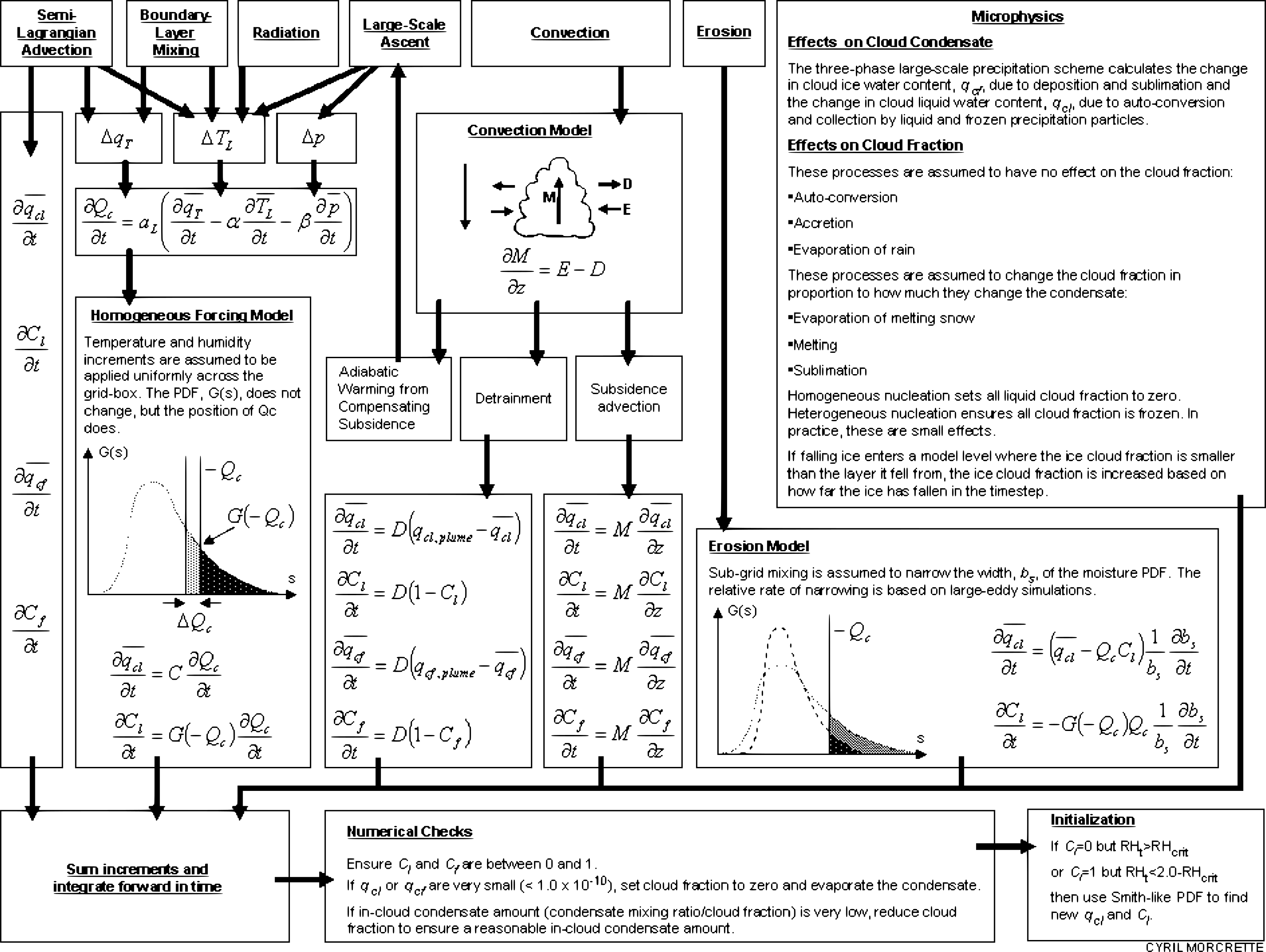
|
Fig. 2 Timestepping diagram for the control (non-PC2) scheme#
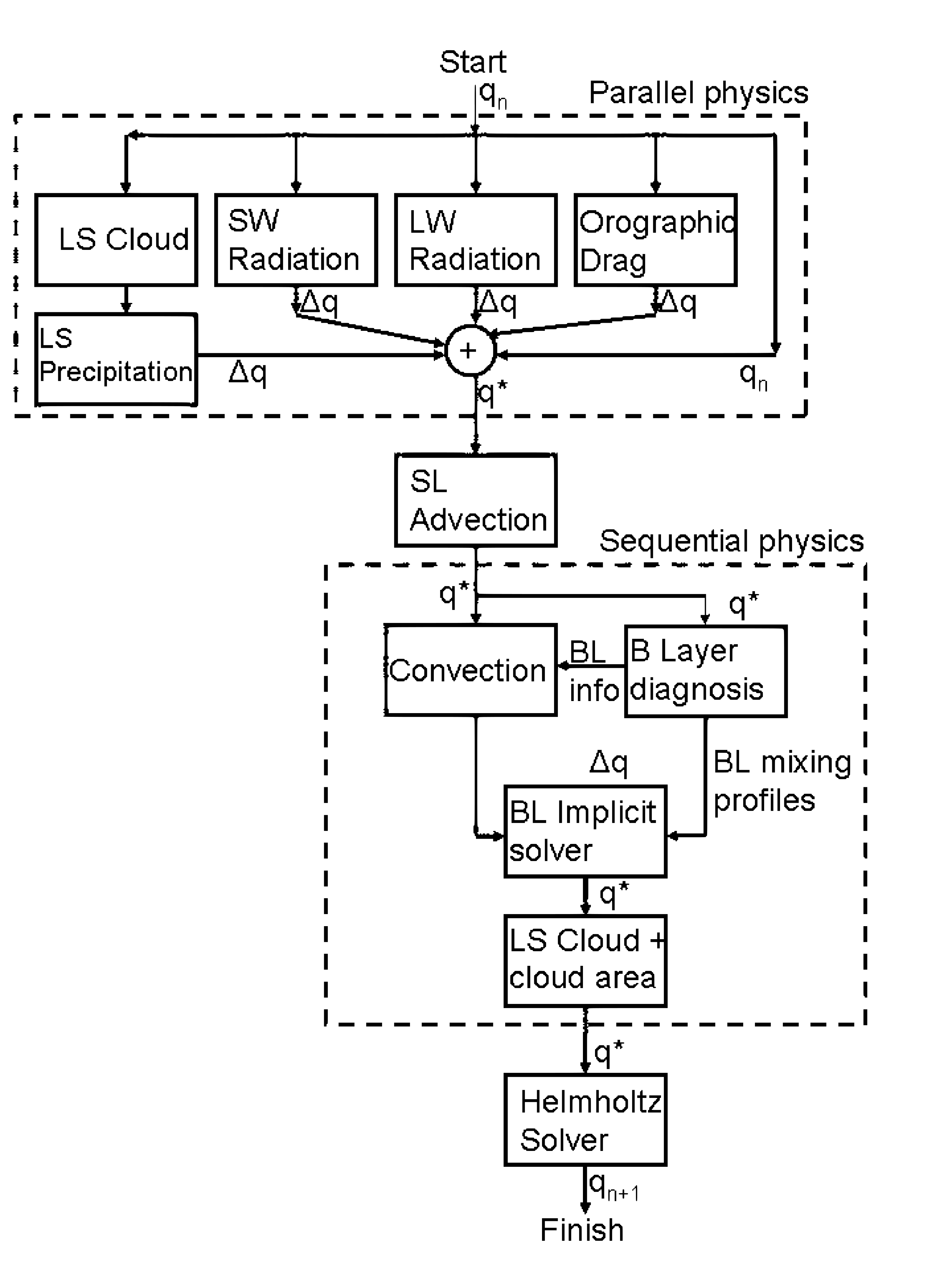
|
Fig. 3 Timestepping diagram for the PC2 scheme#
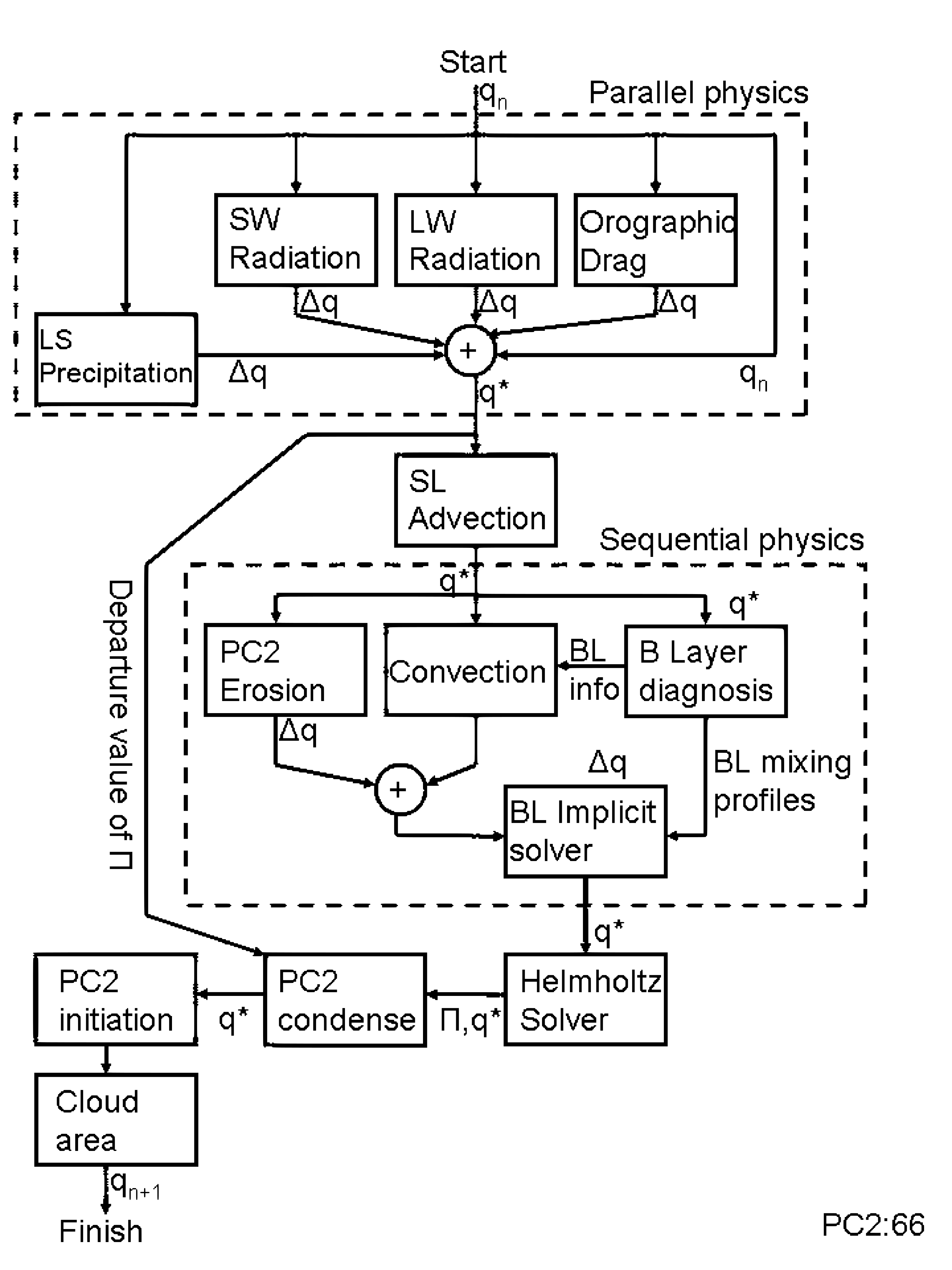
|
References#
Brooks, M. E. and R. J. Hogan and A. J. Illingworth (2005). Parametrizing the Difference in Cloud Fraction Defined by Area and by Volume as Observed with Radar and Lidar. J. Atmos. Sci., 62, 2248-2260.
Bushell, A. C. and D. R. Wilson and D. Gregory (2003). A description of cloud production by non-uniformly distributed processes. Q. J. Roy. Meteor. Soc., 129, 1435-1455.
Wilson, D. and D. Gregory (2003). The behaviour of large-scale model cloud schemes under idealised forcing scenarios. Q. J. Roy. Meteor. Soc., 129, 967-986.
Rogers, R. R. and M. K. Yau (1989). A Short Course in Cloud Physics.
Gregory, D. and D. R. Wilson and A. C. Bushell (2002). Insights into cloud parametrization provided by a prognotic approach. Q. J. Roy. Meteor. Soc., 128, 1485-1504.
Mellor, G. (1977). The {Gaussian} cloud model relations. J. Atmos. Sci., 34, 356-358.
Sommeria, G. and Deardorff, J. W. (1977). Subgrid-scale condensation in models of non-precipitating clouds. J. Atmos. Sci., 34, 344-355.
Tiedtke, M. (1993). Representation of clouds in large-scale models. Mon. Weather Rev., 121, 3040-3061.
Wood, R. and P. R. Field (2000). Relationships between Total Water, Condensed Water and Cloud Fraction in Stratiform Clouds Examined Using Aircraft Data. J. Atmos. Sci., 57, 1888-1905.
Beare, R.J (2008). The role of shear in the morning transition boundary layer. Boundary-Layer Meteorology, 129, 395-410.
Zhang, Y. and S. A. Klein (2013). Factors controlling the vertical extent of fair-weather shallow cumulus clouds over land: Investigation of diurnal-cycle observations collected at the ARM Southern Great Plains site. J. Atmos. Sci., tba, tba.
Smith, R. N. B. (1990). A scheme for predicting layer cloud and their water content in a general circulation model. Q. J. Roy. Meteor. Soc., 116, 435-460.
Boutle, I. A. and C. J. Morcrette (2010). Parametrization of area cloud fraction. Atmos. Sci. Let., 11, 283-289.
Field, P. R. and R. J. Hogan and P. R. A. Brown and A. J. Illingworth and T. W. Choularton and R. J. Cotton (2005). Parametrization of ice particle size distributions for mid-latitude stratiform cloud. Q. J. Roy. Meteor. Soc., 131, 1997-2017.
Field, P.R. and Hill, A.A. and Furtado K. and Korolev, A. (2014). Mixed-phase clouds in a turbulent environment. {II: A}nalytic treatment. Q. J. Roy. Meteor. Soc., 140, 870-880.
Jakob, C. and Gregory, D. and Teixeria, J. (1999). A package of cloud and convection changes for CY21R3. Research Department Memorandum, {ECMWF}, Shinfield Park, Reading {RG2 9AX}, United Kingdom.
Morcrette, C. J. and J. C. Petch (2010). Analysis of prognostic cloud scheme increments in a climate model. Q. J. Roy. Meteor. Soc., 136, 2061-2073.
Rodean, H. C. (1997). Stochastic Lagrangian Models of Turbulent Diffusion. American Meteorological Society, Boston, USA.
Sundqvist, H. (1978). A parametrization scheme for non-convective condensation including prediction of cloud water content. Q. J. Roy. Meteor. Soc., 104, 677-690.
Stiller, O. and D. Gregory (2003). The evolution of subgrid-scale humidity fluctuations in the presence of homogeneous cooling. Q. J. Roy. Meteor. Soc., 129, 1149-1168.
Tompkins, A. (2002). A prognostic parametrization for the subgrid-scale variability of water vapor and clouds in large-scale models and its use to diagnose cloud cover. J. Atmos. Sci., 59, 1917-1942.
Wang, Shouping and Qing Wang (1999). On Condensation and Evaporation in Turbulence Cloud Parametrization. J. Atmos. Sci., 56, 3338-3344.
Wilson, D. (2001). The extension of a prognostic cloud fraction formulation to multiple condensate phases. From Development of a New Cloud Scheme for the Unified Model. Met Office internal note.
C. J. Morcrette (2020). Modification of the thermodynamic variability closure in the Met Office Unified Model prognostic cloud scheme. Atmospheric Science Letters. https://doi.org/10.1002/asl.1021